史鉴
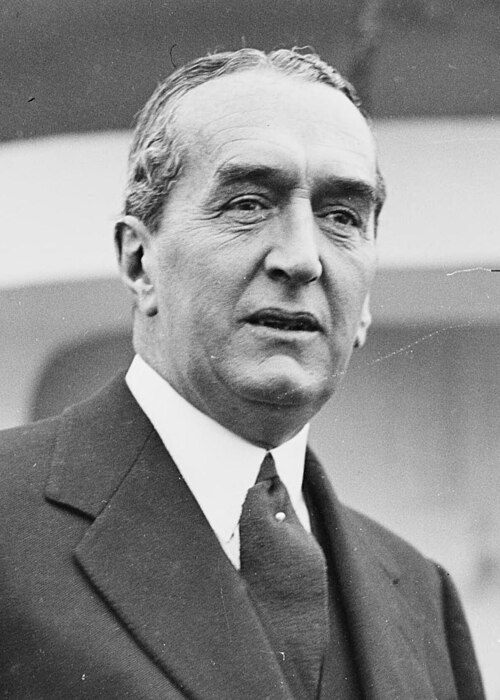
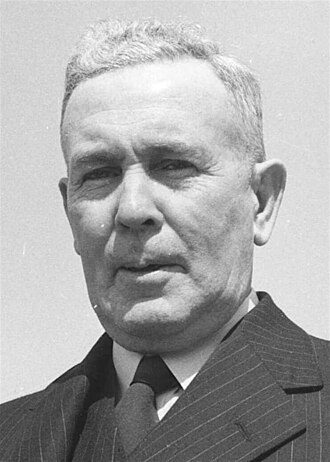
图:Fairfax archive of glass plate negatives · Public domain · 维基共享资源
- 生卒
- 1883 年 4 月 15 日—1967 年 8 月 25 日
- 出生地
- 墨尔本
- 去世地
- 伦敦
- 国籍 / 所属
- 澳大利亚
- 身份
- 律师、政治人物、外交官
- 职位
- 大使、澳大利亚总理、澳大利亚财政部长、澳大利亚外交部长、澳大利亚众议院议员、英国上议院议员 等 7 项
- 父亲
- John Munro Bruce
- 配偶
- Ethel Bruce
- 参与
- 第一次世界大战
- 原文名
- Stanley Melbourne Bruce
- 就读
- 剑桥大学三一学堂
- 所属组织
- 英国皇家学会
- 军种
- 英国陆军
- 简述
- Australian politician, eighth Prime Minister of Australia (1883-1967)
斯坦利·墨尔本·布鲁斯,第一代墨尔本的布鲁斯子爵,CH,MC,PC,FRS(英语:Stanley Melbourne Bruce, 1st Viscount Bruce of Melbourne,1883年4月15日—1967年8月25日),澳大利亚政治家、外交家,第八任澳大利亚总理(1923年–1929年)。
出生于墨尔本郊区的圣基尔达(St Kilda),其父约翰·布鲁斯是苏格兰裔移民,斯坦利是五个孩子最小的。1902年入读剑桥大学三一学堂,后在英国操律师业。1914年回到澳大利亚,同年8月第一次世界大战爆发,斯坦利与他的哥哥欧内斯特被征入役,1915年因功晋升为中尉,编入在埃及的皇家燧发枪兵团第2营,隶属于伊恩·汉密尔顿的29军,8月晋升为上尉,9月膝盖中枪退役。1916年回到澳大利亚主持家族生意,1918年选入澳大利亚议会。1921年任澳大利亚驻国际联盟代表,1921年至1923年任财政大臣。1923年至1929年任国民党和乡村党联合政府总理。他努力发展本国经济,鼓励公共卫生和应用科学的研究工作。1929年政府倒台,他也在大选中失去议会席位。1932年任驻英国公使。1933年至1945年任澳大利亚驻英国战时内阁代表。他反对英国首相温斯顿·丘吉尔要在战后宽大处理德国的意见。1947年任世界粮食理事会主席和英国工业金融公司董事长。1947年布鲁斯受封为墨尔本的布鲁斯子爵,为澳大利亚获此荣誉的第一人。1952年至1961年堪培拉澳大利亚国立大学第一任校长。
布鲁斯退休后逐渐出现耳聋,他的妻子埃塞尔在1967年3月去世后受到很大打击,同年8月25日他也去世,享年84岁。很多人参加了他的追悼会,包括英国王室成员。他的骨灰被撒入堪培拉的伯利格里芬湖中。堪培拉郊区的布鲁斯和墨尔本东南部的布鲁斯国会选区以他的名字命名。
正文摘自中文维基百科「斯坦利·布鲁斯」(删去了参考文献、表格和图片),按 CC BY-SA 4.0 使用
英文维基百科的更多内容
中文维基百科这一条比较短,下面是英文维基百科同一条目的节选,原文为英文,未翻译。
Stanley Melbourne Bruce, 1st Viscount Bruce of Melbourne (15 April 1883 – 25 August 1967) was the eighth prime minister of Australia, serving from 1923 to 1929. He held office as the leader of the Nationalist Party, having previously served as the treasurer of Australia from 1921 to 1923.
Born into a briefly wealthy Melbourne family, Bruce studied at the University of Cambridge and played a leading role in his family's softgoods firm following the suicide of his father John Munro Bruce. He served on the front lines of the Gallipoli Campaign in World War I and returned to Australia wounded in 1917, becoming a spokesman for government recruitment efforts. He gained the attention of the Nationalist Party and prime minister Billy Hughes, who encouraged a political career. He was elected to the House of Representatives in 1918, becoming member of parliament (MP) for the seat of Flinders. He was appointed as treasurer in 1921, before replacing Hughes as prime minister in 1923. He established an anti-socialist coalition government with the agrarian Country Party, working closely with Country leader Earle Page in an arrangement that pioneered the modern Liberal–National coalition.
In office, Bruce pursued an energetic and diverse agenda. He comprehensively overhauled federal government administration and oversaw its transfer to the new capital city of Canberra. He implemented various reforms to the Australian federal system to strengthen the role of the Commonwealth, and helped develop the forerunners of the Australian Federal Police and the CSIRO.……
Early life
Stanley Melbourne Bruce was born on 15 April 1883 in St Kilda, Victoria, a suburb of Melbourne, and was the youngest of five children. He disliked his given name and throughout his life preferred to be known by his initials "S.M.", even among close friends. His wife called him simply "S".……
Military service
Bruce returned briefly to Australia in 1914, swapping positions within the company with his brother Ernest. World War I broke out in August of that year.……
Early years in politics
Bruce's popularity as a speaker for government recruitment efforts also earned him the attention of the National Union of Victoria, an influential group of Melbourne businessmen who provided much of the financing for the federal Nationalist Party.……
Prime Minister, 1923–1929
The Nationalists lost eleven seats and their majority in the Australian House of Representatives in the 1922 election. Only three of these seats were picked up by the Labor Party though, and Labor still lacked the numbers to form government in their own right.……
Return to cabinet, 1931–1933
Bruce returned to England after his defeat to holiday and attend to his business. Sir John Latham, took over as leader of the Nationalists.……
High Commissioner to the United Kingdom, 1933–1945
In September 1933, Bruce was appointed by Lyons to replace the ailing Sir Granville Ryrie as High Commissioner to the United Kingdom, giving him ambassadorial rank. He formally resigned from parliament on 7 October 1933.……
League of Nations
Bruce represented Australia at the League of Nations and successfully lobbied for Australia to participate as a member of the League Council from 1933 to 1936.……
Food and Agriculture Organization, 1946–1951
By the war's end in 1945, Bruce had become tired of the High Commission posting and hinted to Curtin's successor Ben Chifley that he would not object to being replaced in the position.……
Later life
Bruce occupied a range of positions in his later years, sharing his time between the United Kingdom and Australia. He had been Chairman of the Finance Corporation of Industry since 1946 and continued in the role until 1957, providing finance to projects of benefit to the British national economy.……
Death
Bruce remained active and in good health right through his retirement despite the gradual onset of deafness, but the death of his wife Ethel in March 1967 took a deep toll on him. He died on 25 August 1967 at the age of 84. He was the last surviving member of Billy Hughes' Cabinet.……
Legacy and evaluation
Despite his many accomplishments both at home and abroad, Bruce's post-prime ministerial career was not well known in Australia, and most still harboured memories of his harsh anti-union legislation and his government's landslide defeat in 1929.……
正文摘自英文维基百科(原文为英文,未翻译)「Stanley Bruce」(节选,删去了参考文献、表格和图片),按 CC BY-SA 4.0 使用;在维基百科读全文 ›
参与的事件
- 第一次世界大战1914 年 7 月 28 日—1918 年 11 月 11 日 · 战争 · 跨地区
同时代、同地区的人物


同时代、同身份的人物(帝王与政治)