史鉴
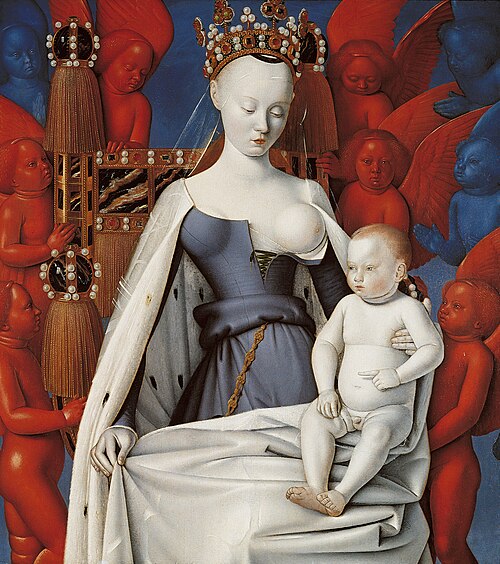
图:Jean Fouquet · Public domain · 维基共享资源
- 生卒
- 1422 年—1450 年 2 月 9 日 (日期为儒略历)
- 出生地
- Fromenteau Castle
- 去世地
- Le Mesnil-sous-Jumièges
- 国籍 / 所属
- 法国
- 身份
- 女官、王室情妇、艺术模型
- 父亲
- Jean Soreau
- 母亲
- Catherine de Maignelais
- 子女
- Marie de Valois、Charlotte de France、Jeanne de Valois
- 原文名
- Agnès Sorel
- 死因
- 汞中毒
- 简述
- French Royal mistress (1422-1450)
阿涅丝·索雷尔(法语:Agnès Sorel,法语发音:[aɲɛs sɔʁɛl],1422年—1450年2月9日),号称法国史上最美的女人,查理七世的情妇。传言查理七世在1441年对她一见钟情,相见第一晚便辗转难眠。后世更认为是她给予查理七世无比的勇气与自信,得以从英国人手上将诺曼底夺回。
她本来是洛林女公爵伊莎贝拉的侍女,1441年查理七世在百年战争后期造访伊莎贝拉一家时,阿涅丝被伊莎贝拉安排去“照顾”国王,查理满心欢喜而将她纳为情妇,开启法国王室情妇的悠久传统。之后查理七世封其为“美丽贵妇”,并命画家画下一幅名为“圣母与小孩”,又名“梅拉的处女”的画。画中的阿涅丝装扮成圣母抱着圣婴,而乳房的意义从中世纪的神圣,也转变成为文艺复兴时期的情色。令法国民间津津乐道的是,即使不施脂粉,她的美貌依旧冠绝宫廷。阿涅丝也是法国王室史上首个公开承认的情妇。
她是个聪慧丽人,不时为国王的难题提出建议,查理七世在和她相处的过程中,逐渐找回自信。国王对阿涅丝的宠爱令她在王宫来去自如,而这也导致她在宫廷树敌。王储路易和王储顾问们十分厌恶她。
1449年当时,阿涅丝已为查理七世生下三个女儿,在她怀他们第四个孩子的时候,她不顾怀有八个月身孕毅然赶往查理七世所在的战场,却因路程颠簸遥远早产诞下一名女婴,婴儿出生不久便夭亡,没过几天阿涅丝亦撒手人寰,1450年2月9日,时年28岁。王室记载是胃部肿胀而死,但数百年来民间传言称是王储的心腹在她赶路途中所饮用的食水和药物中下毒致死。二十一世纪对阿涅丝的开棺验骨也证明死因是水银中毒,但宫中错综复杂的人事和利益关系也令历史学家和科学家难以确认真正幕后指使人。验骨后,专家们按照她的生前夙愿将她的遗骨安放在法王查理七世墓旁。
在她逝世后,其表妹安托瓦内特·德·迈涅莱取而代之成为查理七世新一任的情妇。
正文摘自中文维基百科「阿涅丝·索雷尔」(删去了参考文献、表格和图片),按 CC BY-SA 4.0 使用
英文维基百科的更多内容
中文维基百科这一条比较短,下面是英文维基百科同一条目的节选,原文为英文,未翻译。
Agnès Sorel (French: [aɲɛs sɔʁɛl]; 1422 – 9 February 1450), known by the sobriquet Dame de beauté (Lady of Beauty), was a favourite and chief mistress of King Charles VII of France, by whom she bore four daughters. She is considered the first officially recognized royal mistress of a French king. She was the subject of several contemporary paintings and works of art, including Jean Fouquet's Virgin and Child Surrounded by Angels.
Life in the royal court
Born in 1422, Agnes was the daughter of Jean Soreau, Châtelain of Coudun, and his wife Catherine de Maignelais. She was 20 or 21 years old when she was introduced to King Charles. At that time, Agnes was holding a position in the household of Rene I of Naples, as a maid of honour to his consort Isabella, Duchess of Lorraine. She then went on to serve as the lady-in-waiting for Marie d'Anjou, Charles VII's wife and Isabella's sister in law. Agnes would soon become his mistress. The King gave her the Château de Loches (where he had been persuaded by Joan of Arc to be crowned King of France) as her private residence.
Soon, Agnes' presence was felt at the royal court in Chinon where her company was alleged to have brought the king out of a protracted depression. Her influence on the court was first felt when she succeeded in convincing the poor king to rally his troops and drive English invaders from French soil. Agnes had a very strong influence on the king, and that, in addition to her extravagant tastes, earned her powerful enemies at court. She would become the first officially recognized royal mistress of a French king.
Agnes generated scandal at court, particularly for popularizing the fashion of low-cut gowns. This behavior was both imitated and scorned.……
Children and death
- Agnès gave birth to four daughters fathered by the king:
- Marie, possibly born the summer of 1444
Charlotte, who married Jacques de Brézé (their son, Louis de Brézé, seigneur d'Anet, in turn married Diane de Poitiers, a future royal mistress)
Jeanne
While pregnant with their fourth child, she journeyed from Chinon in midwinter to join Charles on the campaign of 1450 in Jumièges, wanting to be with him as moral support. There, she suddenly became ill, and after giving birth, she and her daughter died on 9 February 1450. She was 28 years old. While the cause of death was originally thought to be dysentery, in 2005 French forensic scientist Philippe Charlier stated that Agnès died of mercury poisoning. Whether or not the poisoning was deliberate remains unknown. Mercury was sometimes used in cosmetic preparations or to treat worms, and such use might have brought about her death. She was interred in the Church of St. Ours, in Loches. Her heart was buried in the Benedictine Abbey of Jumièges.
Charles' son, the future Louis XI, had been in open revolt against his father for the previous four years. It has been speculated that he had Agnès poisoned in order to remove what he may have considered her undue influence over the king. It was also speculated that French financier, noble, and minister Jacques Cœur poisoned her, though that assertion is widely discredited as having been an attempt to remove Cœur from the French court.
Legacy
Sorel plays a main part in Voltaire's poem La Pucelle. She is the subject of an 1836 opera named after her. Two Russian operas from the late 19th century also portray her, along with Charles VII: Pyotr Tchaikovsky's The Maid of Orleans and César Cui's The Saracen.
She is also a featured figure on Judy Chicago's installation piece The Dinner Party, being represented as one of the 999 names on the Heritage Floor. Two garments use Sorel's name in their descriptors, Agnes Sorel bodice, Agnes Sorel corsage and a fashion style named after her as well, Agnes Sorel style, which is described as a "princess" style of dressing.
正文摘自英文维基百科(原文为英文,未翻译)「Agnès Sorel」(节选,删去了参考文献、表格和图片),按 CC BY-SA 4.0 使用;在维基百科读全文 ›
同时代、同地区的人物