史鉴
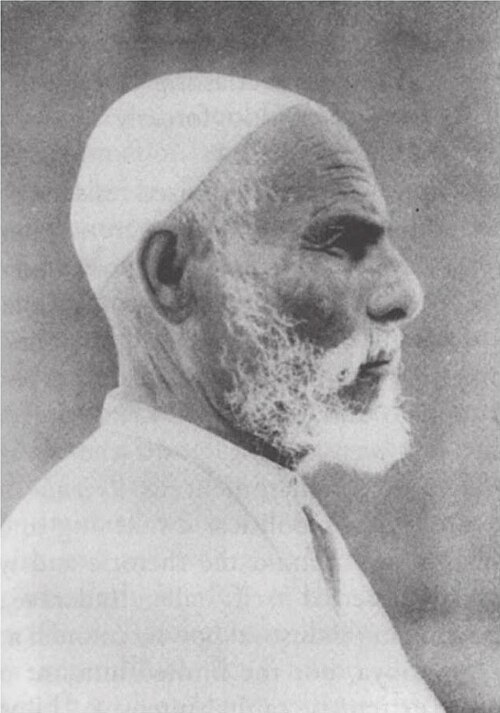
图:Italian colonial administration of Libya [1] · Public domain · 维基共享资源
- 生卒
- 1858 年 8 月 20 日—1931 年 9 月 16 日
- 出生地
- 昔兰尼加
- 去世地
- 利比亚
- 国籍 / 所属
- 利比亚
- 身份
- 游击队员、抵抗运动成员、军事领袖
- 子女
- Mohammed Omar Mukhtar
- 原文名
- عمر المختار、عمر بن مختار بن عمر المنفي
- 宗教
- 逊尼派
- 死因
- 吊死
- 简述
- Leader of the Senussi resistance against the Italian fascist occupation (1858–1931)
欧麦尔·穆赫塔尔(阿拉伯语:عمر المختار,1858年8月20日—1931年9月16日)利比亚独立运动之父,是利比亚的民族英雄和伊斯兰世界和阿拉伯人抵抗运动的象征。曾领导昔兰尼加的抵抗运动,反抗意大利对利比亚的殖民统治。
穆赫塔尔本职为教师,后参与塞努西运动。塞努西是北非穆斯林的修道团体,后来成为利比亚独立运动的领导力量。成为伊斯兰“塞努西教团”的谢赫。19世纪末曾参加奥斯曼土耳其苏丹抵抗法国侵略的战争。从1911年起,穆赫塔尔领导抵抗运动20年。1911年意大利入侵,他在利比亚东部昔兰尼加的绿山区领导抵抗斗争近五年,使意军只能在沿地中海岸的几处城镇活动。1922年墨索里尼登台,又派法西斯军队大规模入侵利比亚。穆赫塔尔时已六十四岁,坚持领导东部游击战争整十年,担任各路游击支队的总司令,多次重创意军,成为国际著名的抵抗运动领袖。1931年9月13日在作战时因中埋伏,73岁的穆合塔尔受伤,被意大利军队俘获。9月16日,在地中海沿岸的苏鲁克城将他处决。因其卓越的游击战能力以及韧性,穆赫塔尔被称为“沙漠雄狮”。现利比亚首都的黎波里与其他许多城市的一些街道与大型建筑物,都是以他命名纪念。
正文摘自中文维基百科「欧麦尔·穆赫塔尔」(节选,删去了参考文献、表格和图片),按 CC BY-SA 4.0 使用;在维基百科读全文 ›
英文维基百科的更多内容
中文维基百科这一条比较短,下面是英文维基百科同一条目的节选,原文为英文,未翻译。
ʿUmar al-Mukhtār Muḥammad bin Farḥāt al-Manifī (Arabic: عُمَر الْمُخْتَار مُحَمَّد بِن فَرْحَات الْمَنِفِي; 20 August 1858 – 16 September 1931), called The Lion of the Desert, known among the colonial Italians as Matari of the Mnifa, was a Libyan revolutionary and Imam who led the native resistance in Cyrenaica (currently Eastern Libya) under the Senussids, against the Italian colonization of Libya. A teacher-turned-general, Omar was a prominent figure of the Senussi movement and is considered the national hero of Libya and a symbol of resistance in the Arab and Islamic worlds. Beginning in 1911, he organised and led the Libyan resistance movement against the Italian colonial empire during the First and Second Italo-Senussi Wars. Externally, he also participated in armed opposition against the French in Chad and the British in Egypt. After many attempts, the Italian Armed Forces managed to capture Al-Mukhtar near Slonta when he was wounded in battle by Libyan colonial troops, and hanged him in 1931 after he refused to surrender.
Early life
Omar Al-Mukhtar was born in 1858 in the town of Zanzur near Tobruk, in the region of Ottoman Cyrenaica to the Arab Mnifa tribe, belonging to the Senussi (who were seen as Libyan Ashrafs clan just like Emir or King Idris es Senussi), before eventually becoming chief or leader of the clan. As a child, Omar lost his father early on and spent his youth in poverty. He was adopted by a sheikh, and was friends with the nephew of Hussein Ghariani, Sharif al Geriani.……
Italian invasion
In October 1911, during the Italo-Turkish War, the Regia Marina (Italian Royal Navy) under the command of Admiral Luigi Faravelli reached the shores of Libya, then a territory subject to Ottoman control. The admiral demanded that the Ottoman administration and garrison surrender their territory to the Italians or incur the immediate destruction of the city of Tripoli and Benghazi. The Ottomans and their Libyan allies withdrew to the countryside instead of surrendering, and the Italians bombarded the cities for three days, and then proclaimed the Tripolitanians to be 'committed and strongly bound to Italy'.……
Guerrilla warfare
A teacher of the Qur'an by profession, Mukhtar was also skilled in the strategies and tactics of desert warfare. He knew local geography well and used that knowledge to advantage in battles against the Italians, who were unaccustomed to desert warfare. Mukhtar repeatedly led his small, highly alert groups in successful attacks against the Italians, after which they would fade back into the desert terrain. Mukhtar’s men skilfully attacked outposts, ambushed troops, and cut lines of supply and communication. The Regio Esercito (Italian Royal Army) was left astonished by his guerrilla tactics.
Capture and execution
Mukhtar's struggle of nearly twenty years came to an end on 11 September 1931, when he was wounded in battle near Slonta, and then captured by Libyan Savaris of the Italian Army. On 16 September 1931, on the orders of the Italian court and with Italian hopes that Libyan resistance would die with him, Mukhtar was hanged before his followers in Soluch concentration camp at the age of 73 with his final words being “To Allah do we belong and to him shall we return”.
Legacy
Omar Al-Mukhtar University was founded in 1961.
Since 1971, Mukhtar's face has appeared on the Libyan ten-dinar note.
His final years were depicted in the movie Lion of the Desert (1981), starring Anthony Quinn, Oliver Reed, and Irene Papas. It was based on the struggles of Mukhtar against Rodolfo Graziani's forces.
In 2009, Libyan leader Muammar Gaddafi wore a photograph of Mukhtar in Italian captivity on his chest while on a state visit to Rome, and brought along Mukhtar's elderly son during the visit.
With the Libyan Civil War beginning on 17 February 2011, Omar Mukhtar again became a symbol for a united, free Libya……
正文摘自英文维基百科(原文为英文,未翻译)「Omar al-Mukhtar」(节选,删去了参考文献、表格和图片),按 CC BY-SA 4.0 使用;在维基百科读全文 ›
同时代、同地区的人物



同时代、同身份的人物(军事)