史鉴
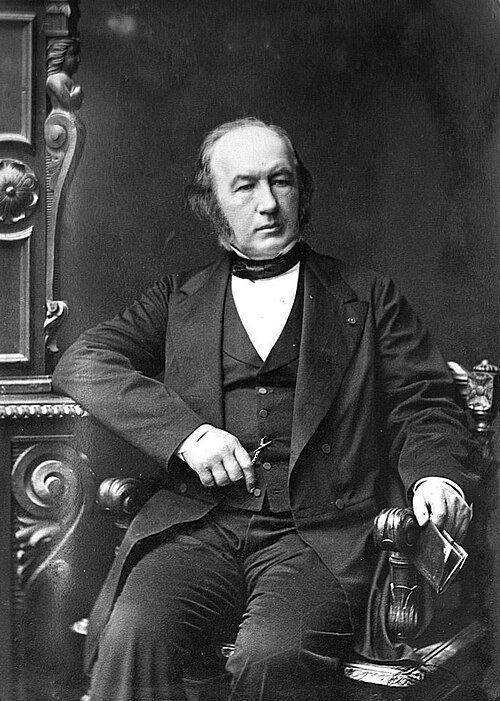
图:佚名 · Public domain · 维基共享资源
- 生卒
- 1813 年 7 月 12 日—1878 年 2 月 10 日
- 出生地
- 圣于连
- 去世地
- 巴黎
- 国籍 / 所属
- 法国
- 身份
- 医生、政治人物、教授、心理学家、医师作家、化学家、生理学家、药理学家
- 职位
- 主席、Member of the Académie française、Second Empire senator、president of the French Academy of Sciences
- 配偶
- 马里·弗朗索瓦兹·贝尔纳
- 代表作
- 内环境
- 受影响于
- 弗朗索瓦·马让迪
- 就读
- 巴黎医学院、巴黎科学学院
- 任职机构
- 法兰西公学院、高等研究应用学院、国家自然历史博物馆、巴黎医学院
- 所属组织
- 俄罗斯科学院、英国皇家学会、法兰西学术院、法国科学院、瑞典皇家科学院、匈牙利科学院 等 12 项
- 领域
- 生理学、医学
- 简述
- French physiologist (1813-1878)
克洛德·贝尔纳(法语:Claude Bernard,发音:[klod bɛʁnaʁ];1813年7月12日—1878年2月10日),法国生理学家。他是定义“内环境”的第一人。哈佛大学科学史家I·伯纳德·科恩称他是“最伟大的科学家之一”。他是首倡用双盲实验确保科学观察的客观性的人之一。
克洛德·贝尔纳生于圣儒利昂。毕业于巴黎医科学校。1843年获医学博士学位,1855年始任法兰西学院教授。为法国科学院院士,伦敦皇家学会会员。他通过对喂以无糖食物动物的观察,于1855年发现肝脏的产糖功能。1857年又从肝脏中分离出糖形成的物质,称之为原糖。还观察到刺伤第四脑室底部能使动物发生暂时性糖尿症,表明体内糖的产生是受中枢神经系统控制的。他还发现胰腺分解中性脂肪的功能。提出内环境(主要指血液和淋巴液)保持恒定状态的理论,这一理论启发了后来生理学的许多研究。
正文摘自中文维基百科「克洛德·贝尔纳」(删去了参考文献、表格和图片),按 CC BY-SA 4.0 使用
英文维基百科的更多内容
中文维基百科这一条比较短,下面是英文维基百科同一条目的节选,原文为英文,未翻译。
Claude Bernard (French: [klod bɛʁnaʁ]; 12 July 1813 – 10 February 1878) was a French physiologist. I. Bernard Cohen of Harvard University called Bernard "one of the greatest of all men of science". He originated the term milieu intérieur and the associated concept of homeostasis (the latter term being coined by Walter Cannon).
Life
Bernard was born on 12 July 1813 in the village of Saint-Julien, near Villefranche-sur-Saône. He received his early education in the Jesuit school of that town, then attended college at Lyon, which he soon left to become assistant in a druggist's shop. He is sometimes described as an agnostic, and even humorously referred to by his colleagues as a "great priest of atheism". Despite this, after his death Cardinal Ferdinand Donnet claimed Bernard was a fervent Catholic, with a biographical entry in the Catholic Encyclopedia. His leisure hours were devoted to the composition of a vaudeville comedy, and the success it achieved moved him to attempt a prose drama in five acts, Arthur de Bretagne. The latter, a tragedy concerning Arthur I, Duke of Brittany, was published only after his death. A second edition appeared in 1943.
In 1834, at the age of twenty-one, he went to Paris to present this play to critic Saint-Marc Girardin, but was dissuaded from adopting literature as a profession. Girardin urged him to take up the study of medicine instead. Bernard followed his advice, later becoming an interne at the Hôtel-Dieu de Paris. There, he met physiologist François Magendie, who served as physician at the hospital. Bernard became preparateur (lab assistant) at the Collège de France in 1841.
In 1845, he married Marie Françoise "Fanny" Martin for convenience; the marriage was arranged by a colleague and her dowry helped finance his experiments.……
Career
Bernard's first major work was on the functions of the pancreas. His discovery that the juices of the pancreas play a significant role in the digestive process won him the prize for experimental physiology from the French Academy of Sciences. His findings specifically showed that the pancreas secreted a fluid containing a lipolytic enzyme that split neutral fats into glycerol and fatty acids. Prior to his research, the function of the pancreas was poorly understood, with many physiologists considering it to be a gland of little significance. Bernard also discovered that introducing ether into the stomach or duodenum induced pancreatic secretions. The physiologist William Bayliss credited Bernard's work as influential in the latter's discovery of secretin, the first hormone to be isolated.
In perhaps his most famous experiment, Bernard discovered the glycogenic function of the liver. The liver, in addition to secreting bile, also produces the sugars that can cause hyperglycemia, which helped advance study of diabetes mellitus and its causes. In 1851, while examining the effects produced in the temperature of various parts of the body by each section of the nerve or nerves belonging to them, Bernard noticed that division of the cervical sympathetic nerve resulted in more active circulation and more forcible pulsation of the arteries in certain parts of the head.……
Honors and awards
Bernard received numerous honours, including the Baly Medal of the Royal College of Physicians in 1869. His Introduction à l’étude de la médecine expérimentale (1865) outlined his philosophy of scientific method and remains a foundational text in experimental medicine. Upon his death in 1878, he was given a state funeral, an honour rarely granted to scientists.
Scientific debates and critiques
Bernard's glycogenic theory drew criticism from Frederick Pavy, who argued that hepatic sugar originated from circulating blood rather than synthesis. The debate persisted for decades until biochemical evidence confirmed Bernard's interpretation. Later work by von Mering and Minkowski on pancreatic diabetes further refined his conclusions about glucose regulation.
正文摘自英文维基百科(原文为英文,未翻译)「Claude Bernard」(节选,删去了参考文献、表格和图片),按 CC BY-SA 4.0 使用;在维基百科读全文 ›
受其影响的人物
同时代、同地区的人物





同时代、同身份的人物(帝王与政治)