史鉴
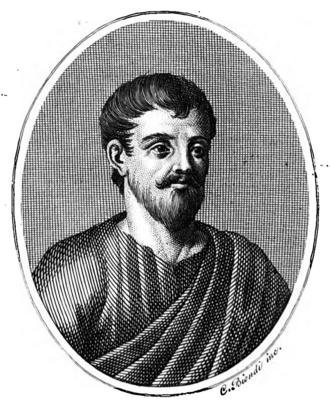
图:Boccanera G. · Public domain · 维基共享资源
- 生卒
- 公元前 6 世纪—公元前 5 世纪 (Wikidata 的生卒只记到世纪,非确切年份)
- 出生地
- Heraclea Lucania
- 去世地
- 古雅典
- 身份
- 画家
- 所属组织
- Zeuxis and Parrhasius
- 领域
- 绘画
- 死因
- 笑死
- 简述
- 5th-century BCE Greek painter
赫拉克利亚的宙克西斯(希腊语:Ζεύξις),约活动于公元前5世纪前后。赫拉克利亚(意大利)的画师之一。
详细介绍
生平
公元前430年至公元前390年为其创作时期,于公元前5世纪前后移居雅典,多次受托作画。后至马其顿的阿尔克拉乌斯王宫(公元前409年至公元前397年)为宫廷作画。他还曾赠予阿尔克拉马斯一幅潘神画像,他是一位著名画师,还是巴赫西斯的竞争对手。他的作品逼真至极,以至招来飞鸟啄食画中的葡萄。其最著名的作品为《特洛伊的海伦》及《妈人与其幼崽》。此外,他还绘制单色画。
正文摘自中文维基百科「宙克西斯」(删去了参考文献、表格和图片),按 CC BY-SA 4.0 使用
英文维基百科的更多内容
中文维基百科这一条比较短,下面是英文维基百科同一条目的节选,原文为英文,未翻译。
Zeuxis (; Ancient Greek: Ζεῦξις) (of Heraclea) was a late 5th-century- early 4th-century BCE Greek artist famed for his ability to create images that appeared highly realistic. None of his works survive, but anecdotes about Zeuxis's art and life have been referenced often in the history and literature of art and in art theory.
Much of the information about Zeuxis comes from Pliny the Elder's Natural History, but his work is also discussed by Xenophon and Aristotle. One of the most famous stories about Zeuxis centers on an artistic competition with the artist Parrhasius to prove which artist could create a greater illusion of nature. Zeuxis, Timanthes, and Parrhasius were painters of the Ionian School of painting. The Ionian School flourished during the 4th century BCE.
Life and work
Zeuxis was born in Heraclea in 464 BCE, probably Heraclea Lucania, in the present-day region of Basilicata in the southeastern "boot" of Italy. He may have studied with Demophilus of Himera (Sicily), or with Neseus of Thasos (an island in the northern Aegean Sea), and/or with the Greek painter Appollodorus.
He was active across the ancient Greek world from Magna Graecia to Ephesus, to Macedonia, Samos and to Athens where his greatest number of works were made. The "Eros" of the temple of Aphrodite and the "Penelope" were some of his first works. Records cite his notable works as Helen, Zeus Enthroned, and The Infant Hercules Strangling the Serpents. He also painted an assembly of gods, Eros crowned with roses, Alcmene, Menelaus, an athlete, Pan, Marsyas chained, and an old woman. King Archelaus I of Macedon employed Zeuxis to decorate the palace of his new capital Pella with a picture of Pan. Most of his works went to Rome and Byzantium but disappeared during the time of Pausanias.
Zeuxis was an innovative Greek painter. Although his paintings have not survived, historical records state they were known for their realism, small scale, novel subject matter, and independent format. His technique created volumetric illusion by manipulating light and shadow, a change from the usual method of filling in shapes with flat colors. Preferring small-scale panels to murals, Zeuxis also introduced genre subjects (such as still life) into painting. He contributed to the composite method of composition and may have originated an approach to, and thus influenced the concept of the ideal form of the nude, as described by art historian Kenneth Clark.……
Painting contest
According to the Naturalis Historia by Pliny the Elder, Zeuxis and his contemporary Parrhasius (of Ephesus and later Athens) staged a contest to determine the greater artist. When Zeuxis unveiled his painting of grapes, they appeared so real that birds flew down to peck at them. But when Parrhasius, whose painting was concealed behind a curtain, asked Zeuxis to pull aside that curtain, the curtain itself turned out to be a painted illusion. Parrhasius won, and Zeuxis said, "I have deceived the birds, but Parrhasius has deceived Zeuxis." This story was commonly referred to in 18th and 19th-century art theory to promote spatial illusion in painting. A similar anecdote says that Zeuxis once drew a boy holding grapes, and when birds, once again, tried to peck them, he was extremely displeased, stating that he must have painted the boy with less skill since the birds would have feared to approach otherwise.
Death
According to the Roman grammarian Festus, Zeuxis died laughing at a picture of an old woman he had just painted.
The legend is mentioned in Karel van Mander's Schilder-boeck (1604) and is known by later artists who alluded to the story in their self-portraits, such as Rembrandt's Self-Portrait as Zeuxis Laughing (c. 1662), Aert de Gelder's Self-Portrait as Zeuxis (1685), and possibly Jean-Étienne Liotard's Self-Portrait Laughing (c. 1770).
正文摘自英文维基百科(原文为英文,未翻译)「Zeuxis (painter)」(节选,删去了参考文献、表格和图片),按 CC BY-SA 4.0 使用;在维基百科读全文 ›
同时代、同地区的人物