史鉴
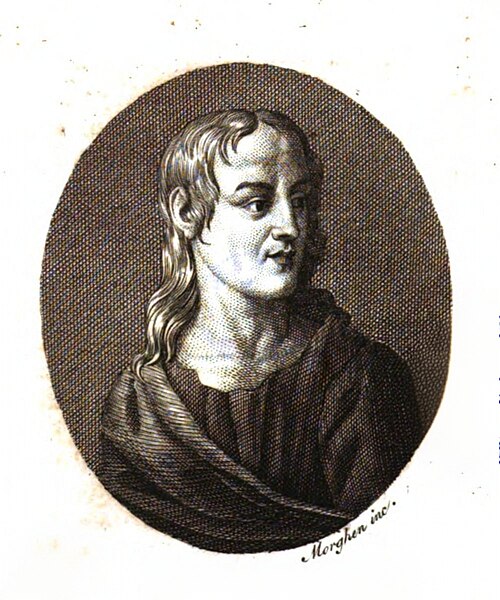
图:PGS 1984 - information from the source may be found on the original file. I did · CC BY-SA 4.0 · 维基共享资源
- 生卒
- 公元前 280 年—公元前 200 年
- 出生地
- 他林敦
- 去世地
- 罗马
- 国籍 / 所属
- 古罗马
- 身份
- 作家、诗人、剧作家、译者
- 代表作
- Odusia
- 本名
- Lucius Livius Andronicus
- 简述
- 3rd-century BC Greco-Roman dramatist and epic poet
卢修斯·李维乌斯·安德罗尼库斯(英语:Livius Andronicus,约公元前284年—约公元前205年),古罗马文学家之一,曾在古罗马享有盛誉。早年生平众说纷纭,曾开馆授徒,并翻译了大量有关古希腊的文学作品。他的剧作亦较为著名,对古罗马文坛影响广泛,其作品罕有传世。
正文摘自中文维基百科「卢修斯·李维乌斯·安德罗尼库斯」(删去了参考文献、表格和图片),按 CC BY-SA 4.0 使用
英文维基百科的更多内容
中文维基百科这一条比较短,下面是英文维基百科同一条目的节选,原文为英文,未翻译。
Lucius Livius Andronicus (; Greek: Λούκιος Λίβιος Ἀνδρόνικος; c. 284 – c. 204 BC) was a Greco-Roman dramatist, actor, and epic poet of the Old Latin period during the Roman Republic.
Andronicus began as an educator in the service of a noble family, producing Latin translations of Greek works, including Homer's Odyssey. The translations were meant, at first, as educational devices for the school which he founded. He also wrote works for the stage—both tragedies and comedies—which are regarded as the first dramatic works written in the Latin language. His comedies were based on Greek New Comedy and featured characters in Greek costume. Thus, the Romans referred to this new genre by the term comoedia palliata or fabula palliata, meaning "cloaked comedy," the pallium being a Greek-style cloak. The Roman biographer Suetonius later coined the term "half-Greek" of Livius and Ennius (referring to their genre, not their ethnic backgrounds). The genre was imitated by later generations of playwrights, and Andronicus is accordingly regarded as the father of Roman drama and of Latin literature in general; that is, he was the first man of letters to write in Latin. Varro, Cicero, and Horace, all men of letters during the subsequent Classical Latin period, considered Livius Andronicus to have been the originator of Latin literature. He is the earliest Roman poet whose name is known.
Biography
Origins
Livius Andronicus was born in Tarentum, Magna Graecia. Not much is known of his childhood, but it is believed he was originally a highly educated Greek, who was bought as a slave by Roman nobles.
Name
In most ancient sources, he is called "Livius Andronicus" or simply "Livius." Andronicus is the latinisation of the Greek name Andronikos, which was held by a number of Greek historical figures of the period, and so it is generally considered that this was his Greek name and that Livius, a name originally local to Latium, was the gentilicium (family name) of his patron (patronus), someone of the gens Livia. His career at Rome was launched from servitude and he was eventually made a freedman (libertus) by his owner. The praenomen Lucius is given by Aulus Gellius and Cassiodorus.
Dates
Livius' dates are based mainly on Cicero and Livy. Cicero writes, "This Livius exhibited his first performance at Rome in the consulship of M. Tuditanus and C. Clodius, the son of Caecus, the year before Ennius was born," that is, in 240 BC. Cicero goes on to relate the point of view of Accius, that Livius was captured from Tarentum in 209, and produced a play in 197.……
Events
Jerome has some additional detail that tends to support the capture at Tarentum and enslavement.……
Works
Odyssia
Livius made a Latin translation of the Odyssey in Saturnian verse. All that survives is parts of 46 scattered lines from 17 books of the Greek 24-book epic. In some lines, he translates literally, though in others more freely.
Plays
Livius' first play, according to Cicero, was staged in 240. Livy states that Livius was the first to create a play with a plot. One story says that after straining his voice, Livius, who was also an actor, was the first to leave the singing to singers and limited the actors to dialogue.
His dramatic works were written in the iambic senarius and trochaic septenarius. They included both lyric passages (cantica) and dialogue (diverbia). His dramatic works had large element of solos for chief actor, often himself. It is not known whether he had a chorus. These dramatic works of Livius Andronicus were consistent with Greek requirements of drama and probably had Greek models, and we have no more than 60 fragments, as quoted in other authors.
His surviving tragedies are as follows:
Achilles, about which a sole fragment survives, preserved in the works of Nonius Marcellus. Marcellus quotes a passage wherein some character states "If I imitate evil women, then you will pay the price for your wrong.……
正文摘自英文维基百科(原文为英文,未翻译)「Livius Andronicus」(节选,删去了参考文献、表格和图片),按 CC BY-SA 4.0 使用;在维基百科读全文 ›