史鉴

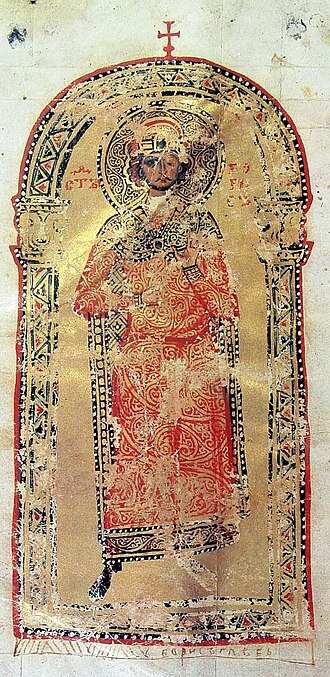
图:Nikolai Karaneschev · CC BY 3.0 · 维基共享资源
- 生卒
- 863 年—927 年 5 月 27 日 (日期为儒略历)
- 出生地
- 普利斯卡
- 去世地
- 大普雷斯拉夫
- 国籍 / 所属
- 保加利亚第一帝国
- 身份
- sovereign
- 职位
- 皇帝、可汗、保加利亚国王
- 父亲
- 鲍里斯一世
- 母亲
- 玛利亚
- 配偶
- María Sursuvul
- 子女
- 彼得一世、米哈伊尔、Boyan The Magician、Ivan
- 原文名
- Цар Симео̀н I
- 家族
- 克鲁姆王朝
- 领域
- 政治人物
- 死因
- 心力衰竭
- 简述
- Bulgarian Tsar who ruled from 893 to 927
西美昂一世大帝(保加利亚语:Симеон I Велики;约864年—927年5月27日)是893年起保加利亚第一帝国的统治者,直至927年去世。在位期间保加利亚第一帝国的国势达到极盛。
西美昂一世即位后不久即击退东罗马帝国和马扎尔人的进攻,并迫使外强中干的东罗马帝国求和。897年与东罗皇帝利奥六世缔结和约。但此后双方仍是交锋不断。913年,西美昂进攻拜占庭,第二年自己撤走。917年西美昂经多次武力征服迫使塞尔维亚人成为自己的臣属。同年再度发兵侵袭东罗马帝国。923年,西美昂与阿拉伯人结成反东罗马联盟。925年,西美昂宣布自己为“全保加利亚人和罗马人的皇帝”。他这个称号得到了教宗的认许。东罗马帝国提出抗议,但无济于事。
9世纪末10世纪初的巴尔干半岛北边、南欧、中欧东南端势力交错。大约状况是迁入潘诺尼亚平原的马扎尔人到处侵扰并驻扎于多瑙河中游蒂萨河流域一带,领袖是阿尔帕德及其继任领袖。另一方面,达尔马提亚公爵、克罗地亚人领袖之一托米斯拉夫在位。托米斯拉夫任内统一潘诺尼亚、达尔马提亚两地,于924年击退侵扰的马扎尔人。同年,由投靠西蒙的塞尔维亚人领袖察斯拉夫·卡罗尼米洛维奇率领的保加利亚军队向西终于击破多年与保加利亚对抗、东罗马帝国影响的塞尔维亚地区;塞尔维亚地区势力向西流亡克罗地亚。另外,东罗马帝国因外交巩固了和克罗地亚的合作关系。在西美昂的视角中,此合作关系与克罗地亚收容塞尔维亚地区流亡势力威胁著保加利亚的西边边防与障碍著西美昂向西施影响力。926年,克罗地亚与保加利亚之间的战役爆发。克罗地亚军队在波斯尼亚地区击败可能包括马扎尔人、由保加利亚贵族率领的军队。在罗马教廷的调停下克罗地亚与保加利亚停战。调停间,西美昂一世突然去世。
正文摘自中文维基百科「西美昂一世」(删去了参考文献、表格和图片),按 CC BY-SA 4.0 使用
英文维基百科的更多内容
中文维基百科这一条比较短,下面是英文维基百科同一条目的节选,原文为英文,未翻译。
Simeon I the Great (Church Slavonic: цѣсар҄ь Сѷмеѡ́нъ А҃ Вели́къ; Bulgarian: цар Симеон I Велики, romanized: Simeon I Veliki [simɛˈɔn ˈpɤrvi vɛˈliki]; Greek: Συμεών Αʹ ὁ Μέγας, romanized: Sumeṓn prôtos ho Mégas) was the ruler of the First Bulgarian Empire from 893 until his death in 927. Simeon's successful campaigns against the Byzantines, Magyars and Serbs led Bulgaria to its greatest territorial expansion ever, making it the most powerful state in contemporary Eastern and Southeast Europe. His reign was also a period of unmatched cultural prosperity and enlightenment later deemed the Golden Age of Bulgarian culture.
During Simeon's rule, Bulgaria spread over a territory between the Aegean, the Adriatic and the Black seas. The newly independent Bulgarian Orthodox Church became the first new patriarchate besides the Pentarchy, and Bulgarian Glagolitic and Cyrillic translations of Christian texts spread all over the Slavic world of the time. It was at the Preslav Literary School in the 890s that the Cyrillic alphabet was developed. Halfway through his reign, Simeon assumed the title of "emperor" (Tsar), having prior to that been styled "prince" (Knyaz).
Background and early life
Simeon was born in 864 or 865, as the third son of Knyaz Boris I of Krum's dynasty. As Boris was the ruler who Christianized Bulgaria in 865, Simeon was a Christian all his life. Because his eldest brother Vladimir was designated heir to the Bulgarian throne, Boris intended Simeon to become a high-ranking cleric, possibly Bulgarian archbishop, and sent him to the University of Constantinople to receive theological education when he was thirteen or fourteen. He took the name Simeon as a novice in a monastery in Constantinople. During the decade (ca.……
Reign
Trade war with Byzantium and Magyar invasions
With Simeon on the throne, the long-lasting peace with the Byzantine Empire established by his father was about to end. A conflict arose when Byzantine Emperor Leo VI the Wise, allegedly acting under pressure from his mistress Zoe Zaoutzaina and her father Stylianos Zaoutzes, moved the marketplace for Bulgarian goods from Constantinople to Thessaloniki, where the Bulgarian merchants were heavily taxed. The Bulgarians sought protection by Simeon, who in turn complained to Leo. However, the Byzantine emperor ignored his embassy.
Culture and religion
During Simeon's reign, Bulgaria reached its cultural apogee, becoming the literary and spiritual centre of Slavic Europe. In this respect, Simeon continued his father Boris' policy of establishing and spreading Slavic culture and attracting noted scholars and writers within Bulgaria's borders. It was in the Preslav Literary School and Ohrid Literary School, founded under Boris, that the main literary work in Bulgaria was concentrated during the reign of Simeon in the new Cyrillic alphabet which was developed there.
Family
Simeon was married twice. By his first wife, whose identity is unknown, Simeon had a son called Michael. Possibly because his mother was of inferior birth, he was excluded from the succession and sent to a monastery.
By his second wife, the sister of the influential noble George Sursubul, he had three sons: Peter, who succeeded as Emperor of Bulgaria in 927 and ruled until 969; Ivan, who unsuccessfully conspired against Peter in 929 and then fled to Byzantium;……
Legacy and popular culture
Tsar Simeon I has remained among the most highly valued Bulgarian historical figures, as indicated by popular vote in the Velikite Bǎlgari (a spin-off of 100 Greatest Britons) television programme, which in February 2007 placed him fourth among the greatest Bulgarians ever. Simeon the Great has been regularly featured in fiction. Bulgarian national writer Ivan Vazov dedicated a children's patriotic poem to him, "Tsar Simeon", and it was later arranged as a song, "Kray Bosfora šum se vdiga" ("A Clamour Rises by the Bosphorus").……
正文摘自英文维基百科(原文为英文,未翻译)「Simeon I of Bulgaria」(节选,删去了参考文献、表格和图片),按 CC BY-SA 4.0 使用;在维基百科读全文 ›
亲属
所属政权

同时代、同地区的人物



同时代、同身份的人物(帝王与政治)