史鉴
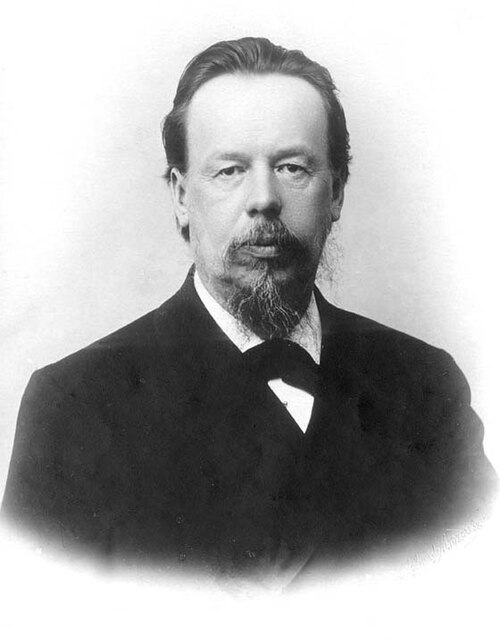
图:佚名 · Public domain · 维基共享资源
- 生卒
- 1859 年 3 月 4 日—1905 年 12 月 31 日 (日期为儒略历)
- 出生地
- 克拉斯诺图林斯克
- 去世地
- 圣彼得堡
- 国籍 / 所属
- 俄罗斯、俄罗斯帝国
- 身份
- 工程师、物理学家、发明家、教育学家
- 原文名
- Александр Попов
- 就读
- Yekaterinburg Seminary、Perm Theological Seminary、Faculty of Physics and Mathematics of the Saint Petersburg University
- 任职机构
- 圣彼得堡国立电子科技大学
- 领域
- 物理学
- 死因
- 脑内出血
- 简述
- 俄罗斯物理学家(1859—1906)
亚历山大·斯捷潘诺维奇·波波夫(俄语:Александр Степанович Попов,1859年3月16日—1906年1月13日),俄国物理学家和电气工程师,是研究电磁波的先驱。
详细介绍
生平
波波夫出生于乌拉尔山区的一个小村庄,父亲是一位神父,1877年进入圣彼得堡帝国大学学习,1892年毕业后留校在实验室工作,1893年到俄国海军喀琅施塔得鱼雷学校任教。
波波夫于1894年发明了第一架无线电接收器,一个金属检波器,1895年改进成接收闪电发出的电磁波装置,同年5月7日他在彼得堡物理和化学协会物理学部年会上演示了他制成的一架无线电接收装置-雷电指示器,这一天后来被俄罗斯定为“无线电日”庆祝。7月将这个装置安装在圣彼得堡林学院的气象站中,几个月后发表了一篇论文说明这种装置可以接收人工震荡源的信号。1896年3月在彼得堡物理学年会时,在彼得堡大学的两座建筑物、距离约为250米之间进行了发送和接收电磁波信号的实验,这比意大利物理学家马可尼于1896年6月取得专利的装置要早。
1898年他和俄国海军一起进行了10 千米距离的海岸和军舰之间的通信实验,1899年实现了50千米通信。但由于马可尼先取得了专利,国际上一般认为是马可尼发明的无线电通信,而俄罗斯人尊波波夫为无线电发明人。
1900年俄国海军在波波夫的指导下在波罗的海中的高戈兰岛设立了无线电站,和芬兰沿海城市科特卡之间实现了无线电通讯。(当时芬兰属于沙皇俄国),2月5日发出第一条信息,到了4月份,破冰船爱尔马克号前往高戈兰岛解救被冰困住的战舰,同时解救出50名芬兰渔民,无线电站已经成功地发送了440条信息,这时马可尼刚开始第一次通信实验。
1901年波波夫被任命为电技术研究所的教授,1905年被选为研究所所长,年底健康状况恶化,翌年初即死于脑溢血。
正文摘自中文维基百科「亚历山大·斯捷潘诺维奇·波波夫」(删去了参考文献、表格和图片),按 CC BY-SA 4.0 使用
英文维基百科的更多内容
中文维基百科这一条比较短,下面是英文维基百科同一条目的节选,原文为英文,未翻译。
Alexander Stepanovich Popov (sometimes spelled Popoff; Russian: Александр Степанович Попов; 16 March [O.S. 4 March] 1859 – 13 January 1906 [O.S. 31 December 1905]) was a Russian physicist who was one of the first people to invent a radio receiving device.
Popov's work as a teacher at a Russian naval school led him to explore high-frequency electrical phenomena. On 7 May 1895, he presented a paper on a wireless lightning detector he had built that worked via using a coherer to detect radio noise from lightning strikes. This day is celebrated today in Russia as Radio Day. In a 24 March 1896 demonstration, he transmitted radio signals 250 meters between different campus buildings in St. Petersburg. His work was based on that of another physicist, Oliver Lodge, and contemporaneous with the work of Guglielmo Marconi.
Early life
Born in the town of Krasnoturyinsk, currently Sverdlovsk Oblast, in the Urals as the son of a priest, he became interested in natural sciences when he was a child. His father wanted Alexander to join the priesthood and sent him to the Seminary School at Yekaterinburg. There he developed an interest in science and mathematics and instead of going on to Theology School in 1877 he enrolled at Saint Petersburg University, where he studied physics. After graduation with honors in 1882, he stayed on as a laboratory assistant at the university.……
Radio wave receiver
Along with his teaching duties at the naval school, Popov pursued related areas of research. Trying to solve a problem with the failure in the electrical wire insulation on steel ships (which turned out to be a problem with electrical resonance) led him to further explore oscillations of high-requency electrical currents. His interest in this area of study (including the new field of "Hertzian" or radio waves) was intensified by his trip in 1893 to the Chicago World's Columbian Exposition in the United States, where he was able to confer with other researchers in the field.
Operating principle
In Popov's lightning detector the coherer (C) was connected to an antenna (A), and to a separate circuit with a relay (R) and battery (V) which operated an electric bell (B).……
Later work
In 1900 a radio station was established under Popov's instructions on Hogland island (Suursaari) to provide two-way communication by wireless telegraphy between the Russian naval base and the crew of the battleship General-Admiral Apraksin. The battleship had run aground on Hogland island in the Gulf of Finland in November 1899. The crew of the Apraksin were not in immediate danger, but the water in the Gulf began to freeze. Due to bad weather and bureaucratic red tape, the crew of Apraksin did not arrive until January 1900 to establish a wireless station on Hogland Island. By 5 February, however, messages were being received reliably.……
Death
In 1905 he became seriously ill and died of a brain hemorrhage on 13 January 1906.
He was succeeded as head of the Russian national wireless organisation by Simeon Aisenstein with whom he had worked closely.
Honors
Radio Day
In 1945 on the 50th anniversary of Popov's experiment the old Soviet Union made 7 May a new holiday, Radio Day, the day they claim Popov invented radio. Historians note this holiday may be more due to Cold War era politics than historical evidence. Radio Day is still officially marked in Russia and Bulgaria.
Named after
A minor planet, 3074 Popov, discovered by Soviet astronomer Lyudmila Zhuravlyova in 1979.
Crater Popov on the back side of the Moon.
Monuments
Monument to A. S. Popov, Nizhny Novgorod, Museum of Radiophysics
Monument to A. S. Popov, Yekaterinburg, Popov Square on Pushkin Street.
Family
Some of his descendants escaped to Manchuria during the Bolshevik Revolution and eventually made their way to the United States.
Among others were his cousin, Paul Popov, who became a prominent physician in San Francisco and Paul's son, Egor Popov (1913–2001), who became a UC Berkeley Professor Emeritus of Civil and Environmental Engineering.
正文摘自英文维基百科(原文为英文,未翻译)「Aleksandr Popov (physicist)」(节选,删去了参考文献、表格和图片),按 CC BY-SA 4.0 使用;在维基百科读全文 ›
所属政权
同时代、同地区的人物



同时代、同身份的人物(科学与发明)