史鉴
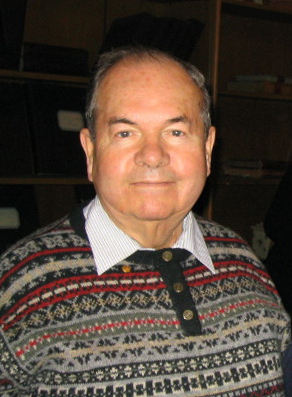
图:AA_Abrikosov_and_VL_Ginzburg_ANL.jpg: ANL.gov derivative work: Materialscientist · Public domain · 维基共享资源
- 生卒
- 1928 年 6 月 25 日—2017 年 3 月 29 日
- 出生地
- 莫斯科
- 去世地
- 帕洛阿尔托
- 国籍 / 所属
- 美国、俄罗斯、苏联
- 身份
- 物理学家、大学教师
- 父亲
- Alexei Abrikosov
- 配偶
- Svetlana Bunkova
- 代表作
- 凝聚态物理学
- 原文名
- Алексей Алексеевич Абрикосов
- 就读
- MSU Faculty of Physics
- 任职机构
- 莫斯科国立大学、伊利诺伊大学厄巴纳-香槟分校、下诺夫哥罗德罗巴切夫斯基国立大学、郎道理论物理研究所、伊利诺伊大学芝加哥分校、犹他州立学院 等 12 项
- 所属组织
- 俄罗斯科学院、英国皇家学会、匈牙利科学院、美国国家科学院、美国文理科学院、美国物理学会 等 7 项
- 领域
- 理论物理学、凝聚态物理学
- 死因
- 心肌梗死
- 简述
- 物理学家, 俄罗斯
阿列克谢·阿列克谢维奇·阿布里科索夫(俄语:Алексе́й Алексе́евич Абрико́сов,1928年6月25日—2017年3月29日),俄罗斯物理学家,2003年获诺贝尔物理学奖。
详细介绍
生平
阿布里科索夫生于莫斯科,父母都是医生。1948年从莫斯科国立大学毕业,入列夫·朗道领导的苏联科学院物理问题研究所进修,1951年因等离子体里的热扩散研究通过博士资格考试,1955年以高温下的量子电动力学研究获得物理和数学博士学位。1951年阿布里科索夫在分析玻璃底板上所镀金属薄膜的实验数据时,发现了第二类超导体,提出磁场线形成周期性的“格子”和“混合态”的理论进行了解释,但这一研究并未得到导师朗道的认可,论文被搁置下来,直到1957年才发表。
1965年阿布里科索夫任苏联科学院郎道理论物理研究所研究室主任。1966年起兼任莫斯科大学教授。1987年成为苏联科学院院士。1991年起任职于美国国立阿贡实验室材料科学部凝聚态物理研究组,生前拥有俄罗斯和美国双重国籍。
1966年曾共同荣获苏联最高奖———列宁奖金。2005年,阿布里科索夫获香港科技大学颁授理学荣誉博士学位。
正文摘自中文维基百科「阿列克谢·阿布里科索夫」(删去了参考文献、表格和图片),按 CC BY-SA 4.0 使用
英文维基百科的更多内容
中文维基百科这一条比较短,下面是英文维基百科同一条目的节选,原文为英文,未翻译。
Alexei Alexeyevich Abrikosov (Russian: Алексе́й Алексе́евич Абрико́сов; June 25, 1928 – March 29, 2017) was a Russian-American theoretical physicist whose main contributions are in the field of condensed matter physics. He was the co-recipient of the 2003 Nobel Prize in Physics, with Vitaly Ginzburg and Anthony James Leggett, for theories about how matter can behave at extremely low temperatures.
Education and early life
Abrikosov was born in Moscow, Russian SFSR, Soviet Union, on June 25, 1928, to a couple of physicians: Aleksey Abrikosov and Fani (née Wulf). His mother was Jewish. After graduating from high school in 1943, Abrikosov began studying energy technology. He graduated from Moscow State University in 1948. From 1948 to 1965, he worked at the Institute for Physical Problems of the USSR Academy of Sciences, where he received his Ph.D. in 1951 for the theory of thermal diffusion in plasmas, and then his Doctor of Physical and Mathematical Sciences (a "higher doctorate") degree in 1955 for a thesis on quantum electrodynamics at high energies. Abrikosov moved to the US in 1991 and lived there until his death in 2017, in Palo Alto, California. While in the US, Abrikosov was elected to the National Academy of Sciences in 2000, and in 2001, to be a foreign member of the Royal Society.
Career
From 1965 to 1988, he worked at the Landau Institute for Theoretical Physics (USSR Academy of Sciences). He has been a professor at Moscow State University since 1965. In addition, he held tenure at the Moscow Institute of Physics and Technology from 1972 to 1976, and at the Moscow Institute of Steel and Alloys from 1976 to 1991. He served as a full member of the USSR Academy of Sciences from 1987 to 1991. In 1991, he became a full member of the Russian Academy of Sciences.
In two works in 1952 and 1957, Abrikosov explained how magnetic flux can penetrate a class of superconductors. This class of materials are called type-II superconductors. The accompanying arrangement of magnetic flux lines is called the Abrikosov vortex lattice.
Together with Lev Gor'kov and Igor Dzyaloshinskii, Abrikosov has written an iconic book on theoretical solid-state physics, which has been used to train physicists in the field for decades.
From 1991 until his retirement, he worked at Argonne National Laboratory in the U.S. state of Illinois. Abrikosov was an Argonne Distinguished Scientist at the Condensed Matter Theory Group in Argonne's Materials Science Division. When he received the Nobel Prize, his research was focused on the origins of magnetoresistance, a property of some materials that change their resistance to electrical flow under the influence of a magnetic field.
Honours and awards
Abrikosov was awarded the Lenin Prize in 1966, the Fritz London Memorial Prize in 1972, and the USSR State Prize in 1982. In 1989 he received the Landau Prize from the Academy of Sciences, Russia. Two years later, in 1991, Abrikosov was awarded the Sony Corporation's John Bardeen Award. The same year he was elected a Foreign Honorary Member of the American Academy of Arts and Sciences. He shared the 2003 Nobel Prize in Physics. He was also a member of the Royal Academy of London, a fellow of the American Physical Society, and in 2000 was elected to the prestigious National Academy of Sciences. Other awards include:
Personal life
Abrikosov was the son of the physicians Alexei Ivanovich Abrikosov (1875-1955) and his second wife, Fania Davidovna Woolf (1895—1965). Through his father, Abrikosov was the nephew of the martyred Catholic nun Anna Abrikosova (1882-1936).
His sister was Maria Alekseevna Abrikósova (1929-1998), physician.
He married Svetlana Yuriyevna Bunkova and had 3 children.
He died in California on 29 March 2017 at the age of 88.
正文摘自英文维基百科(原文为英文,未翻译)「Alexei Abrikosov (physicist)」(节选,删去了参考文献、表格和图片),按 CC BY-SA 4.0 使用;在维基百科读全文 ›
亲属
所属政权

同时代、同地区的人物



同时代、同身份的人物(思想与学术)