史鉴
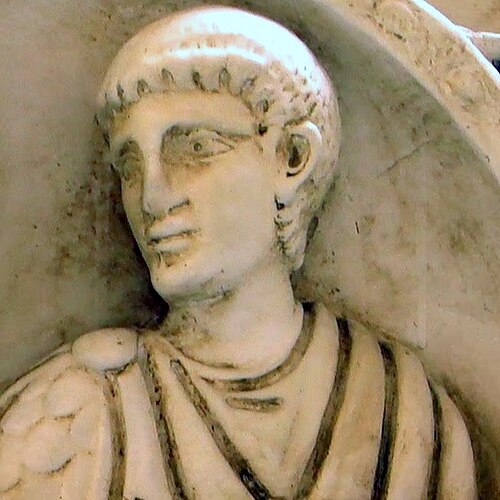
图:Tataryn · CC BY-SA 4.0 · 维基共享资源
- 生卒
- 390 年代—454 年 9 月 21 日 (Wikidata 的生卒只记到十年,非确切年份)
- 出生地
- 锡利斯特拉
- 去世地
- 拉韦纳
- 国籍 / 所属
- 西罗马帝国、古罗马
- 身份
- 军人、政治人物
- 职位
- 罗马执政官、古罗马元老
- 父亲
- Gaudentius
- 配偶
- Pelagia
- 子女
- 高登提乌斯、Carpilio、Aetia
- 参与
- 沙隆战役、里米尼战役 (432年)
- 原文名
- Flavius Aetius、Flavius Aëtius
- 军种
- 罗马帝国晚期军事
- 军衔
- 大元帅
- 简述
- 罗马帝国将领和政治家(约390-454)
弗拉维乌斯·埃提乌斯(拉丁语:Flavius Aetius,396年—454年),又译阿哀契乌斯,西徐亚裔罗马人,西罗马帝国末期的主要军事统帅。
生于杜罗斯托鲁姆(今保加利亚锡利斯特拉),他的主要战绩为在沙隆战役击败匈人入侵,并取得了古代欧洲规模最大一场会战的胜利。爱德华·吉本将此战役称为“西罗马帝国的最后一次胜利”。451年,匈人首领阿提拉入侵西罗马帝国,埃提乌斯联合西哥特王国反击并将其击退。后来,他又多次击退蛮族进攻。
454年,佩特罗尼乌斯·马克西穆斯诬告埃提乌斯谋反。皇帝瓦伦蒂尼安三世信以为真,亲手刺死了埃提乌斯。
正文摘自中文维基百科「埃提乌斯」(删去了参考文献、表格和图片),按 CC BY-SA 4.0 使用
英文维基百科的更多内容
中文维基百科这一条比较短,下面是英文维基百科同一条目的节选,原文为英文,未翻译。
Flavius Aetius (also spelled Aëtius; Latin: [aːˈɛtiʊs]; c. 390 – 21 September 454) was a Roman general and statesman of the closing period of the Western Roman Empire. He was a military commander and the most influential man in the Empire for two decades (433–454). He managed policy in regard to the attacks of barbarian federates settled throughout the West. Notably, he mustered a large Roman and allied (foederati) army in the Battle of the Catalaunian Plains, ending an invasion of Gaul by Attila in 451, though Attila and his subjugated allies still managed to invade Italy the following year, an incursion best remembered for the Sack of Aquileia and the intercession of Pope Leo I. In 454, Aetius was assassinated by the emperor Valentinian III.
Aetius has often been called the "Last of the Romans". Edward Gibbon refers to him as "the man universally celebrated as the terror of Barbarians and the support of the Republic" for his victory at the Catalaunian Plains. J. B. Bury notes, "That he was the one prop and stay of the Western Empire during his life time was the unanimous verdict of his contemporaries."
Biography
Origins and family
Aetius was born at Durostorum in Moesia Secunda (modern Silistra, Bulgaria), roughly around 390, as he was described as a "young adolescent" in 405. His father, Gaudentius, was a Roman general and described as a native of the province of Scythia. Aetius's mother, whose name is unknown, was a wealthy aristocratic woman of ancestry from Rome or some other city in the Italian peninsula. Before 425 Aetius married the daughter of Carpilio, who gave him a son, also named Carpilio. Later he married Pelagia, widow of Bonifacius, from whom he had a son, Gaudentius. It is possible that he also had a daughter, whose husband, Thraustila, avenged Aetius's death by killing emperor Valentinian III.
Early years and service under Joannes
As a boy, Aetius was at the service of the imperial court, enrolled in the military unit of the Protectores Domestici and then elevated to the position of tribunus praetorianus partis militaris, setting him up for future political eligibility. Between 405 and 408 he was kept as hostage at the court of Alaric I, king of the Visigoths. In 408 Alaric asked to keep Aetius as a hostage, but was refused, as Aetius was sent to the court of Uldin, king of the Huns, where he would stay throughout much of the reign of Charaton, Uldin's successor. Some modern historians have suggested that Aetius's upbringing amongst militaristic peoples gave him a martial vigour not common in contemporary Roman generals.
Legacy
Military legacy
Aetius is generally viewed as a great military commander – indeed, he was held in such high esteem by the Eastern Roman Empire that he became known as the last true Roman of the west. Traditionally, historians also consider the Battle of the Catalaunian Plains as decisively important, crippling Attila by destroying his aura of invincibility. Gibbon states this view:
[Attila's] retreat across the Rhine confessed the last victory which was achieved in the name of the Western Roman Empire.
Aetius effectively ruled the western empire from 433 to 454, and attempted to stabilize its European borders under a deluge of barbarians, foremost of which were Attila and the Huns. One of his greatest achievements was the assembling of the coalition against Attila. Regarding this, historian Arther Ferrill states:
After he secured the Rhine, Attila moved into central Gaul and put Orléans under siege. Had he gained his objective, he would have been in a strong position to subdue the Visigoths in Aquitaine, but Aetius had put together a formidable coalition against the Hun. The Roman leader had built a powerful alliance of Visigoths, Alans and Burgundians, uniting them with their traditional enemy, the Romans, for the defense of Gaul.……
正文摘自英文维基百科(原文为英文,未翻译)「Flavius Aetius」(节选,删去了参考文献、表格和图片),按 CC BY-SA 4.0 使用;在维基百科读全文 ›
参与的事件
- 里米尼战役 (432年)432 年 · 战役 · 欧洲
- 沙隆战役451 年 6 月 20 日 · 战役 · 欧洲
所属政权
同时代、同地区的人物


同时代、同身份的人物(帝王与政治)