史鉴
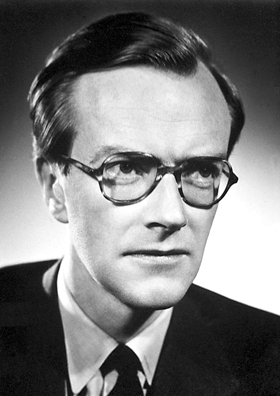
图:佚名 · Public domain · 维基共享资源
- 生卒
- 1916 年 12 月 15 日—2004 年 10 月 5 日
- 出生地
- Pongaroa
- 去世地
- 布莱克希斯
- 国籍 / 所属
- 英国、新西兰
- 身份
- 医生、物理学家、作者、研究者、生物物理学家、晶体学家
- 配偶
- Patricia Ann Chidgey、Ruth Wilkins
- 参与
- 曼哈顿计划
- 原文名
- Maurice Hugh Frederic Wilkins
- 就读
- 剑桥大学、伯明翰大学、剑桥大学圣约翰学院、爱德华国王学校
- 任职机构
- 加州大学伯克利分校、伦敦国王学院
- 所属组织
- 英国皇家学会、美国文理科学院、欧洲分子生物学组织
- 领域
- 分子生物学、磷光、电磁分离、X射线晶体学、显微镜学
- 简述
- 生物物理学家, 新西兰
莫里斯·休·弗雷德里克·威尔金斯 CBE FRS(英语:Maurice Hugh Frederick Wilkins,1916年12月15日—2004年10月5日),出生于新西兰,英国分子生物学家,专注于磷光、雷达、同位素分离与X光衍射等领域。其在伦敦国王学院期间解开了DNA分子结构,以及一些相关研究,使其与弗朗西斯·克里克、詹姆斯·沃森共同获得了1962年的诺贝尔生理学或医学奖。他在国王大学的同事罗莎琳·富兰克林,也是这项研究的主要贡献者之一,但因病逝世,无缘得奖。
正文摘自中文维基百科「莫里斯·威尔金斯」(删去了参考文献、表格和图片),按 CC BY-SA 4.0 使用
英文维基百科的更多内容
中文维基百科这一条比较短,下面是英文维基百科同一条目的节选,原文为英文,未翻译。
Maurice Hugh Frederick Wilkins (15 December 1916 – 5 October 2004) was a New Zealand-born British biophysicist and Nobel laureate whose research spanned multiple areas of physics and biophysics, contributing to the scientific understanding of phosphorescence, isotope separation, optical microscopy, and X-ray diffraction. He is most noted for initiating and leading early X-ray diffraction studies on DNA at King's College London, and for his pivotal role in enabling the discovery of the double helix structure of DNA.
Wilkins began investigating nucleic acids in 1948. By 1950, he and his team had produced some of the first high-quality X-ray diffraction images of DNA fibers. He presented this work in 1951 at a conference in Naples, where it significantly influenced James Watson, prompting Watson to pursue DNA structure research with Francis Crick.
In 1951, Rosalind Franklin joined King’s College and was assigned to the same DNA project, though without a clear delineation of leadership. Tensions developed due to overlapping roles and lack of administrative clarity. During this period, Franklin and graduate student Raymond Gosling captured the high-resolution Photo 51, a diffraction image of B-form DNA. In early 1953, John Randall instructed Gosling to hand it over to Wilkins. Wilkins, in turn, showed it to Watson—without Franklin's consent. This action has been the subject of significant ethical and historiographical debate.
Using insights from Photo 51 and prior data—including Wilkins' own diffraction studies—Watson and Crick constructed their double helix model in March 1953. Wilkins simultaneously continued experimental validation, producing confirmatory diffraction images published in the same issue of Nature.
Early life and education
Wilkins was born in Pongaroa, New Zealand, where his father, Edgar Henry Wilkins, was a medical doctor. His older sister was the translator and poet Eithne Wilkins. His family had come from Dublin, where his paternal and maternal grandfathers were, respectively, Headmaster of Dublin High School and a Chief of Police. The Wilkinses moved to Birmingham, England when Maurice was 6. Later, he attended Wylde Green College and then went to King Edward's School, Birmingham from 1929 to 1935.
Wilkins went to St John's College, Cambridge in 1935; he studied the Natural Sciences Tripos, specialising in Physics, and received a Bachelor of Arts degree in 1938. Mark Oliphant, who was one of Wilkins' instructors at St.……
Career and research
Post war years: 1945–1950
During World War II, Wilkins developed improved radar screens at Birmingham, then worked on isotope separation at the Manhattan Project at the University of California, Berkeley during the years 1944–45.
Meanwhile, Randall had been appointed to the Chair of Physics at the University of St Andrews. In 1945, he appointed Wilkins as Assistant Lecturer in his department at the University of St Andrews. Randall was negotiating with the Medical Research Council (MRC) to set up a laboratory to apply the experimental methods of physics to problems of biology. The combination of these disciplines as biophysics was a novel idea. The MRC told Randall that this had to be done in another university.……
DNA – Phase One
At King's College, Wilkins pursued, among other things, X-ray diffraction work on ram sperm and DNA that had been obtained from calf thymus by the Swiss scientist Rudolf Signer.……
Personal life
Wilkins was married twice. His first wife, Ruth, was an art student whom he met whilst he was at Berkeley. Their marriage ended in divorce, and Ruth bore her son by Wilkins after their divorce. Wilkins married his second wife Patricia Ann Chidgey in 1959. They had four children, Sarah, George, Emily and William. He was survived by his widow Patrica and their children.
In the years before World War II, he was an anti-war activist, joining the Cambridge Scientists' Anti-War Group. He joined the Communist Party, until the invasion of Poland by the Soviet Army in September 1939. Formerly classified UK security service papers reveal that Wilkins came under suspicion of leaking atomic secrets.……
正文摘自英文维基百科(原文为英文,未翻译)「Maurice Wilkins」(节选,删去了参考文献、表格和图片),按 CC BY-SA 4.0 使用;在维基百科读全文 ›
参与的事件
- 曼哈顿计划1939 年—1946 年 · 其他事件 · 北美洲
同时代、同地区的人物




同时代、同身份的人物(科学与发明)