史鉴
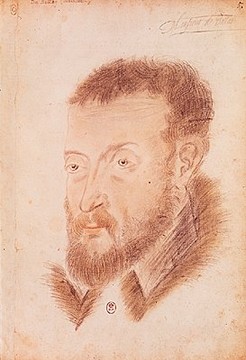
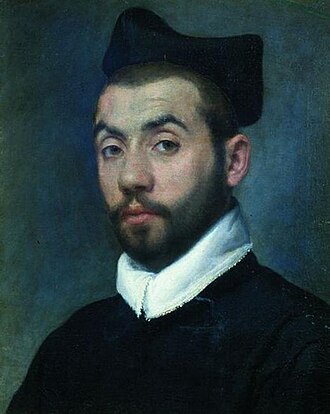
图:Jean Cousin le Jeune. · Public domain · 维基共享资源
- 生卒
- 1522 年—1560 年 1 月 1 日 (日期为儒略历)
- 出生地
- 利雷
- 去世地
- 巴黎
- 国籍 / 所属
- 法国
- 身份
- 作家、诗人、文学评论家
- 父亲
- Jean III du Bellay
- 代表作
- 法语的捍卫与弘扬、Le fruit noir avec un noyaux、The Regrets
- 原文名
- Joachim du Bellay
- 家族
- du Bellay family
- 就读
- 普瓦捷大学
- 所属组织
- 七星诗社
- 领域
- 法国文学、启蒙文学
- 流派 / 运动
- 七星诗社
- 死因
- 中风
- 简述
- French writer, poet, literary critic, and member of the Pléiade (1522–1560)
约阿希姆·杜·贝莱(法语:Joachim du Bellay,发音:[ʒɔaʃɛ̃ dy bɛlɛ];1522年—1560年),文艺复兴时期欧洲诗人。他为七星诗社的成员,1549年发表最早的法语彼特拉克的十四行诗。其著作包括拉丁语诗歌和讽刺诗文。在1549年,他还写了重要的理论著作《保卫与发扬法兰西语言》。
正文摘自中文维基百科「约阿希姆·杜·贝莱」(删去了参考文献、表格和图片),按 CC BY-SA 4.0 使用
英文维基百科的更多内容
中文维基百科这一条比较短,下面是英文维基百科同一条目的节选,原文为英文,未翻译。
Joachim du Bellay (French: [ʒɔaʃɛ̃ dy bɛlɛ]; c. 1522 – 1 January 1560) was a French poet, critic, and a founder of La Pléiade. He notably wrote the manifesto of the group: Défense et illustration de la langue française, which aimed at promoting French as an artistic language, equal to Greek and Latin.
Biography
Joachim du Bellay was born at the Castle of La Turmelière, not far from Liré, near Angers, being the son of Jean du Bellay, Lord of Gonnor, first cousin of the cardinal Jean du Bellay and of Guillaume du Bellay. His mother was Renée Chabot, daughter of Perceval Chabot and heiress of La Turmelière (Plus me plaît le séjour qu'ont bâti mes aïeux).
Both his parents died while he was still a child, and he was left to the guardianship of his elder brother, René du Bellay, who neglected his education, leaving him to run wild at La Turmelière. When he was twenty-three, however, he received permission to study law at the University of Poitiers, no doubt with a view to his obtaining preferment through his kinsman the Cardinal Jean du Bellay. At Poitiers he came in contact with the humanist Marc Antoine Muret, and with Jean Salmon Macrin (1490–1557), a Latin poet famous in his day. There too he probably met Jacques Peletier du Mans, who had published a translation of the Ars Poetica of Horace, with a preface in which much of the program advocated later by La Pléiade is to be found in outline.
It was probably in 1547 that du Bellay met Ronsard in an inn on the way to Poitiers, an event which may justly be regarded as the starting-point of the French school of Renaissance poetry. The two had much in common, and became fast friends. Du Bellay returned with Ronsard to Paris to join the circle of students of the humanities attached to Jean Dorat at the Collège de Coqueret.
While Ronsard and Jean-Antoine de Baïf were most influenced by Greek models, du Bellay was more especially a Latinist, and perhaps his preference for a language so nearly connected with his own had some part in determining the more national and familiar note of his poetry.……
Last works and death
A long and eloquent Discours au roi (detailing the duties of a prince, and translated from a Latin original written by Michel de l'Hôpital, now lost) was dedicated to Francis II in 1559, and is said to have secured for the poet a tardy pension, although it was not published until 1567, after his death. In Paris he was still in the employ of the cardinal, who delegated to him the lay patronage which he still retained in the diocese. In the exercise of these functions Joachim quarrelled with Eustache du Bellay, bishop of Paris, who prejudiced his relations with the cardinal, less cordial since the publication of the outspoken Regrets. His chief patron, Marguerite de Valois, to whom he was sincerely attached, had gone to Savoy. Du Bellay's health was weak; his deafness seriously hindered his official duties; and on 1 January 1560 he died at the age of 38. There is no evidence that he was in priest's orders, but he was a clerk, and as such held various preferments. He had at one time been a canon of Notre Dame of Paris, and was accordingly buried in the cathedral. The statement that he was nominated archbishop of Bordeaux during the last year of life is unauthenticated by documentary evidence and is in itself extremely improbable.
His remains were reportedly identified in 2024 in a lead coffin found in April 2022 during excavations carried out by the National Institute for Preventive Archaeological Research (Inrap) after the Cathedral fire in 2019. Traces of bone tuberculosis and chronic meningitis found on the skeleton, of which the poet showed symptoms in the last years of his life, leave little doubt as to the identity of the deceased, according to Éric Crubézy, a doctor and professor of anthropology at the Toulouse III - Paul Sabatier University.……
正文摘自英文维基百科(原文为英文,未翻译)「Joachim du Bellay」(节选,删去了参考文献、表格和图片),按 CC BY-SA 4.0 使用;在维基百科读全文 ›
同时代、同地区的人物




同时代、同身份的人物(文学)