史鉴
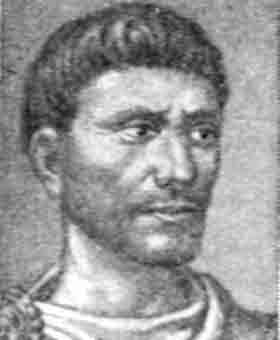
图:佚名 · Public domain · 维基共享资源
- 生卒
- 200 年—284 年
- 出生地
- 亚历山大
- 去世地
- 亚历山大
- 国籍 / 所属
- 古罗马
- 身份
- 数学家
- 代表作
- Arithmetica
- 本名
- Διόφαντος
- 原文名
- Διόφαντος ὁ Ἀλεξανδρεύς
- 领域
- 数论
- 简述
- 古希腊数学家
亚历山大港的丢番图(古希腊语:Διόφαντος ὁ Ἀλεξανδρεύς,罗马化:Dióphantos ho Alexandreús;200年—284年),又译刁藩都,是罗马时代的数学家.
详细介绍
生平
人们对丢番图的生活知之甚少,一般认为他生活在罗马时期的埃及亚历山大港,生活的年代大概从公元200年或214年到284年或298年。关于他的身份有希腊人、非希腊人、希腊化的埃及人、希腊化的巴比伦人、犹太人、迦勒底人等多种说法。
大部分有关丢番图生平的信息来源于5世纪时希腊人梅特罗多勒斯(Metrodorus)在其文集中收录的一篇具有数学谜题性质的《丢番图墓志铭》:
据此列一元一次方程可知,丢番图享寿84岁,于33岁时成婚,38岁时生子,80岁时丧子。但此墓志铭的真实性尚不可考。
学术成就
丢番图作着的丛书《算术》(Arithmetica)处理求解代数方程组的问题,但其中有不少已经遗失。后来当法国数学家费马研究《算术》一书时,对其中某个方程颇感兴趣并认为其无解,说他对此“已找到一个绝妙的证明”,但却没有记录下来,直到三个世纪后才出现完整的证明(详见费马大定理)。
丢番图的研究在数论中占有重要地位,如丢番图方程、丢番图几何、丢番图逼近等都是数学里的重要领域。丢番图是第一个承认分数是一种数的希腊数学家,并允许方程中的系数和解为有理数,这在数学史中是具有开创性的。不过在今天,丢番图方程一词通常指以整数作为系数的代数方程,而其解也要求是整数。丢番图在数学符号方面也作出了贡献。
正文摘自中文维基百科「丢番图」(删去了参考文献、表格和图片),按 CC BY-SA 4.0 使用
英文维基百科的更多内容
中文维基百科这一条比较短,下面是英文维基百科同一条目的节选,原文为英文,未翻译。
Diophantus of Alexandria (; Ancient Greek: Διόφαντος, romanized: Diophantos; fl. 250 CE) was a Greek mathematician who was the author of the Arithmetica in thirteen books, of which ten are extant, made up of arithmetical problems that are solved through algebraic equations.
Joseph-Louis Lagrange called Diophantus "the inventor of algebra"; his exposition became the standard within the Neoplatonic schools of Late antiquity, and its translation into Arabic in the 9th century AD and had influence in the development of later algebra: Diophantus' method of solution matches medieval Arabic algebra in its concepts and overall procedure. The 1621 edition of Arithmetica by Bachet gained fame after Pierre de Fermat wrote his famous "Last Theorem" in the margins of his copy.
In modern use, Diophantine equations are algebraic equations with integer coefficients for which integer solutions are sought. Diophantine geometry and Diophantine approximations are two other subareas of number theory that are named after him. Some problems from the Arithmetica have inspired modern work in both abstract algebra and number theory. As a result of his work, he has sometimes been referred to as the father of algebra.
Biography
The exact details of Diophantus' life are obscure. Although he probably flourished in the third century CE, he may have lived anywhere between 170 BCE, roughly contemporaneous with Hypsicles, the latest author he quotes from, and 350 CE, when Theon of Alexandria quotes from him.……
Arithmetica
Arithmetica is the major work of Diophantus and the most prominent work on premodern algebra in Greek mathematics. It is a collection of 290 algebraic problems giving numerical solutions of determinate equations (those with a unique solution) and indeterminate equations. Arithmetica was originally written in thirteen books, but only six of them survive in Greek, while another four books survive in Arabic, which were discovered in 1968.……
Other works
Another work by Diophantus, On Polygonal Numbers is transmitted in an incomplete form in four Byzantine manuscripts along with the Arithmetica. Two other lost works by Diophantus are known: Porisms and On Parts.
Recently, Wilbur Knorr has suggested that another book, Preliminaries to the Geometric Elements, traditionally attributed to Hero of Alexandria, may actually be by Diophantus.
On polygonal numbers
This work on polygonal numbers, a topic that was of great interest to the Pythagoreans consists of a preface and five propositions in its extant form.……
The Porisms
The Porisms was a collection of lemmas along with accompanying proofs.……
Influence
Diophantus' work has had a large influence in history. Although Joseph-Louis Lagrange called Diophantus "the inventor of algebra", he did not invent it, however his work Arithmetica created a foundation for work on algebra and in fact much of advanced mathematics is based on algebra. Diophantus and his works influenced mathematics in the medieval Islamic world, and editions of Arithmetica exerted a profound influence on the development of algebra in Europe in the late sixteenth and through the 17th and 18th centuries.
Later antiquity
After its publication, Diophantus' work continued to be read in the Greek-speaking Mediterranean from the 4th through the 7th centuries.……
Editions and translations
Bachet de Méziriac, C.G. Diophanti Alexandrini Arithmeticorum libri sex et De numeris multangulis liber unus. Paris: Lutetiae, 1621.
Tannery, P. L. Diophanti Alexandrini Opera omnia: cum Graecis commentariis, Lipsiae: In aedibus B.G. Teubneri, 1893-1895 (online: vol. 1, vol. 2)
Sesiano, Jacques. The Arabic text of Books IV to VII of Diophantus’ translation and commentary. Thesis. Providence: Brown University, 1975.
Thomas L. Heath (1910). Diophantus of Alexandria: A Study in the History of Greek Algebra (2nd ed.). Cambridge University Press.
正文摘自英文维基百科(原文为英文,未翻译)「Diophantus」(节选,删去了参考文献、表格和图片),按 CC BY-SA 4.0 使用;在维基百科读全文 ›