史鉴
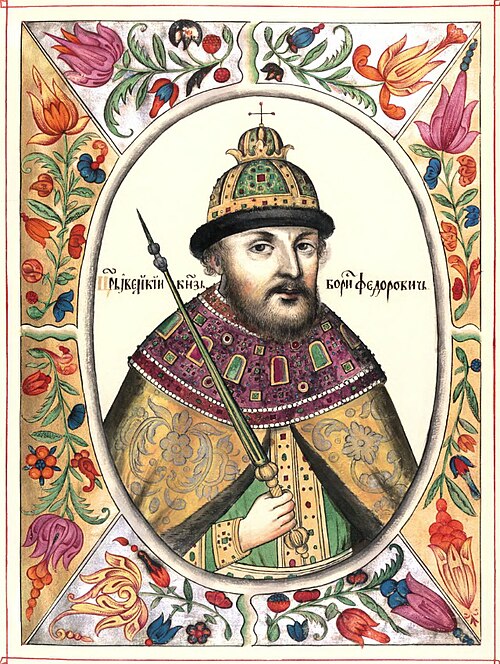
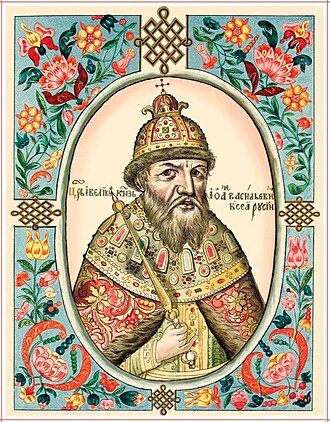
图:佚名 · Public domain · 维基共享资源
- 生卒
- 1552 年 8 月 12 日—1605 年 4 月 23 日 (日期为儒略历)
- 出生地
- 维亚济马
- 去世地
- 莫斯科
- 国籍 / 所属
- 俄罗斯沙皇国
- 身份
- 政治人物、特辖区管
- 职位
- 俄罗斯沙皇
- 父亲
- Fyodor Godunov
- 配偶
- Maria Skuratova-Belskaya
- 子女
- 费奥多尔·戈东诺夫、克谢尼娅·鲍里索芙娜
- 家族
- 戈东诺夫王朝
- 宗教
- 俄罗斯正教会
- 死因
- 疾病
- 简述
- Russian Tsar (1598–1605)
鲍里斯·费奥多罗维奇·戈东诺夫(俄语:Борис Фёдорович Годунов,罗马化:Boris Fyodorovich Godunov;1552年—1605年4月23日),也译作高笃诺夫、戈杜诺夫、郭都诺夫、郭德诺夫,俄国沙皇,于1598年-1605年间在位。
鞑靼贵族出身。曾经侍奉过伊凡雷帝。他妹妹伊琳娜·戈东诺娃嫁给伊凡雷帝的幼子费奥多尔·伊万诺维奇。费奥多尔身体有病,智力不健全,因此大权被戈东诺夫所掌握。1598年费奥多尔去世,无子嗣。留里克王朝灭亡。全俄缙绅会议推举戈东诺夫为俄罗斯沙皇。
戈东诺夫继承伊凡雷帝遗志,停止与波兰的战争,在北方向瑞典发动战争,扩大了波罗的海出海口。向东继续侵略西伯利亚汗国,南方与克里米亚汗国交战,修建了一系列要塞城市。他推进俄罗斯农奴化进程,规定如果一个自由人为他人工作满六个月以上,就沦为这个人的奴仆。还公布逃亡农奴的追捕期限为五年。后发生三年大饥荒,约2百万人,相当于全国三分之一人口饿死,在位末期俄罗斯不断发生农奴起义。
1604年波兰利用留里克王朝后嗣德米特里·伊万诺维奇死亡疑案,支持伪德米特里一世入侵俄国。
1605年戈东诺夫去世,其子费奥多尔即位,不久被杀死。其后伪德米特里一世在波兰支持下自立为沙皇。
俄国文豪普希金将戈东诺夫的一生改编为戏剧,并由作曲家穆索尔斯基再改编成歌剧。
正文摘自中文维基百科「鲍里斯·戈东诺夫」(删去了参考文献、表格和图片),按 CC BY-SA 4.0 使用
英文维基百科的更多内容
中文维基百科这一条比较短,下面是英文维基百科同一条目的节选,原文为英文,未翻译。
Boris Feodorovich Godunov (; Russian: Бори́с Фёдорович Годуно́в, pronounced [bɐˈrʲis ˈfʲɵdərəvʲɪdʑ ɡədʊˈnof]; 12 August [O.S. 2 August] 1552 – 23 April [O.S. 13 April] 1605) was the de facto regent of Russia from 1585 to 1598 and then tsar from 1598 to 1605 following the death of Feodor I, the last of the Rurik dynasty. After the end of Feodor's reign, Russia descended into the Time of Troubles.
Early years
Boris was the son of Feodor Ivanovich Godunov "Krivoy" (lit. 'the one-eyed', died c. 1568–1570) and his wife Stepanida Ivanovna. His older brother Vasily died young and without issue. There is a version according to which the Godunovs were descended from the Tatar murza Chet, who came to Russia in 1330 during the reign of Ivan Kalita. This version was included in later editions of the 16th-century Gosudarev Rodoslovets, but historians have raised doubts about this version of Godunov's ancestry due to various chronological and genealogical issues.
Godunov's career began at the court of Ivan the Terrible. He is mentioned in 1570 for taking part in the Serpeisk campaign as an archer of the guard.……
Regency
Three years later, on his deathbed, Ivan IV appointed a council whose members consisted of Godunov, Feodor Nikitich Romanov, Vasili Shuiski and others to guide his son and successor of Russia Feodor I, who was feeble in both mind and body: "he took refuge from the dangers of the palace in devotion to religion; and though his people called him a saint, they recognized the fact that he lacked the iron to govern men."
At the time of his death, Ivan also had a three-year-old son, Dmitry Ivanovich (1581–1591), from his seventh and last marriage. This son (and his mother's family) had no claim to the throne because the Eastern Orthodox Church only recognized Ivan's first three marriages as legitimate.……
Reign
Upon the death of the childless tsar Feodor on 7 January 1598, self-preservation as much as ambition constrained Boris to seize the throne. Had he not done so, the mildest treatment he could have hoped for would have been lifelong seclusion in a monastery. His election was proposed by Patriarch Job of Moscow, who believed that Boris was the only man who would be able to cope with the difficulties of the situation. Boris, however, would only accept the throne from a Zemsky Sobor, or national assembly, which met on February 17 and unanimously elected him on the 21st. On September 1, he was solemnly crowned tsar.
During the first years of his reign, he was both popular and prosperous, and ruled well.……
Family
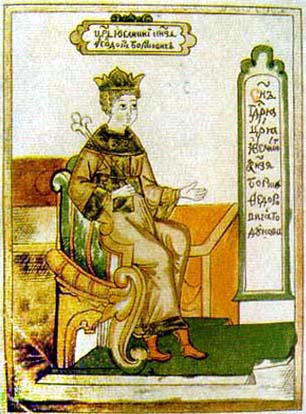
Boris left one son, Feodor II, who succeeded him but only ruled Russia for less than a month, until he and Boris's widow were murdered by the enemies of the Godunovs in Moscow on 10/20 June 1605. Boris's first son, Ivan, was born in 1587 and died in 1588. His daughter, Xenia, was born in 1582. She was engaged to Johann of Schleswig-Holstein, but he died shortly before their planned wedding in October 1602. Xenia was given the name "Olga" upon being forced to take monastic vows at the Voskresensky Monastery in Beloozero and her name is inscribed as "the Nun Olga Borisovna" at the crypt of the Godunovs at the Trinity Lavra of St.……
Arts and popular media
Boris's life was dramatised by the founder of Russian literature, Alexander Pushkin, in his play Boris Godunov (1831), which was inspired by Shakespeare's Henry IV. Modest Mussorgsky based his opera Boris Godunov on Pushkin's play. Sergei Prokofiev later wrote incidental music for Pushkin's drama. In 1997, the score of a 1710 baroque opera based on the reign of Boris by German composer Johann Mattheson was rediscovered in Armenia and returned to Hamburg, Germany. This opera, never performed during the composer's lifetime, had its world premiere in 2005 at the Boston Early Music Festival & Exhibition.
正文摘自英文维基百科(原文为英文,未翻译)「Boris Godunov」(节选,删去了参考文献、表格和图片),按 CC BY-SA 4.0 使用;在维基百科读全文 ›
亲属
所属政权
同时代、同地区的人物


同时代、同身份的人物(帝王与政治)