史鉴
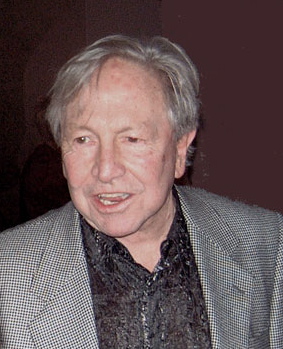
图:Fvlcrvm · CC BY-SA 3.0 · 维基共享资源
- 生卒
- 1925 年 10 月 22 日—2008 年 5 月 12 日
- 出生地
- 阿瑟港
- 去世地
- 卡普蒂瓦
- 国籍 / 所属
- 美国、德国
- 身份
- 摄影师、艺术家、画家、雕塑家、剧装设计、平面设计师、建筑绘图员、编舞者
- 参与
- 4.文献展、Documenta II、Documenta III、De Calder à Koons, Bijoux d'Artistes, La Collection Idéale de Diane Venet、Von Picasso bis Warhol Künstlerschmuck der Avantgarde
- 代表作
- Canyon
- 原文名
- Robert Rauschenberg
- 就读
- 得克萨斯大学奥斯汀分校、朱利安艺术学校、纽约艺术学生联盟、黑山学院、堪萨斯城艺术学院
- 所属组织
- 皇家艺术学院、美国艺术暨文学学会、美国文理科学院、Experiments in Art and Technology
- 领域
- 集合艺术、珠宝设计
- 流派 / 运动
- 现代艺术、后现代主义、当代艺术、新达达主义
- 死因
- 心肌梗死
- 简述
- 美国画家、图形艺术家
罗伯特·劳森伯格(英语:Robert Rauschenberg,1925年10月22日—2008年5月12日),美国画家、图形艺术家。
详细介绍
生平
他的早期作品属于波普艺术运动。罗伯特·劳森伯格以1950年代的“组合”而闻名于世,该作品使用非传统材料及物体来创新组合。劳森伯格是一个画家,也是一个雕塑家,他也创作摄影,版画,造纸术及表演。他于1993年获得国家艺术奖章,在1995年获得达芬奇世界艺术奖。
罗伯特·劳森伯格在纽约市以及佛罗里达州卡普蒂瓦生活,直到2008年5月12日因心脏衰竭去世。
正文摘自中文维基百科「罗伯特·劳森伯格」(删去了参考文献、表格和图片),按 CC BY-SA 4.0 使用
英文维基百科的更多内容
中文维基百科这一条比较短,下面是英文维基百科同一条目的节选,原文为英文,未翻译。
Milton Ernest "Robert" or "Bob" Rauschenberg (October 22, 1925 – May 12, 2008) was an American painter and multi-media artist, whose work has been associated with numerous mid-20th century art movements including the New York School, Conceptual Art, Pop art, and Neo-Dada. Rauschenberg is well known for his Combines (1954–1964), a group of artworks which incorporated everyday objects as art materials and which blurred the distinctions between painting and sculpture. Rauschenberg was primarily a painter and a sculptor, but he also worked with photography, printmaking, papermaking and performance.
Rauschenberg received numerous awards during his nearly 60-year artistic career. Among the most prominent were the International Grand Prize in Painting at the 32nd Venice Biennale in 1964 and the National Medal of Arts in 1993.
Rauschenberg lived and worked in New York City and on Captiva Island, Florida, until his death on May 12, 2008.
Early life and education
Rauschenberg was born Milton Ernest Rauschenberg in Port Arthur, Texas, the son of Dora Carolina (née Matson) and Ernest R. Rauschenberg. His father was of German and his mother of Dutch descent. Rauschenberg incorrectly claimed that his paternal grandmother Tina “Tiny” Jane Howard was Cherokee. His father worked for Gulf States Utilities, a light and power company. His parents were Fundamentalist Christians. He had a younger sister named Janet Begneaud.
At 18, Rauschenberg was admitted to the University of Texas at Austin where he began studying pharmacology, but he dropped out shortly after due to the difficulty of the coursework—not realizing at this point that he was dyslexic—and because of his unwillingness to dissect a frog in biology class.……
Personal life
Rauschenberg married Susan Weil in the summer of 1950 at the Weil family home in Outer Island, Connecticut. Their only child, Christopher, was born July 16, 1951. The two separated in June 1952 and divorced in 1953. Thereafter, Rauschenberg had romantic relationships with fellow artists Cy Twombly and Jasper Johns, poet John Giorno, among others. His partner for the last 25 years of his life was artist Darryl Pottorf, his former assistant.
In the 1970s he moved into NoHo in Manhattan in New York City.
Rauschenberg purchased the Beach House, his first property on Captiva Island, on July 26, 1968. However, the property did not become his permanent residence until the fall of 1970.
Death
Rauschenberg died of heart failure on May 12, 2008, on Captiva Island, Florida.
Work
Rauschenberg's approach was sometimes called "Neo-Dadaist," a label he shared with the painter Jasper Johns. Rauschenberg famously stated that "painting relates to both art and life," and he wanted to work "in the gap between the two." Like many of his Dadaist predecessors, Rauschenberg questioned the distinction between art objects and everyday objects, and his use of readymade materials reprised the intellectual issues raised by Marcel Duchamp's Fountain (1917). Duchamp's Dadaist influence can also be observed in Jasper Johns' paintings of targets, numerals, and flags, which were familiar cultural symbols: "things the mind already knows."
Legacy
Rauschenberg believed strongly in the power of art as a catalyst for social change. The Rauschenberg Overseas Culture Interchange (ROCI) began in 1984 as an effort to spark international dialogue and enhance cultural understanding through artistic expression. A ROCI exhibition went on view at the National Gallery of Art, D.C., in 1991, concluding a ten-country tour: Mexico, Chile, Venezuela, China, Tibet, Japan, Cuba, U.S.S.R., Germany, and Malaysia.
In 1970, Rauschenberg created a program called Change, Inc., to award one-time emergency grants of up to $1,000 to visual artists based on financial need.……
正文摘自英文维基百科(原文为英文,未翻译)「Robert Rauschenberg」(节选,删去了参考文献、表格和图片),按 CC BY-SA 4.0 使用;在维基百科读全文 ›
同时代、同地区的人物







同时代、同身份的人物(艺术与音乐)