史鉴
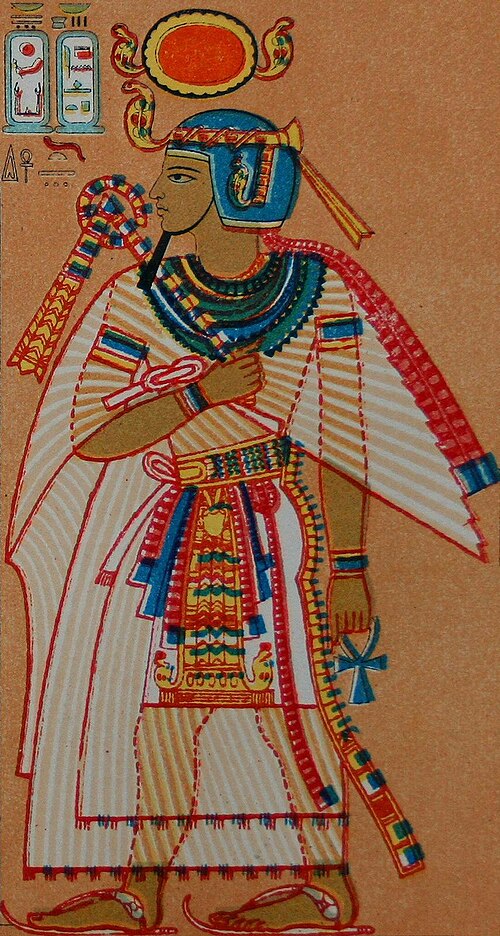
图:佚名 · Public domain · 维基共享资源
- 生卒
- 公元前 1527 年—公元前 1506 年
- 出生地
- 新王国时期
- 国籍 / 所属
- 古埃及、新王国时期
- 职位
- 18th dynasty pharaoh、pharaoh in the New Kingdom
- 父亲
- 雅赫摩斯一世
- 母亲
- 雅赫摩斯-纳菲尔泰丽
- 配偶
- 雅赫摩斯-美丽塔蒙
- 家族
- 埃及第十八王朝
- 简述
- second Pharaoh of the Eighteenth dynasty of Egypt
阿蒙霍特普一世 (英语文献中一般写作:Amenhotep I;?—约前1506年)古埃及第十八王朝法老(约前1525年—约前1506年在位)。
阿蒙霍特普一世是雅赫摩斯一世与雅赫摩斯-纳菲尔泰丽的第三个儿子。他的长兄们均先他而死,使他得以成为父亲的继承者。即位初年曾击退利比亚人的入侵。阿蒙霍特普一世发动对努比亚的远征,以恢复埃及在那里的传统势力。
由于阿蒙霍特普一世死后无嗣,王位由他的军事统帅图特摩斯继承(后者即图特摩斯一世)。
详细介绍
法老的名字
像其他所有第十八王朝的法老一样,阿蒙霍特普一世有两个名字。其中一个是王衔(praenomen,或者叫假名),在第十八王朝的法老中一般是拉名;另一个是真名,即出生时的名字。阿蒙霍特普一世的真名是阿蒙霍特普(Amenhotep),意思是“阿蒙(神)的仆人”。王衔是杰瑟卡拉(Zeserkare),这是一个与埃及太阳神拉有关的名字。另外,有些文献会引用一个源自希腊语的代表阿蒙霍特普一世的名字阿蒙诺菲斯(Amenophis)。
正文摘自中文维基百科「阿蒙霍特普一世」(删去了参考文献、表格和图片),按 CC BY-SA 4.0 使用
英文维基百科的更多内容
中文维基百科这一条比较短,下面是英文维基百科同一条目的节选,原文为英文,未翻译。
Amenhotep I or Amenophis I ( from Ancient Greek Ἀμένωφις), was the second Pharaoh of the 18th Dynasty of Egypt. His reign is generally dated from 1526 to 1506 BC (Low Chronology).
He was a son of Ahmose I and Ahmose-Nefertari but had an elder brother, Ahmose-ankh, and was not expected to inherit the throne. However, sometime in the eight years between Ahmose I's 17th regnal year and his death, his heir apparent died and Amenhotep became crown prince. He then acceded to the throne and ruled for about 21 years.
Although his reign is poorly documented, it is possible to piece together a basic history from available evidence. He inherited the kingdom formed by his father's military conquests and maintained dominance over Nubia and the Nile Delta but probably did not attempt to maintain Egyptian power in the Levant. He continued the rebuilding of temples in Upper Egypt and revolutionized mortuary complex design by separating his tomb from his mortuary temple, setting a trend in royal funerary monuments which would persist throughout the New Kingdom. After his death, he was deified as a patron god of Deir el-Medina.
Family
Amenhotep I was the son of Ahmose I and Ahmose-Nefertari. His elder brother, the crown prince Ahmose-ankh, died before him, thus clearing the way for his ascension to the throne. Amenhotep probably came to power while he was still young himself, and his mother, Ahmose-Nefertari, appears to have been regent for him for at least a short time.……
Dates and length of reign
New Kingdom high and low chronology
In Year 9 of Amenhotep, a heliacal rise of Sothis was observed on the ninth day of the third month of summer. Modern astronomers have calculated that, if the observation was made from Memphis or Heliopolis, the observation was made on that day in 1537 BC (NK High Chronology). If the observation was made in Thebes, then the event occurred on July 11, 1517 BC (NK Low Chronology).
Reign length
Manetho's Epitome states that Amenhotep I ruled Egypt for twenty years and seven months or twenty-one years, depending on the source.……
Foreign policy
Amenhotep I's Horus and Two Ladies names, "Bull who conquers the lands" and "He who inspires great terror", are generally interpreted to mean that Amenhotep I intended to dominate the surrounding nations. Two tomb texts indicate that he led campaigns into Nubia.……
Cultural and intellectual developments
Large numbers of statues of Amenhotep have been found, but they are mostly from the Ramesside period and relate to his continuing funerary cult, made for his posthumous funerary cult. This makes study of the art of his reign difficult. Based upon his few authentic statues, it appears that Amenhotep continued the practice of copying Middle Kingdom styles.……
Building projects
Amenhotep began or continued a number of building projects at temple sites in Upper Egypt but most of the structures he built were later dismantled or obliterated by his successors. From written sources it is known that he commissioned the architect Ineni to expand the Temple of Karnak. Ineni's tomb biography indicates that he created a 20-cubit gate of limestone on the south side of Karnak.……
Mortuary complex
Amenhotep I was the first king of Egypt to separate his mortuary temple from his tomb, probably in an attempt to keep his tomb safe from robbers.……
Tomb and burial
The original location of Amenhotep's tomb has not been securely identified. A report on the security of royal tombs in the Theban Necropolis commissioned during the troubled reign of Ramesses IX noted that it was then intact, but its location was not specified. Two sites for Amenhotep I's tomb have been proposed, one high up in the Valley of the Kings, KV39 and the other at Dra' Abu el-Naga', Tomb ANB.……
Mummy
Sometime during the 20th or 21st Dynasty, Amenhotep's original tomb was either robbed or deemed insecure and emptied and his body was moved for safety, probably more than once.……
Succession and legacy
Amenhotep I is thought to have had only one child, a son who died in infancy, although some sources indicate he had no children.
Amenhotep I was succeeded by Thutmose I, apparently a senior military figure. It is unclear if there was any blood relationship between the two, although it has been suggested that Thutmose I was the son of Amenhotep I.……
Funerary cult
Amenhotep was deified upon his death and made the patron deity of the village which he opened at Deir el-Medina.……
正文摘自英文维基百科(原文为英文,未翻译)「Amenhotep I」(节选,删去了参考文献、表格和图片),按 CC BY-SA 4.0 使用;在维基百科读全文 ›