史鉴
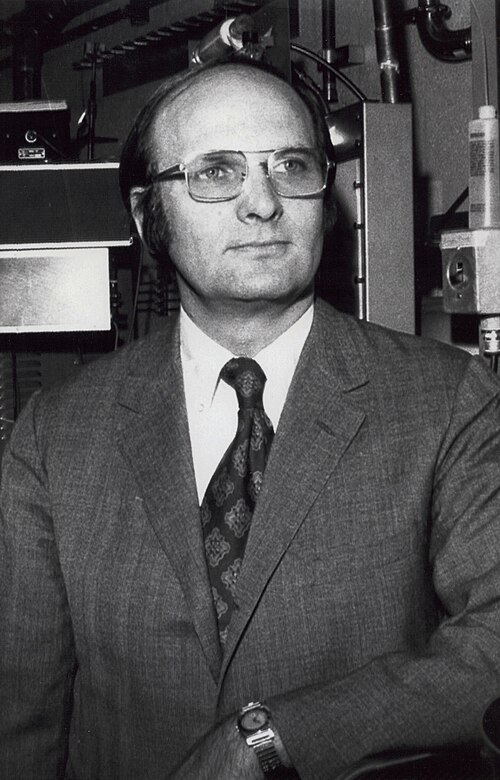
图:佚名 · CC BY-SA 3.0 nl · 维基共享资源
- 生卒
- 1931 年 5 月 31 日—2019 年 7 月 27 日
- 出生地
- 奥克帕克
- 去世地
- 塔拉赫西
- 国籍 / 所属
- 美国
- 身份
- 物理学家、大学教师
- 原文名
- John Robert Schrieffer
- 就读
- 麻省理工学院、伊利诺伊大学厄巴纳-香槟分校、Eustis High School
- 任职机构
- 宾夕法尼亚大学、芝加哥大学、伯明翰大学、加利福尼亚大学圣巴巴拉分校、洛斯阿拉莫斯国家实验室、伊利诺伊大学厄巴纳-香槟分校 等 8 项
- 所属组织
- 俄罗斯科学院、美国国家科学院、美国文理科学院、美国哲学会、美国物理学会、丹麦皇家科学院 等 7 项
- 领域
- 物理学、超导现象
- 简述
- 物理学家, 美国
约翰·罗伯特·施里弗(英语:John Robert Schrieffer,1931年5月31日—2019年7月27日)是一名美国物理学家。他因为与约翰·巴丁和利昂·库珀共同创立了超导微观理论,即BCS理论,于1972年共同荣获诺贝尔物理学奖。
详细介绍
生平
1953年麻省理工学院物理学士(原就读电机,大三改修物理),毕业后因对固态物理兴趣,赴伊利诺伊大学厄巴纳-香槟分校师从约翰·巴丁。
正文摘自中文维基百科「约翰·施里弗」(删去了参考文献、表格和图片),按 CC BY-SA 4.0 使用
英文维基百科的更多内容
中文维基百科这一条比较短,下面是英文维基百科同一条目的节选,原文为英文,未翻译。
John Robert Schrieffer ( SHREE-fer; May 31, 1931 – July 27, 2019) was an American theoretical physicist who received the 1972 Nobel Prize in Physics along with John Bardeen and Leon Cooper for developing the BCS theory, the first successful quantum description of superconductivity.
Early life and education
John Robert Schrieffer was born on May 31, 1931, in Oak Park, Illinois, the son of Louise (née Anderson) and John Henry Schrieffer. His family moved in 1940 to Manhasset, New York, and then in 1947 to Eustis, Florida, where his father, a former pharmaceutical salesman, began a career in the citrus industry. In his Florida days, Schrieffer enjoyed playing with homemade rockets and ham radio, a hobby that sparked an interest in electrical engineering.
After graduating from Eustis High School in 1949, Schrieffer was admitted to the Massachusetts Institute of Technology (MIT), where for two years he majored in electrical engineering before switching to physics in his junior year. He completed a bachelor's thesis on multiplets in heavy atoms under the direction of John C. Slater in 1953. Pursuing his interest in condensed-matter physics, Schrieffer began graduate studies at the University of Illinois at Urbana-Champaign, where he was hired immediately as a research assistant to John Bardeen. After working out a theoretical problem of electrical conduction on semiconductor surfaces, Schrieffer spent a year in the laboratory, applying the theory to several surface problems. In his third year of graduate studies, he joined Bardeen and Leon Cooper in developing the theory of superconductivity.
Research and career
Schrieffer recalled that in January 1957 he was on a subway train in New York City when he had an idea of how to describe mathematically the ground state of superconducting electrons. Schrieffer and Bardeen's collaborator Cooper had discovered that electrons in a superconductor are grouped in pairs, now called Cooper pairs, and that the motions of all Cooper pairs within a single superconductor are correlated and function as a single entity due to phonon-electron interactions. Schrieffer's mathematical breakthrough was to describe the behavior of all Cooper pairs at the same time, instead of each individual pair. The day after returning to Illinois, Schrieffer showed his equations to Bardeen, who immediately realized they were the solution to the problem. The Bardeen–Cooper–Schrieffer or BCS theory of superconductivity, as it is now known, accounted for more than 30 years of experimental results that had stymied some of the greatest theorists in physics.
After completing his doctoral thesis on the theory of superconductivity, Schrieffer spent the 1957–1958 academic year as a National Science Foundation fellow at the University of Birmingham in England and at the Niels Bohr Institute in Denmark, where he continued research into superconductivity. Following a year as an assistant professor at the University of Chicago, he returned to the University of Illinois in 1959 as a faculty member. In 1960, he went back to the Bohr Institute for a summer visit, during which he became engaged to Anne Grete Thomsen, whom he married at Christmas of that year. They had three children, Bolette, Paul, and Regina. Two years later, Schrieffer joined the faculty of the University of Pennsylvania in Philadelphia. In 1964, Schrieffer published his book on the BCS theory, Theory of Superconductivity.
Later life and death
On September 24, 2004, while driving with a suspended license, Schrieffer was involved in an automobile accident that killed one person and injured seven others. Schrieffer was said to have fallen asleep at the wheel of his car. On November 6, 2005, he was sentenced to two years in prison for vehicular manslaughter. Schrieffer was incarcerated in Richard J. Donovan Correctional Facility at Rock Mountain near San Diego, California.
Schrieffer died on July 27, 2019, at a nursing facility in Florida while sleeping. He was 88 years old. He was a Christian.
正文摘自英文维基百科(原文为英文,未翻译)「John Robert Schrieffer」(节选,删去了参考文献、表格和图片),按 CC BY-SA 4.0 使用;在维基百科读全文 ›
同时代、同地区的人物





同时代、同身份的人物(思想与学术)