史鉴
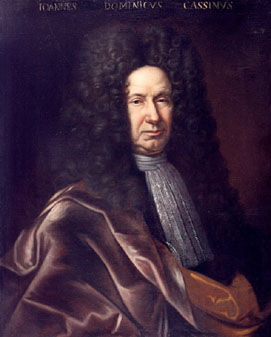
图:佚名 · Public domain · 维基共享资源
- 生卒
- 1625 年 6 月 8 日—1712 年 9 月 14 日
- 出生地
- 佩里纳尔多
- 去世地
- 巴黎
- 身份
- 天文学家、工程师、占星家、数学家、土地测量师、生物学家、月面学家
- 职位
- 主管
- 配偶
- Geneviève de Laistre
- 子女
- 雅克·卡西尼
- 代表作
- 卡西尼环缝、卡西尼卵形线、卡西尼定律、Cassini's identity
- 原文名
- Giovanni Domenico Cassini
- 家族
- 卡西尼家族
- 就读
- 博洛尼亚大学、圣盎博罗削圣安德肋耶稣教堂、Panzano Observatory
- 任职机构
- 博洛尼亚大学、巴黎天文台
- 所属组织
- 英国皇家学会、法国科学院
- 领域
- 天文学
- 简述
- Italian/French mathematician, astronomer, engineer, and astrologer (*1625 – †1712)
乔瓦尼·多梅尼科·卡西尼(意大利语:Giovanni Domenico Cassini,1625年6月8日—1712年9月14日),法文名让-多米尼克·卡西尼(法语:Jean-Dominique Cassini),是一位在热那亚共和国(今意大利境内)出生的法国籍天文学家和水利工程师。
卡西尼1625年出生于热那亚共和国的佩里纳尔多(即今意大利因佩里亚省佩里纳尔多),在1648年至1669年期间曾在旁扎诺天文台工作。1640年起,担任博洛尼亚大学天文学教授,并在1671年巴黎天文台落成后成为该台的第一任总监直到去世。1673年加入法国国籍,改名为法文,即让-多米尼克·卡西尼,又称卡西尼一世(Cassini Ier,其曾孙与其同名,称卡西尼二世)。
卡西尼被认为与胡克同时发现了大红斑(1665年)。卡西尼是第一个发现土星的四个卫星(土卫八、土卫五、土卫四、土卫三)的人。1690年,他在观测木星的大气层时发现木星赤道旋转得比两极快,因此发现了木星的差异自转。1675年,他发现土星光环中间有条暗缝,这就是后来以他名字命名的著名的卡西尼环缝。他猜测,光环是由无数小颗粒构成。两个多世纪后的分光观测证实了他的猜测。1671年到1679年,他仔细观测了月球的表面特征,1679年送呈法国皇家科学院一份大幅月面图,在一个多世纪内始终没人能在这方面超过他。1683年3月起,卡西尼研究了黄道光,认为它是由于行星际尘埃反射太阳光引起的,不属于大气现象。
卡西尼是一位保守的天文学家,他拒绝接受哥白尼的日心说,也反对开普勒定律、艾萨克·牛顿的万有引力定律和光速有限说。卡西尼于1711年失明,次年(1712年)逝世于法国巴黎。除了天文学的贡献以外,他亦曾被教宗委任治理波河的防治、管理及防汛工程。
当代人类探测土星的探测器“卡西尼号”即以他的名字命名。
正文摘自中文维基百科「乔瓦尼·多梅尼科·卡西尼」(删去了参考文献、表格和图片),按 CC BY-SA 4.0 使用
英文维基百科的更多内容
中文维基百科这一条比较短,下面是英文维基百科同一条目的节选,原文为英文,未翻译。
Giovanni Domenico Cassini (8-11 June 1625 – 14 September 1712) was an Italian-French mathematician, astronomer, astrologer and engineer. Cassini was born in Perinaldo, near Imperia, at that time in the County of Nice, part of the Savoyard state. He discovered four satellites of Saturn and noted the division of its rings, later named the Cassini Division. Cassini was also the first of his family to begin work on the project of creating a topographic map of France. In addition, he also created the first scientific map of the Moon.
The Cassini space probe, launched in 1997, was named after him and became the fourth to visit Saturn and the first to orbit it.
Life
Time in Italy
Cassini was the son of Jacopo Cassini, a Tuscan, and Giulia Crovesi. In 1648 Cassini accepted a position at the observatory at Panzano (Castelfranco Emilia), near Bologna, to work with Marquis Cornelio Malvasia, a rich amateur astronomer, initiating the first part of his career. During his time at the Panzano Observatory, Cassini was able to complete his education under the scientists Giovanni Battista Riccioli and Francesco Maria Grimaldi. In 1650 the senate of Bologna appointed him as the principal chair of astronomy at the University of Bologna.
While in his position in Bologna, he observed and wrote a book on the comet of 1652.……
Moving to France
Cassini's determinations of the rotational periods of Jupiter and Mars in 1665–1667 enhanced his fame, and in 1669, with the reluctant assent of the Pope, he moved to France and through a grant from Louis XIV, the "Sun King" of France, helped to set up the Paris Observatory, which opened in 1671;……
Astronomer
Cassini observed and published surface markings on Mars (earlier seen by Christiaan Huygens but not published), determined the rotation periods of Mars and Jupiter, and discovered four satellites of Saturn: Iapetus and Rhea in 1671 and 1672, and Tethys and Dione (1684). Cassini was the first to observe these four moons, which he called Sidera Lodoicea (the stars of Louis), including Iapetus, whose anomalous variations in brightness he correctly ascribed as being due to the presence of dark material on one hemisphere (now called Cassini Regio in his honour). In addition, he discovered the Cassini Division in the rings of Saturn in 1675.……
Astrologer
Attracted to the heavens in his youth, his first interest was in astrology. While young he read widely on the subject, and soon was very knowledgeable about it; this extensive knowledge of astrology led to his first appointment as an astronomer. Later in life he focused almost exclusively on astronomy and all but denounced astrology as he became increasingly involved in the Scientific Revolution.
In 1645 the Marquis Cornelio Malvasia, a senator of Bologna with a great interest in astrology, invited Cassini to Bologna and offered him a position in the Panzano Observatory, which he was constructing at that time.……
Engineering
In 1653, Cassini, wishing to employ the use of a meridian line, sketched a plan for a new and larger meridian line but one that would be difficult to build. His calculations were precise; the construction succeeded perfectly; and its success gave Cassini a brilliant reputation for working with engineering and structural works.
Cassini was employed by Pope Clement IX in regard to fortifications, river management, and flooding of the Po River. "Cassini composed several memoirs on the flooding of the Po River and on the means of avoiding it;……
Works
Specimen observationum Bononiensium (in Latin). Bologna: eredi Evangelista Dozza (1.). 1656.
Martis circa axem proprium revolubilis observationes Bononiae habitae (in Latin). Bologna: eredi Evangelista Dozza (1.). 1666.
Spina celeste meteora osservata in Bologna il mese di marzo 1668 (in Italian). Bologna: Emilio Maria Manolessi & fratelli. 1668.
Observations astronomiques faites en divers endroits du royaume, pendant l'année 1672 (in French).
Abregé des observations et des reflections sur la comete qui a paru au mois de Decembre 1680, et aux mois de Ianvier, Fevrier et Mars de cette annee 1681 (in French). Paris: Estienne Michallet. 1681.
正文摘自英文维基百科(原文为英文,未翻译)「Giovanni Domenico Cassini」(节选,删去了参考文献、表格和图片),按 CC BY-SA 4.0 使用;在维基百科读全文 ›
同时代、同地区的人物





同时代、同身份的人物(科学与发明)