史鉴
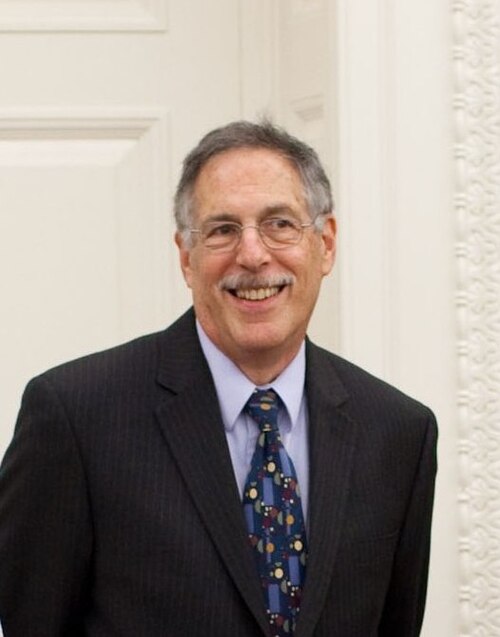
图:The White House from Washington, DC · Public domain · 维基共享资源
- 生卒
- 1940 年 4 月 29 日
- 出生地
- 纽约
- 国籍 / 所属
- 美国
- 身份
- 教授、经济学家、大学教师
- 职位
- 总统
- 原文名
- Peter A. Diamond
- 就读
- 麻省理工学院、耶鲁大学、劳伦斯高中
- 任职机构
- 麻省理工学院、加州大学伯克利分校
- 所属组织
- 美国科学进步协会、美国国家科学院、美国文理科学院、经济计量学会
- 领域
- 政治经济学、行为经济学、福利经济学
- 简述
- 经济学家, 美国
彼得·阿瑟·戴蒙德(英语:Peter Arthur Diamond,1940年4月29日—),美国犹太裔经济学家、麻省理工学院教授,知名于最优税收理论研究。2010年,他与戴尔·莫滕森、克里斯托弗·皮萨里德斯共获诺贝尔经济学奖,表彰他在“对于存在搜索摩擦情况的市场的分析”的贡献。
详细介绍
经历
戴蒙德于1960年获耶鲁大学数学学士学位,后于1963年获麻省理工学院博士学位。1964至1965年间,他在加州大学伯克利分校任助理教授。其后,他回母校麻省理工学院任教,1966年升为副教授、1970年升任教授。1985至1986年间,曾任麻省理工学院经济学院院长。1997年,他获得学院教授(Institute Professor)称号。
2003年,他曾担任美国经济学会(American Economic Association)主席。他还是美国科学院院士与美国文理科学院院士。
正文摘自中文维基百科「彼得·戴蒙德」(删去了参考文献、表格和图片),按 CC BY-SA 4.0 使用
英文维基百科的更多内容
中文维基百科这一条比较短,下面是英文维基百科同一条目的节选,原文为英文,未翻译。
Peter Arthur Diamond (born April 29, 1940) is an American economist known for his analysis of U.S. Social Security policy and his work as an advisor to the Advisory Council on Social Security in the late 1980s and 1990s. He was awarded the Nobel Memorial Prize in Economic Sciences in 2010, along with Dale T. Mortensen and Christopher A. Pissarides. He is an Institute Professor at the Massachusetts Institute of Technology. On June 6, 2011, he withdrew his nomination to serve on the Federal Reserve's board of governors, citing intractable Republican opposition for 14 months.
Early life and education
Diamond was born to a Jewish family in New York City. His grandparents immigrated to the U.S. at the turn of the 20th century. His mother's parents and six older siblings came from Poland. His father's parents met in New York, she came from Russia and he came from Romania. His parents, both born in 1908, grew up in New York City and never lived outside the metropolitan area. Both finished high school and went to work, his father studying at Brooklyn Law School at night while selling shoes during the day. They married in 1929. He has one brother, Richard, born in 1934.
He started public school in the Bronx, and switched to suburban public schools in the second grade when the family moved to Woodmere, on Long Island. He eventually graduated from Lawrence High School. He earned a bachelor's degree summa cum laude in mathematics from Yale University (1960), and a Ph.D. at the Massachusetts Institute of Technology (1963).
Career
He was an assistant professor at the University of California, Berkeley, from 1963 to 1965 and an acting associate professor there before joining the MIT faculty as an associate professor in 1966. Diamond was promoted to full professor in 1970, served as head of the Department of Economics in 1985–86 and was named an Institute Professor in 1997.
In 1968, Diamond was elected a fellow and served as president of the Econometric Society. In 2003, he served as president of the American Economic Association. He is a Fellow of the American Academy of Arts and Sciences (1978), a member of the National Academy of Sciences (1984), and is a founding member of the National Academy of Social Insurance (1988). Diamond was the 2008 recipient of the Robert M. Ball Award for Outstanding Achievements in Social Insurance, awarded by NASI. As a Fulbright Distinguished Chair, in 2000 he taught economics at the University of Siena.
Diamond wrote a book on Social Security with Peter R. Orszag, President Obama's former director of the Office of Management and Budget, titled Saving Social security: a balanced approach (2004,-5, Brookings Institution Press). An earlier paper from Brookings Institution introduced their ideas.
Professional activity
Diamond's career has covered public finance, taxation, Social Security, labor markets, and behavioral economics.
Dynamic inefficiency
Diamond (1965) extended the Ramsey–Cass–Koopmans model, from a representative infinitely-lived agent to a setup where new individuals are continually being born and old individuals are continually dying. He built on a framework developed by Paul Samuelson, who had termed it "an exact consumption-loan model."
Since individuals born at different times attain different utility levels, it is not clear how to evaluate social welfare. One of the main results of this paper is that the decentralized equilibrium might not be dynamically Pareto efficient, even though markets are competitive and externalities are absent. In particular, depending on the preferences and technology, the economy might find itself saving too much, pushing the capital stock above what Edmund Phelps called the Golden Rule level. In this situation, government debt can crowd out capital and, in doing so, increase welfare.
Diamond–Mirrlees production efficiency result
The Diamond–Mirrlees production efficiency result follows from a set of assumptions which characterise what can be called a 'DM world'.
- It is characterised by 7 assumptions:
- i) perfect competition
- ii) constant returns to scale to production
正文摘自英文维基百科(原文为英文,未翻译)「Peter Diamond」(节选,删去了参考文献、表格和图片),按 CC BY-SA 4.0 使用;在维基百科读全文 ›
同时代、同地区的人物








同时代、同身份的人物(思想与学术)