 史鉴
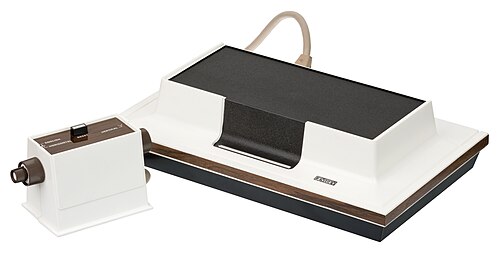
图:Evan-Amos · Public domain · 维基共享资源
- 时间
- 1972 年 9 月
- 类型
- 特定历史
- 简述
- aspect of history
The history of video game consoles, both home and handheld, began in the 1970s. The first console that played games on a television set was the 1972 Magnavox Odyssey, first conceived by Ralph H. Baer in 1966. Handheld consoles originated from electro-mechanical games that used mechanical controls and light-emitting diodes (LED) as visual indicators. Handheld electronic games had replaced the mechanical controls with electronic and digital components, and with the introduction of liquid-crystal display (LCD) to create video-like screens with programmable pixels, systems like the 1979 Microvision and the 1980 Game & Watch became the first handheld video game consoles.
Since then, home game consoles have progressed through technology cycles typically referred to as generations. Each generation has lasted approximately five years, during which the major console manufacturers have released consoles with broadly similar specifications. Handheld consoles have seen similar advances, and are usually grouped into the same generations as home consoles.
While early generations were led by former manufacturers like Atari and Sega, the modern home console industry is dominated by Nintendo, Sony, and Microsoft, colloquially known as the "big three". The handheld market has waned since the introduction of mobile gaming in the late 2000s, and today, the only major manufacturer in handheld gaming is Nintendo.
详细介绍
Origins
Home consoles
The first video games were created on mainframe computers in the 1950s, typically with text-only displays or computer printouts, and limited to simple games like Tic Tac Toe or Nim. Eventually displays with rudimentary vector displays for graphics were available, leading to titles like Spacewar! in 1962. Spacewar! directly influenced Nolan Bushnell and Ted Dabney to create Computer Space in 1971, the first arcade video game.
Separately, while at Sanders Associates in 1966, Ralph H. Baer conceived of the idea of an electronic device that could be connected to a standard television to play games. With Sanders' permission, he created the prototype "Brown Box" which was able to play a limited number of games, including a version of table tennis and a simple light gun game. Sanders patented the unit and licensed the patents to Magnavox, where it was manufactured as the first home video game console, the Magnavox Odyssey, in 1972. Bushnell, after seeing the Odyssey and its table tennis game, believed he could make something better. He and Dabney formed Atari, Inc., and with Allan Alcorn, created their second arcade game, Pong.……
Handheld consoles
The origins of handheld game consoles are found in handheld and tabletop electronic game devices of the 1970s and early 1980s.……
Console generations
Like most consumer electronics, home video game consoles are developed based on improving the features offered by an earlier product with advances made by newer technology. For video game consoles, these improvements typically occur every five years, following a Moore's law progression where a rough aggregate measure of processing power doubles every 18 months or increases ten-fold after five years. This cyclic market has resulted in an industry-wide adoption of the razor-and-blades model in selling consoles at minimal profit margin while making revenue from the sale of games produced for that console, and then transitioning users to the next console model at the fifth year as the successor console enters the market. This approach incorporates planned obsolescence into the products to continue to bring consumers towards purchasing the newer models.
Because of the industry dynamics, many console manufacturers release their new consoles in roughly the same time period, with their consoles typically offering similar processing power and capabilities as their competitors.……
Home console history timeline by generation
The development of video game consoles primarily follows the history of video gaming in the North American and Japanese markets. Few other markets saw any significant console development on their own, such as in Europe where personal computers tended to be favored alongside imports of video game consoles. The video game clone in less-developed markets like China and Russia were not considered here.
The following table provides an overview of the major hardware technical specifications of the consoles of each major generations by central processor unit (CPU), graphics processor unit (GPU), memory, game media, and other features.
While there is no similar distinction of generations for handheld consoles, they are included in the sections below based on which home console generation they were released.
First generation (1972–1983)
The first generation of home consoles were generally limited to dedicated consoles with just one or two games pre-built into the console hardware, with a limited means to alter gameplay factors.……
Console sales
Below is a timeline of each generation with the top three home video consoles of each generation based on worldwide sales.
正文摘自英文维基百科(原文为英文,未翻译)「History of video game consoles」(节选,删去了参考文献、表格和图片),按 CC BY-SA 4.0 使用;在维基百科读全文 ›
同时期的同类事件(时代与时期)
- 冷战1945 年—1991 年 12 月 25 日 · 时代与时期 · 跨地区
- 21世纪2001 年 1 月 1 日—2100 年 12 月 31 日 · 时代与时期
- 南非种族隔离1948 年—1991 年 · 时代与时期
- 华沙条约组织1955 年 5 月 14 日—1991 年 7 月 1 日 · 时代与时期
- 铁幕1946 年 3 月 5 日—1989 年 8 月 19 日 · 时代与时期 · 欧洲
- 东柏林1949 年—1990 年 10 月 2 日 · 时代与时期 · 欧洲
- 东方集团1944 年—1990 年 · 时代与时期
- 哥伦比亚革命武装力量1964 年—2016 年 · 时代与时期 · 拉丁美洲
- 北爱尔兰问题1960 年代—1998 年 · 时代与时期 · 欧洲
- 同盟国军事占领德国1945 年—1949 年 5 月 23 日 · 时代与时期 · 欧洲
- 大灾难 (巴勒斯坦)1948 年 · 时代与时期 · 西亚
- 平成1989 年 1 月 8 日—2019 年 4 月 30 日 · 时代与时期 · 东亚