 史鉴
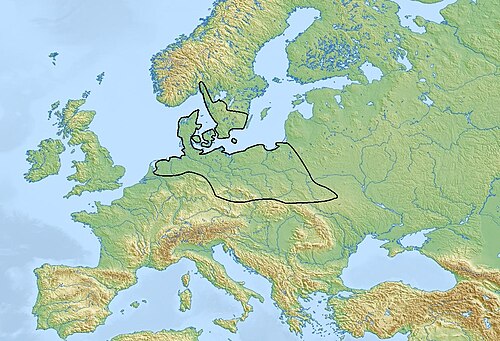
图:Krakkos · CC BY-SA 4.0 · 维基共享资源
- 时间
- 公元前 4200 年代—公元前 2800 年代 (Wikidata 的日期只记到十年,非确切年份)
- 地点
- 中欧
- 属于
- 新石器时代
- 后一事件
- 双耳细颈椭圆尖底陶器文化
- 类型
- 考古学文化、人口群
- 简述
- archaeological culture
漏斗杯文化是公元前4300年至公元前2800年期间欧洲中北部的一种考古学文化。漏斗杯文化的名字来自于人们在这一时期的墓葬中发现的具有漏斗状的陶器。漏斗杯文化后来被绳纹器文化取代。
正文摘自中文维基百科「漏斗杯文化」(删去了参考文献、表格和图片),按 CC BY-SA 4.0 使用
英文维基百科的更多内容
中文维基百科这一条比较短,下面是英文维基百科同一条目的节选,原文为英文,未翻译。
The Funnel(-neck-)beaker culture, in short FBC, TRB or TBK (German: Trichter(-rand-)becherkultur, Dutch: Trechterbekercultuur; Danish: Tragtbægerkultur; c. 4100–2800 BCE), was an archaeological culture in north-central Europe.
It developed as a technological merger of local neolithic and mesolithic techno-complexes between the lower Elbe and middle Vistula rivers. These predecessors were the (Danubian) Lengyel-influenced Stroke-ornamented ware culture (STK) groups/Late Lengyel and Baden-Boleráz in the southeast, Rössen groups in the southwest and the Ertebølle-Ellerbek groups in the north. The TRB introduced farming and husbandry as major food sources to the pottery-using hunter-gatherers north of this line.
The TRB techno-complex is divided into a northern group including Northern Germany and southern Scandinavia (TRB-N, roughly the area that previously belonged to the Ertebølle-Ellerbek complex), a western group in the Netherlands between the Zuiderzee and lower Elbe that originated in the Swifterbant culture, an eastern group centered on the Vistula catchment, roughly ranging from Oder to Bug, and south-central groups (TRB-MES, Altmark) around the middle and upper Elbe and Saale. Especially in the southern and eastern groups, local sequences of variants emerged. In the late 4th millennium BCE, the Globular Amphora culture (GAC) replaced most of the eastern and subsequently also the southern TRB groups, reducing the TRB area to modern northern Germany and southern Scandinavia.
The younger TRB in these areas was superseded by the Single Grave culture (EGK) at about 2800 BCE.
The north-central European megaliths were built primarily during the TRB era.
Nomenclature
The Funnelbeaker culture is named for its characteristic ceramics, beakers and amphorae with funnel-shaped tops, which were found in dolmen burials.
History
The Funnelbeaker culture emerged in northern modern-day Germany c. 4100 BCE. Archaeological evidence strongly suggests that it originated through a migration of colonists from the Michelsberg culture of Central Europe.……
Distribution
The TRB ranges from the Elbe catchment in Germany and Bohemia with a western extension into the Netherlands, to southern Scandinavia (Denmark up to Uppland in Sweden and the Oslofjord in Norway) in the north, and to the Vistula catchment in Poland and the area between Dnister and Western Bug headwaters in Ukraine in the east.
Characteristics
Settlements
With the exception of some inland settlements such as the Alvastra pile-dwelling, the settlements are located near those of the previous Ertebølle culture on the coast. It was characterized by single-family daubed houses c. 12 m x 6 m.
Economy
Studies on plant use at Funnel Beaker sites are biased by the scarcity of sites with waterlogged preservation.……
Ethnicity
In the context of the Kurgan hypothesis (or steppe hypothesis), the culture is seen as non-Indo-European, representing a culture of Neolithic origin, as opposed to the Indo-European-language-speaking peoples (see Yamna culture) who later intruded from the east.
Genetics
Ancient DNA analysis has found the people who produced the Funnelbeaker culture to be genetically different from earlier hunter-gather inhabitants of the region, and are instead closely related to other European Neolithic farmers, who ultimately traced most of their ancestry from early farmers in Anatolia, with some admixture from European hunter-gatherer groups.……
正文摘自英文维基百科(原文为英文,未翻译)「Funnelbeaker culture」(节选,删去了参考文献、表格和图片),按 CC BY-SA 4.0 使用;在维基百科读全文 ›