 史鉴
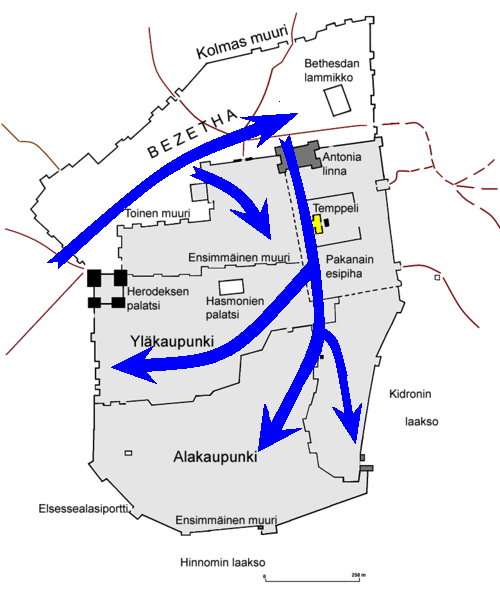
图:User:Barosaurus Lentus · CC BY-SA 3.0 · 维基共享资源
- 时间
- 70 年 2 月—70 年 9 月 8 日
- 地点
- 耶路撒冷
- 属于
- 犹太战争
- 类型
- 攻城战
- 简述
- siege of Jerusalem in 70 AD by the Roman army
耶路撒冷围城战是第一次犹太–罗马战争期间的一场战役,当时提图斯率领下的罗马帝国军队围攻耶路撒冷。经过五个月的围困后,罗马帝国军队攻入耶路撒冷,并摧毁该城市以及第二圣殿。
70年4月,当时正值逾越节的前三天,罗马帝国军队开始围攻耶路撒冷 。在开始围攻后的三周内,罗马军队就攻破了城市的最外围的两堵城墙,但但犹太人依然在第三堵城墙和安东尼亚堡垒对抗罗马帝国。
70年8月30日,罗马军队攻入耶路撒冷并放火焚烧了第二圣殿。 犹太人继续抵抗一个月,但最终整个耶路撒冷被占领,城市被夷为平地。提图斯只留下了希律堡的三座塔楼。罗马帝国当局为了庆祝攻占耶路撒冷,在罗马举办凯旋仪式,并修建两座凯旋门以示纪念。罗马帝国当局还向公众展出从第二圣殿抢来的宝物。
战争结束后,罗马帝国在耶路撒冷废墟上建立第十海峡军团的军营以及罗马殖民地爱利亚加比多连。犹太人被禁止进入耶路撒冷。这一系列的举措通常被认为是巴尔科赫巴起义的导火索之一。
正文摘自中文维基百科「耶路撒冷围城战 (70年)」(删去了参考文献、表格和图片),按 CC BY-SA 4.0 使用
英文维基百科的更多内容
中文维基百科这一条比较短,下面是英文维基百科同一条目的节选,原文为英文,未翻译。
The siege of Jerusalem in 70 CE was the decisive event of the First Jewish Revolt against the Roman Empire (66–73 CE). Roman forces led by Titus, son of the emperor Vespasian, besieged Jerusalem, the Jewish capital and the revolt's main stronghold. After months of fighting, they breached the defenses, destroyed the Second Temple, and razed the city. Much of its population was killed, enslaved, or displaced by the Romans. The city's fall marked the effective end of the revolt and a turning point in Jewish history.
In winter 69–70, following a respite in the revolt's suppression caused by a succession war in Rome, Titus led four legions and auxiliary forces, numbering at least 48,200 soldiers, back into Judaea. By spring, this army had encircled Jerusalem, whose population had swollen with refugees and Passover pilgrims. Inside the city, rival factions led by John of Gischala, Simon bar Giora, and Eleazar ben Simon fought each other, destroying the city's food supplies and weakening its defenses. The factions eventually united and mounted fierce resistance, but the Romans breached the walls and drove the defenders into the Temple precincts.
In the month of Av (July/August), the Romans captured the Temple Mount and destroyed the Second Temple—an event commemorated annually in Judaism on Tisha B'Av. The rest of Jerusalem fell in the following weeks, and the Romans systematically demolished most of the city. A year later, Titus and Vespasian celebrated the victory with a triumph in Rome, parading Temple spoils—including the menorah—alongside hundreds of captives. The victory was later commemorated in monuments such as the Arch of Titus and on the Judaea capta coinage.
Background
Jerusalem on the eve of the revolt
Jerusalem was a prosperous city during the first century CE, serving as the religious and political center of Jewish life both in Judaea and the diaspora.……
Jerusalem's defenses
Jerusalem was bounded by the Kidron Valley to the east and the Hinnom Valley to the south and west.……
Titus's march on Jerusalem and early engagements
In winter 69/70, Titus marched from Egypt through the coastal plain to Caesarea Maritima, where he established his main base.……
Battle for Jerusalem's walls
On 14 Nisan, the start of the Passover festival, the Romans took advantage of a temporary halt in Jewish attacks to move their siege forces closer to Jerusalem's walls.……
From Antonia to the Temple Mount
When hostilities resumed, Titus constructed siege ramps at the Antonia Fortress and against the towers of the Upper City, while also employing psychological warfare. He staged a four-day parade of cavalry and infantry in polished armor and distributed their pay in view of the walls.……
Destruction of the Second Temple
According to Josephus, on 8 Av (July/August), two legions completed their ramps against the Temple. When the battering rams failed to breach the masonry, Titus ordered the gates set alight; the fire spread through the porticoes, and the outer court fell into Roman hands.……
Conquest of the Lower and Upper City
After the Temple's destruction, some rebels sought a parley with Titus, meeting on a bridge overlooking the ruins, possibly at what is now Wilson's Arch.……
Destruction of Jerusalem
By early September, the conquest of Jerusalem was complete. According to Josephus, Titus ordered the city razed, except for a few structures:
Captives and executions
After Jerusalem's fall, Titus ordered the killing of those who continued to resist, though many elderly and infirm prisoners were massacred as well, despite his orders to the contrary.……
Aftermath
Casualties, enslavement, and displacement
During the siege of Jerusalem and its aftermath, the population suffered mass extermination. Josephus claims that 1.1 million people died in the siege, mostly Jews who came for Passover and became trapped in the city as pilgrims kept arriving despite the revolt.……
Triumph and mop-up operations
in the summer of 71, about a year after Jerusalem's fall, Titus and Vespasian held a triumph in Rome celebrating their victory in Judaea.……
Jewish responses
The destruction of the Second Temple marked a turning point in Jewish history, transforming Jewish identity and practice. With the loss of its religious and national center, Judaism had to adapt to displacement and uncertainty.……
Apocalyptic literature
The destruction prompted a resurgence of Jewish apocalyptic literature, which sought to interpret the destruction of the Temple and expressed hopes for its restoration.……
Legacy and cultural impact
In Jewish tradition and culture
The destruction of Jerusalem marked a profound turning point for the Jewish people, and Jewish political control over the city would not resume until the 20th century. Even so, Jerusalem remained central to Jewish religious life and identity throughout this long period.……
正文摘自英文维基百科(原文为英文,未翻译)「Siege of Jerusalem (70 CE)」(节选,删去了参考文献、表格和图片),按 CC BY-SA 4.0 使用;在维基百科读全文 ›
同时期、同地区的大事
- 犹太战争66 年—74 年 · 革命与起义 · 西亚