 史鉴
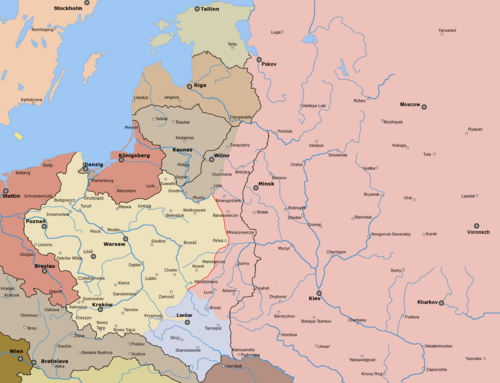
图:佚名 · CC BY-SA 3.0 · 维基共享资源
- 时间
- 1918 年 11 月 1 日—1919 年 7 月 17 日
- 地点
- 东欧
- 参与方
- 波兰第二共和国、西乌克兰人民共和国
- 属于
- 乌克兰独立战争
- 类型
- 战争
- 简述
- 1918–1919 conflict between the Second Polish Republic and West Ukrainian People's Republic
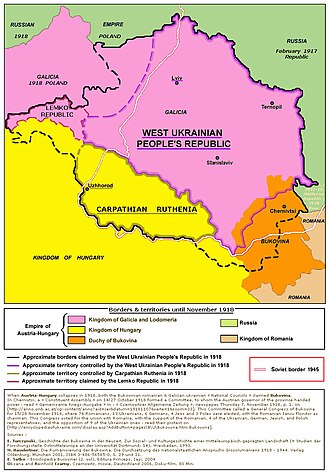
波乌战争发生于波兰第二共和国时期。当时重生后的波兰与要求独立的乌克兰人,在东加利西亚皆有居民,双方为了争夺该地的主权,进行了一场历时八个月的战争。这场战事以一连串的利沃夫冲突为开端,最后以非正式的停战协议收场。乌克兰人并没有放弃独立的主张,但变更东边国界对波兰人来说,也完全不在考量之内。1923年3月15日,大使会议承认了波兰在东加利西亚的主权,但是波兰必须让这个地区拥有自治地位。1922年9月,波兰针对这个地区颁布了自治省法,而此法的名称本身,便说明了东加利西亚地区在波兰这个国家里的特殊地位。
正文摘自中文维基百科「波乌战争」(删去了参考文献、表格和图片),按 CC BY-SA 4.0 使用
英文维基百科的更多内容
中文维基百科这一条比较短,下面是英文维基百科同一条目的节选,原文为英文,未翻译。
The Polish–Ukrainian War, from November 1918 to July 1919, was a conflict between the Second Polish Republic and Ukrainian forces (both the West Ukrainian People's Republic and the Ukrainian People's Republic).
The conflict had its roots in ethnic, cultural, and political differences between the Polish and Ukrainian populations living in the region, as Poland and both Ukrainian republics emerged from the collapse of the Russian and Austrian empires.
The war started in Eastern Galicia after the dissolution of the Austro-Hungarian Empire and spilled over into the Chełm and Volhynia regions formerly belonging to the Russian Empire.
Poland won the disputed territory on 18 July 1919.
Background
The origins of the conflict lie in the complex nationality situation in Galicia at the turn of the 20th century. As a result of the House of Habsburg's relative leniency toward national minorities, Austria-Hungary was the perfect ground for the development of both Polish and Ukrainian national movements.……
Prelude
Due to the intervention of Archduke Wilhelm of Austria, who adopted a Ukrainian identity and considered himself a Ukrainian patriot, in October 1918 two regiments of mostly Ukrainian troops were garrisoned in Lemberg (modern Lviv).……
War
Initial stages
Fighting between Ukrainian and Polish forces was concentrated around the declared Ukrainian capital of Lviv and the approaches to that city. In Lviv, the Ukrainian forces were opposed by local self-defence units formed mostly of World War I veterans, students and children. However, skillful command, good tactics and high morale allowed Poles to resist the poorly planned Ukrainian attacks.……
Diplomatic front
The Polish and Ukrainian forces struggled on the diplomatic as well as military fronts both during and after the war. The Ukrainians hoped that the western allies of World War I would support their cause because the Treaty of Versailles that ended the first world war was based on the principle of national self-determination.……
Civilian casualties
Historian Christoph Mick states there was no systematic violence nor massacres of ethnic Poles by Ukrainians during the course of this war but that both sides blamed each other for bloodshed. When Ukrainian forces first captured Lwów they refused to take hostages, tolerated Polish recruitment centers and were even prepared to enter negotiations with the Polish side, but were met with armed resistance.……
Aftermath
Approximately 10,000 Poles and 15,000 Ukrainians, mostly soldiers, died during this war. Ukrainian POWs were kept in ex-Austrian POW camps in Dąbie (Kraków), Łańcut, Pikulice, Strzałków, and Wadowice.
Both sides conducted mass arrests of civilians. By July 1919, as many as 25,000 Poles ended up in Ukrainian internment camps, in Zhovkva, Zolochiv, Mykulyntsi, Strusiv, Yazlovets, Kolomyya and Kosiv.……
Legacy
Although the 70 to 75 thousand men who fought in the Ukrainian Galician Army lost their war, and Galicia became Polish, the experience of proclaiming a Ukrainian state and fighting for it significantly intensified and deepened the nationalistic Ukrainian orientation within Galicia. Since the interwar era, Galicia has been the center of Ukrainian nationalism.
正文摘自英文维基百科(原文为英文,未翻译)「Polish–Ukrainian War」(节选,删去了参考文献、表格和图片),按 CC BY-SA 4.0 使用;在维基百科读全文 ›
下属事件
相关人物
相关政权
同时期、同地区的大事
- 犹太人大屠杀1933 年—1945 年 · 屠杀与暗杀 · 欧洲
- 大萧条1929 年 10 月 29 日—1941 年 · 时代与时期 · 欧洲
- 凡尔赛条约1920 年 1 月 10 日 · 条约与会议 · 欧洲
- 十月革命1917 年 10 月 25 日—1917 年 10 月 26 日 · 革命与起义 · 欧洲
- 国家社会主义德国工人党1920 年 2 月 24 日—1945 年 10 月 10 日 · 其他事件 · 欧洲
- 党卫队1925 年 4 月 4 日—1945 年 5 月 8 日 · 其他事件 · 欧洲
- 盖世太保1933 年 4 月 26 日—1945 年 5 月 8 日 · 其他事件 · 欧洲
- 德国国旗1917 年 · 其他事件 · 欧洲
- 乌克兰大饥荒1932 年—1933 年 · 屠杀与暗杀 · 欧洲
- 俄国二月革命1917 年 3 月 8 日—1917 年 3 月 16 日 · 革命与起义 · 欧洲
- 巴黎和会1919 年 1 月 18 日—1920 年 1 月 21 日 · 其他事件 · 欧洲
- 巴尔干战争1912 年 10 月 8 日—1913 年 7 月 18 日 · 战争 · 欧洲
同时期的同类事件(战争)
- 第二次世界大战1939 年 9 月 1 日—1945 年 9 月 2 日 · 战争 · 跨地区
- 第一次世界大战1914 年 7 月 28 日—1918 年 11 月 11 日 · 战争 · 跨地区
- 西班牙内战1936 年 7 月 18 日—1939 年 4 月 1 日 · 战争 · 欧洲
- 俄国内战1917 年 11 月 7 日—1922 年 10 月 25 日 · 战争 · 跨地区
- 日俄战争1904 年 2 月 8 日—1905 年 9 月 5 日 · 战争 · 东亚
- 同盟国1939 年 · 战争
- 冬季战争1939 年 11 月 30 日—1940 年 3 月 13 日 · 战争 · 欧洲
- 中国抗日战争1937 年 7 月 7 日—1945 年 9 月 9 日 · 战争 · 东亚
- 苏德战争1941 年 6 月 22 日—1945 年 5 月 7 日 · 战争 · 欧洲
- 美西战争1898 年 4 月 25 日—1898 年 8 月 11 日 · 战争 · 拉丁美洲
- 国共内战1927 年 8 月 1 日—1950 年 5 月 1 日 · 战争 · 东亚
- 甲午战争1894 年 8 月 1 日—1895 年 4 月 17 日 · 战争 · 东亚