史鉴
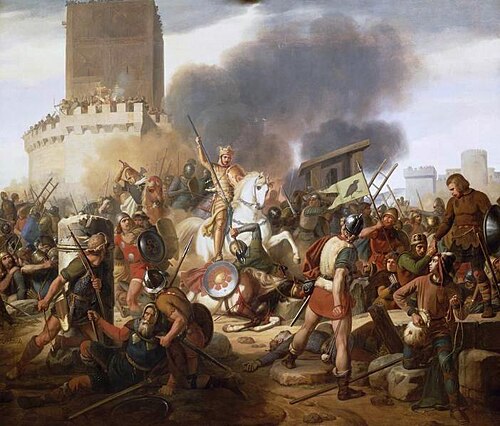
图:Jean Victor Schnetz · Public domain · 维基共享资源
- 时间
- 885 年 11 月 25 日—886 年 10 月 (日期为儒略历)
- 地点
- 巴黎
- 国家 / 地区
- 法国
- 参与方
- 西法兰克王国
- 属于
- 维京人的扩张
- 类型
- 攻城战
- 简述
- 历史战役
巴黎围城战发生于885年至886年,是维京扩张中的一场决定性战役,位于西法兰克王国的城市巴黎。这次围城是胖子查理统治时期最重要的事件,也是法国历史中的一个转折点,证明了巴黎作为法国最大城市的重要性。围攻是塞努斯神父的诗的重要主题。
885年11月,维京人带着数百艘战船和数万人抵达巴黎郊外,并向巴黎要求西法兰克王国向维京人进贡。巴黎伯爵厄德向他们拒绝,尽管他只能有约两百名士兵保卫这座城市。维京人使用各种攻城器械进行攻击,但连续数天强攻却未有进展。围攻持续了十多个月,直到胖子查理带着援军抵达。
正文摘自中文维基百科「巴黎围城战 (885年—886年)」(删去了参考文献、表格和图片),按 CC BY-SA 4.0 使用
英文维基百科的更多内容
中文维基百科这一条比较短,下面是英文维基百科同一条目的节选,原文为英文,未翻译。
The siege of Paris of 885–886 was part of a Viking raid on the Seine, in the western part of the Frankish Empire. The siege was the most important event of the reign of Charles the Fat and a turning point in the fortunes of the Carolingian dynasty and the history of France. It also proved for the Franks the strategic importance of Paris at a time when it also was one of the largest cities in West Francia. The siege is the subject of an eyewitness account in the Latin poem Bella Parisiacae urbis of Abbo Cernuus.
With hundreds of ships, and possibly tens of thousands of men, the Vikings arrived outside Paris in late November 885, demanding tribute. This was denied by Odo, Count of Paris, despite the fact he could assemble only several hundred soldiers to defend the city. The Vikings attacked with a variety of siege engines but failed to break through the city walls despite days of intense attacks. The siege was maintained for months but without any significant assaults after the initial attack. As the siege continued, most of the Vikings left Paris to pillage further upriver. The Vikings made a final unsuccessful attempt to take the city during the summer. In October, Charles the Fat arrived with his army.
To the frustration of the Parisians who had fought to defend the city, Charles stopped short of attacking the Viking invaders. Instead, he allowed them to sail farther up the Seine to raid Burgundy (which was in revolt) and promised a payment of 700 livres (257 kg) of silver. Odo, highly critical of this, attempted to defy Charles' promises. When Charles died in 888, Odo was elected the first non-Carolingian king of the Franks.
Background
Although the Vikings had attacked parts of Francia previously, they reached Paris for the first time in 845, sacking the city. They attacked Paris three more times in the 860s, leaving only when they had acquired sufficient loot or bribes. In 864, by the Edict of Pistres, bridges were ordered built across the Seine at Pîtres and in Paris, where two were built, one on each side of the Île de la Cité, which served admirably in the siege of 885.……
Siege
Vikings under Sigfred and Sinric sailed towards West Francia again in 885, having raided the north-eastern parts of the country before. Sigfred demanded a bribe from Charles but was refused, and he promptly led 700 ships up the Seine, carrying perhaps as many as 30,000 or 40,000 men. The number, the largest ever recorded for a Viking fleet in contemporary sources, originates from poet Abbo Cernuus.……
Aftermath
The Parisians and Odo refused to let the Vikings down the Seine, and the invaders had to drag their boats overland to the Marne to leave the country. When Charles died in 888, the French elected Odo as their king. Odo's brother Robert I of France was later elected king as well, in opposition to the Carolingian Charles the Simple. Throughout the 9th century, the Robertians, descendants of Robert the Strong, held the crown and remained leading figures in West Francia.……
Representation in popular media
Following the popularization of the Viking sagas many different medias such as TV shows, and video games gave new artistic depictions of the Viking raids as well as the lifestyle and world that the Vikings lived in over 1,200 years ago.
The TV show Vikings includes the siege in the third season in the 8th-10th episodes.
正文摘自英文维基百科(原文为英文,未翻译)「Siege of Paris (885–886)」(节选,删去了参考文献、表格和图片),按 CC BY-SA 4.0 使用;在维基百科读全文 ›