 史鉴
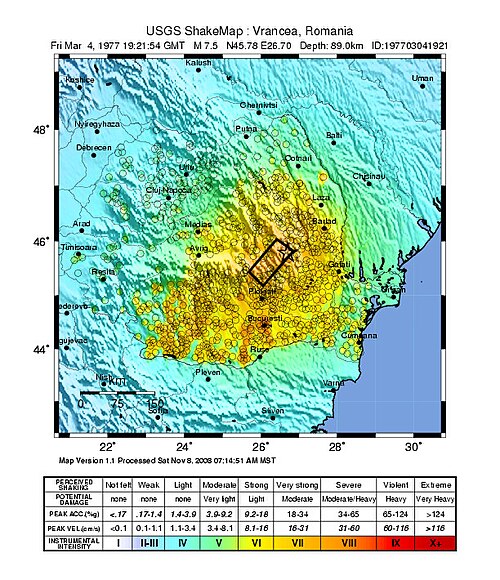
图:USGS · Public domain · 维基共享资源
- 时间
- 1977 年 3 月 4 日
- 国家 / 地区
- 摩尔多瓦、罗马尼亚
- 死亡人数
- 1,578 人
- 类型
- 地震
- 简述
- March 1977 earthquake in Romania
1977年弗朗恰地震发生于1977年3月4日罗马尼亚当地时间21:22,整个巴尔干地区都有震感,里氏7.2级,是罗马尼亚20世纪第二强烈的地震,震中位于弗朗恰山脉,深度94千米。该地震共造成1578人死亡,其中罗马尼亚首都布加勒斯特1,424人死亡,11,300人受伤。
详细介绍
反应
当时,罗马尼亚领导人齐奥塞斯库取消正在尼日利亚进行的正式访问,并宣布紧急状态。此次地震摧毁了32,900幢建筑,地震发生后35000户家庭失去住所,经济损失据信高达20亿美元,但当时官方并未公布总额,而有关地震造成的具体损害的报告一直未曾公布。地震损害大部分集中于布加勒斯特,有33栋大型建筑倒塌。大多数倒塌建筑建于第二次世界大战之前且未得到加固。其中也包括历史古迹莫戈索亚宫。地震发生后,布加勒斯特市长扬·丁卡负责当地的重建工作。罗马尼亚政府开始实行更为严格的建筑标准,并以此次地震为借口在1982年在布加勒斯特开始了大规模的拆迁,并一直持续到1991年。
在保加利亚斯维什托夫,三栋单元楼倒塌,造成超过100人死亡。许多其他建筑受损,包括斯维什托夫圣三位一体教堂。在苏联摩尔达维亚,此次地震也摧毁了许多建筑,并在首府基希讷乌引发恐慌。
正文摘自中文维基百科「1977年弗朗恰地震」(删去了参考文献、表格和图片),按 CC BY-SA 4.0 使用
英文维基百科的更多内容
中文维基百科这一条比较短,下面是英文维基百科同一条目的节选,原文为英文,未翻译。
The 1977 Vrancea earthquake occurred on 4 March 1977, at 21:22 local time, and was felt throughout the Balkans. It had a magnitude of 7.5, making it the second most powerful earthquake recorded in Romania in the 20th century, after the 10 November 1940 seismic event. The hypocenter was situated in the Vrancea Mountains, the most seismically active part of Romania, at a depth of 85.3 km.
The earthquake killed about 1,578 people in Romania, 1,424 of them in Bucharest, and left more than 11,300 injured. Among the victims were actor Toma Caragiu and writers A. E. Bakonsky, Alexandru Ivasiuc and Corneliu M. Popescu. Communist ruler Nicolae Ceaușescu suspended his official visit to Nigeria and declared a state of emergency.
About 32,900 buildings were damaged or destroyed. Immediately after the earthquake, 35,000 families were without shelter. The economic losses are believed to have been as high as two billion US dollars though the sum was not confirmed by the authorities at that time. A detailed report on the destruction the earthquake caused was never published. Most of the damage was concentrated in Romania's capital, Bucharest, where about 33 large buildings collapsed. Most of those buildings were built before World War II, and were not reinforced. After the earthquake, the Romanian government imposed tougher construction standards, and started major demolition campaigns in Bucharest in 1982 until 1991.
In Bulgaria the earthquake is known as the Vrancea earthquake or Svishtov earthquake. Three blocks of flats in the Bulgarian town of Svishtov (on the Danube, opposite the Romanian town of Zimnicea) collapsed, killing more than 100 people. Other buildings damaged included the Church of the Holy Trinity. In Soviet Moldavia the earthquake also destroyed and damaged buildings;……
Damage and casualties
The earthquake of 4 March 1977 incurred one of the heaviest earthquake-related death tolls of the 1970s around the world. It caused the loss of 1,578 lives and injured an additional 11,221, with 90% of the fatalities being in the capital city Bucharest. The reported damage included 32,897 collapsed or demolished dwellings, 34,582 homeless families, 763 industrial units affected and many other damaged in all sectors of the economy. A 1978 World Bank report estimated a total loss of US$2.048 billion, with Bucharest accounting for 70% of the total, i.e. US$1.4 billion. According to this report, out of Romania's 40 counties, 23 were strongly affected.
1Based on focal depth of 110 km
Bucharest
The city center saw the greatest destruction and loss of life, since the earthquake particularly affected multi-storey buildings, mostly apartment buildings.……
Aftershocks
The earthquake epicenter was located in the south-west part of Vrancea County, the most active seismic area in Romania, at a depth of about 85.3 km (53.0 mi). The shock wave was felt in almost all countries in the Balkan Peninsula, as well as the Soviet republics of Ukraine and Moldavia, albeit with a lower intensity. Seismic movement was followed by aftershocks of smaller magnitude. The strongest aftershock occurred on the morning of 5 March 1977, at 02:00 AM, at a depth of 109 km (68 mi), with a magnitude was 4.9 on the Richter scale. Other aftershocks' magnitudes did not exceed 4.3 or 4.5 Mw.
Reactions of authorities
At the time of the earthquake, Nicolae and Elena Ceaușescu were on an official visit to Nigeria. Ceaușescu heard about the disaster in the country from a Romanian official.
Initially, news about the earthquake were confusing, and people talked about a much larger catastrophe. Due to a power failure in Bucharest, communication services were down for several hours. The population took to the streets, scared of possible aftershocks. At that moment, authorities had not taken any concrete steps.
Residents of many damaged buildings took part in ad hoc rescue efforts. Doctors, soldiers, and many civilians helped in these rescue efforts. Nine hospitals were shut down.……
Notable victims
Individuals killed in the earthquake include:
正文摘自英文维基百科(原文为英文,未翻译)「1977 Vrancea earthquake」(节选,删去了参考文献、表格和图片),按 CC BY-SA 4.0 使用;在维基百科读全文 ›
同时期、同地区的大事
- 切尔诺贝利核事故1986 年 4 月 26 日 · 其他事件 · 欧洲
- 两德统一1989 年 11 月 9 日—1990 年 10 月 3 日 · 其他事件 · 欧洲
- 申根公约1985 年 6 月 14 日 · 条约与会议 · 欧洲
- 布拉格之春1968 年 · 其他事件 · 欧洲
- 波斯尼亚战争1992 年 4 月 6 日—1995 年 12 月 14 日 · 战争 · 欧洲
- 不扩散核武器条约1968 年 7 月 1 日 · 条约与会议 · 欧洲
- 五月风暴1968 年 5 月 2 日—1968 年 6 月 23 日 · 其他事件 · 欧洲
- 康乃馨革命1974 年 4 月 25 日 · 革命与起义 · 欧洲
- 东欧剧变1989 年 3 月 9 日—1992 年 4 月 27 日 · 其他事件 · 欧洲
- 克罗地亚战争1991 年 3 月 31 日—1995 年 8 月 7 日 · 战争 · 欧洲
- 南斯拉夫内战1991 年 3 月 31 日—2001 年 8 月 13 日 · 战争 · 欧洲
- 天鹅绒革命1989 年 11 月 17 日—1989 年 12 月 29 日 · 革命与起义 · 欧洲
同时期的同类事件(灾难与瘟疫)
- 艾滋病1959 年 · 灾难与瘟疫
- 2004年印度洋大地震2004 年 12 月 26 日 · 灾难与瘟疫 · 东南亚
- 1960年智利大地震1960 年 5 月 21 日 · 灾难与瘟疫 · 拉丁美洲
- 2005年克什米尔大地震2005 年 10 月 8 日 · 灾难与瘟疫 · 东亚
- 唐山大地震1976 年 7 月 28 日 · 灾难与瘟疫 · 东亚
- 三年大饥荒1959 年—1961 年 · 灾难与瘟疫 · 东亚
- 阪神大地震1995 年 1 月 17 日 · 灾难与瘟疫 · 东亚
- 1952年伦敦烟雾事件1952 年 12 月 5 日—1952 年 12 月 9 日 · 灾难与瘟疫 · 欧洲
- 亚美尼亚大地震1988 年 12 月 7 日 · 灾难与瘟疫 · 西亚
- 希尔斯堡惨案1989 年 4 月 15 日 · 灾难与瘟疫 · 欧洲
- 1999年伊兹密特地震1999 年 8 月 17 日 · 灾难与瘟疫 · 西亚
- 2007年秘鲁大地震2007 年 8 月 15 日 · 灾难与瘟疫 · 拉丁美洲