 史鉴
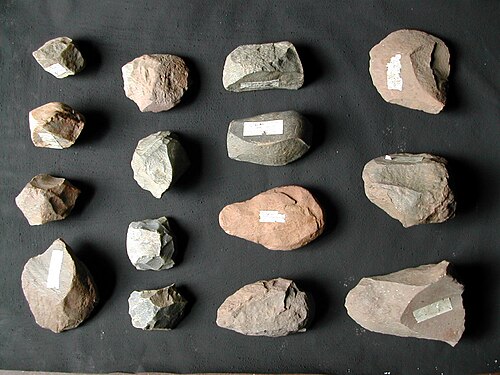
图:Gustavimam · CC BY-SA 4.0 · 维基共享资源
- 时间
- 约 330 万年前—约 30.2 万年前 (Wikidata 的日期只是大约的年代)
- 属于
- 旧石器时代
- 后一事件
- 旧石器时代中期
- 类型
- 考古时期
- 简述
- earliest subdivision of the Paleolithic or Old Stone Age
旧石器时代初期是处于旧石器时代的早期阶段。它横跨自250万年以前,使用第一个石器的原始人出现在目前的考古记录,直到约30万年前,跨越奥都万和阿舍利文化的雕刻技术。
在非洲考古学中,这个时间段大致相当于石器时代的早期,开始于约260万年前,模式1的石器技术,并结束于40万至25万年以前的模式2技术。
旧石器时代初期之后是旧石器时代中期,外观上更为先进的核心工具制造技术,如莫斯特出现。原始人类最早的防火技术可以追溯至旧石器时代初期或旧石器时代中期仍然是一个悬而未决的问题。
正文摘自中文维基百科「旧石器时代初期」(删去了参考文献、表格和图片),按 CC BY-SA 4.0 使用
英文维基百科的更多内容
中文维基百科这一条比较短,下面是英文维基百科同一条目的节选,原文为英文,未翻译。
The Lower Paleolithic (or Lower Palaeolithic) is the earliest subdivision of the Paleolithic or Old Stone Age. It spans the time from around 3.3 million years ago when the first evidence for stone tool production and use by hominins appears in the current archaeological record, until around 300,000 years ago, spanning the Oldowan (Mode 1) and Acheulean (Mode 2) lithics industries.
In African archaeology, the time period roughly corresponds to the Early Stone Age, the earliest finds dating back to 3.3 million years ago, with Lomekwian stone tool technology, spanning Mode 1/Oldowan stone tool technology, which begins roughly 2.6 million years ago and ends between 400,000 and 250,000 years ago, with Mode 2/Acheulean technology.
The Middle Paleolithic followed the Lower Paleolithic and recorded the appearance of the more advanced prepared-core tool-making technologies such as the Mousterian. Whether the earliest control of fire by hominins dates to the Lower or to the Middle Paleolithic remains an open question.
Gelasian
The Lower Paleolithic began with the appearance of the first stone tools in the world. Formerly associated with the emergence of Homo habilis, some 2.8 million years ago, this date has been pushed back significantly by finds of the early 2000s, the Oldowan or Mode 1 horizon, long considered the oldest type of lithic industry, is now considered to have developed from about 2.6 million years ago, with the beginning Gelasian (Lower Pleistocene), possibly first used by australopithecine forebears of the genus Homo (such as Australopithecus garhi).
Calabrian
Homo erectus moved from scavenging to hunting, developing the hunting-gathering lifestyle that would remain dominant throughout the Paleolithic into the Mesolithic.
The unlocking of the new niche of hunting-gathering subsistence drove a number of further behavioral and physiological changes leading to the appearance of Homo heidelbergensis by some 800,000–600,000 years ago. As such, Homo rose to the ranks of omnivorous predators (and possibly became hypercarnivores before Homo sapiens again transformed into hypocarnivores). As active hunters, they came in opposition to other, quadruped predators and started living in large groups.
Chibanian
The appearance of Homo heidelbergensis about 600,000 years ago heralds a number of other new varieties, such as Homo rhodesiensis and Homo cepranensis about 400,000 years ago.
Homo heidelbergensis is a candidate for first developing an early form of symbolic language. Whether control of fire and earliest burials date to this period or only appear during the Middle Paleolithic is an open question.
Transition to the Middle Paleolithic
From about 300,000 years ago, technology, social structures and behaviour appear to grow more complex, with prepared-core technique lithics, earliest instances of burial and changes to hunting-gathering patterns of subsistence. Homo sapiens first appeared about 300,000 years ago, as evidenced by fossils found at Jebel Irhoud in Morocco.
By region
South India
The Madrasian culture is a prehistoric archaeological culture of the Indian subcontinent, dated to the Lower Paleolithic, the earliest subdivision of the Stone Age. It belongs to the Acheulian industry, and some scholars consider the distinction between the Madrasian and the broader, regional Acheulian tradition defunct.
The Madrasian is characterized by bifacial handaxes and cleavers, but also includes flake tools, microliths and other chopping tools. Most were made from quartzite.
North India
Guy Ellcock Pilgrim, a British geologist and palaeontologist, discovered 1.5 million-year-old prehistoric human teeth and part of a jaw indicating that ancient people, intelligent hominins dating as far back as 1,500,000 ybp Acheulean period, lived in the Pinjore region near Chandigarh.……
正文摘自英文维基百科(原文为英文,未翻译)「Lower Paleolithic」(节选,删去了参考文献、表格和图片),按 CC BY-SA 4.0 使用;在维基百科读全文 ›
同时期的同类事件(时代与时期)
- 旧石器时代约 330 万年前—公元前 14 千纪 · 时代与时期