 史鉴
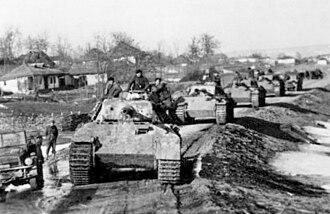
图:Becke, Heinrich von der · CC BY-SA 3.0 de · 维基共享资源
- 时间
- 1944 年 4 月 8 日—1944 年 6 月 6 日
- 地点
- 摩尔达维亚
- 国家 / 地区
- 摩尔多瓦
- 属于
- 苏德战争
- 类型
- 军事攻势
- 简述
- 1944 military offensive
第一次雅西-基希讷乌攻势,是苏联和轴心国在1944年4月8日至6月6日间的一场战斗,这次进攻实际上是苏联红军的乌克兰第2方面军及第3方面军根据约瑟夫·斯大林显示苏联的军事实力和对巴尔干的政治影响,而协调入侵罗马尼亚的行动。
根据苏军最高统帅部的计划:以两个苏军方面军将切断轴心国在罗马尼亚北部的主要防线,这就将有利于苏军以后向整个巴尔干地区的进攻。苏联进攻开始时实施第一次特尔古弗鲁莫斯战役和波杜伊洛阿耶伊战役,并最终进行第二次特尔古弗鲁莫斯战役,然而苏军未能克服德军在该地区的防御和进攻行动最终失败。失败主要是由于苏军低落的作战能力以及德军防御阵地的精心准备。
这一行动是一系列“被遗忘的战役”的一部分,几乎完全被苏联档案记录和史学忽略,根据军事历史学家大卫·格兰兹的说话:“在第二次世界大战结束近60年来,苏联和俄罗斯的军事历史学家和理论家仔细抹去任何提及第2和第3乌克兰方面军在第一次雅西—基希讷乌攻势的历史记录,在此期间苏军的两个方面军试图在1944年4月至5月侵入罗马尼亚,由于这次攻势与苏军在战争期间进行了的许多其他的军事行动案件有关,所以他们故意这样做,在这个过程中把这次攻势贬谪为苏德战争中一张颇长的“被遗忘的战役”之名单的其中之一”。
正文摘自中文维基百科「第一次雅西-奇西瑙攻势」(删去了参考文献、表格和图片),按 CC BY-SA 4.0 使用
英文维基百科的更多内容
中文维基百科这一条比较短,下面是英文维基百科同一条目的节选,原文为英文,未翻译。
The first Jassy–Kishinev offensive, named after the two major cities in the area, Jassy and Kishinev, was a series of military engagements between 8 April and 6 June 1944 (according to David Glantz) by the Soviet Union and Axis powers. Richard C. Hall also refers to a first Jassy–Kishinev operation which began on 5 April, without providing an exact date for its end. According to Glantz, the purported offensive was a coordinated invasion of Romania conducted by Red Army's 2nd and 3rd Ukrainian Fronts, in accordance with Joseph Stalin's strategy of projecting Soviet military power and political influence into the Balkans. However, according to the German Military History Research Office, a threatened Soviet offensive in northern Moldavia "failed to materialize" in the first part of April, and the military engagements during the rest of the month were used by the Axis forces to straighten the frontline; furthermore, on 6 May, the main command of the Soviet military (Stavka) issued orders to take no further offensive actions in this sector of the front.
Glantz claims that the plans of the Stavka envisioned the two Soviet fronts would cut off vital Axis defensive lines in northern Romania, facilitating a subsequent advance by the Red Army into the entire Balkan region. Glantz considers the Soviet attack commenced with the First Battle of Târgu Frumos and the Battle of Podu Iloaiei, and culminated with the Second Battle of Târgu Frumos. Soviet forces failed to overcome German defenses in the region and the offensive operation ultimately failed, mainly due to the poor combat performance of Soviet troops and the effectiveness of German defensive preparations.……
Planning
On 5 March 1944, Marshal Ivan Konev—commander of the 2nd Ukrainian Front—commenced the Uman–Botoșani offensive operation in Ukraine. This operation succeeded in separating Army Group South's 1st Panzer-Armee from 8th Army by 17 March. By early April Soviet units approached the Romanian border.
Glantz claims that starting with early April 1944, Stavka ordered the 2nd and 3rd Ukrainian Fronts to mount a major offensive with strategic implications in Romania. In Glantz's view, Stavka's strategic intentions were to break German and Romanian strategic defenses in northern Romania, capture the key cities of Iași and Chișinău, and afterward project forces deep into Romanian territory, if possible as deep as Ploiești and Bucharest. By 5 April, Konev's front had crossed the upper reaches of Dniester and Prut rivers, captured Hotin and Dorohoi, and approached the Târgu Frumos and Botoșani regions—30–60 mi (48–97 km) northwest of Iași—facing only light Romanian resistance. On 8 April, Konev ordered the 27th and 40th Armies to conduct a coordinated offensive southward along the Târgu Frumos axis, in close cooperation with Semyon Bogdanov's 2nd Tank Army. While Konev's shock group was advancing toward Târgu Frumos, Konstantin Koroteev's 52nd Army and elements of Andrei Gravchenko's 6th Tank Army— which were operating north of Iași—were conducting operations alongside the Iași axis in order to support Konev's main effort.
As Konev's armies prepared to launch their offensive toward Târgu Frumos, Otto Wöhler's German 8th Army was involved in the heavy fighting taking place in and around the village of Popricani, 9 mi (14 km) north of Iași, where two Soviet corps were fighting with armored Kampfgruppen, distracting the Germans' attentions and forces away from the critical Târgu Frumos sector. Exploiting the 52nd Army diversionary operations in the Iași region, the three armies of Konev's shock group began advancing southward early in the morning of 8 April. The advance was quite slow due to mud-clogged roads during the rasputitsa (the twice yearly period of water-logged ground), as well as crossing to the west bank of the Prut River northwest of Iași.
正文摘自英文维基百科(原文为英文,未翻译)「First Jassy–Kishinev offensive」(节选,删去了参考文献、表格和图片),按 CC BY-SA 4.0 使用;在维基百科读全文 ›
下属事件
- First Battle of Târgu Frumos1944 年 4 月 9 日—1944 年 4 月 12 日 · 战役 · 欧洲
同时期、同地区的大事
- 犹太人大屠杀1933 年—1945 年 · 屠杀与暗杀 · 欧洲
- 大萧条1929 年 10 月 29 日—1941 年 · 时代与时期 · 欧洲
- 奥斯威辛集中营1940 年 5 月 20 日—1945 年 1 月 27 日 · 其他事件 · 欧洲
- 西班牙内战1936 年 7 月 18 日—1939 年 4 月 1 日 · 战争 · 欧洲
- 斯大林格勒战役1942 年 8 月 23 日—1943 年 2 月 2 日 · 战役 · 欧洲
- 苏德互不侵犯条约1939 年 8 月 23 日—1941 年 6 月 22 日 · 其他事件 · 欧洲
- 盖世太保1933 年 4 月 26 日—1945 年 5 月 8 日 · 其他事件 · 欧洲
- 意大利国旗1946 年 6 月 18 日 · 其他事件 · 欧洲
- 冬季战争1939 年 11 月 30 日—1940 年 3 月 13 日 · 战争 · 欧洲
- 乌克兰大饥荒1932 年—1933 年 · 屠杀与暗杀 · 欧洲
- 巴巴罗萨行动1941 年 6 月 22 日—1941 年 12 月 5 日 · 战役 · 欧洲
- 雅尔塔会议1945 年 2 月 4 日—1945 年 2 月 11 日 · 条约与会议 · 欧洲
同时期的同类事件(战役)
- 珍珠港事件1941 年 12 月 7 日 · 战役 · 大洋洲
- 第二次中东战争1956 年 10 月 29 日—1956 年 11 月 7 日 · 战役 · 非洲
- 波兰战役1939 年 9 月 1 日—1939 年 10 月 6 日 · 战役 · 欧洲
- 不列颠战役1940 年 7 月 10 日—1940 年 10 月 31 日 · 战役 · 欧洲
- 加里波利之战1915 年 4 月 25 日—1916 年 1 月 9 日 · 战役 · 西亚
- 法国战役1940 年 5 月 10 日—1940 年 6 月 25 日 · 战役 · 欧洲
- 海王行动1944 年 6 月 6 日—1944 年 8 月 29 日 · 战役 · 欧洲
- 柏林战役1945 年 4 月 16 日—1945 年 5 月 2 日 · 战役 · 欧洲
- 库尔斯克会战1943 年 7 月 5 日—1943 年 8 月 23 日 · 战役 · 欧洲
- 列宁格勒围城战1941 年 9 月 8 日—1944 年 1 月 27 日 · 战役 · 欧洲
- 凡尔登战役1916 年 2 月 21 日—1916 年 12 月 18 日 · 战役 · 欧洲
- 索姆河战役1916 年 7 月 1 日—1916 年 11 月 17 日 · 战役 · 欧洲