 史鉴
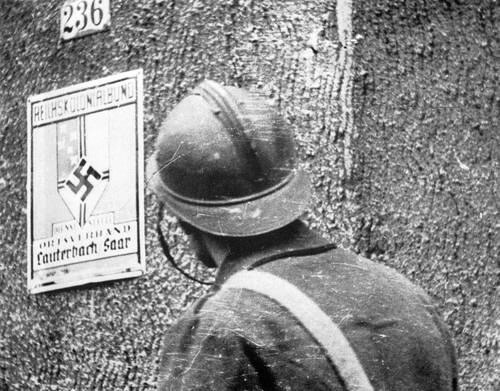
图:Service Cinématographique des Armées · Public domain · 维基共享资源
- 时间
- 1939 年 9 月 7 日—1939 年 9 月 16 日
- 地点
- 萨尔兰州
- 国家 / 地区
- 德国
- 属于
- 西方战线
- 类型
- 军事攻势
- 简述
- French ground operation into Saarland from 7 to 16 September 1939
萨尔攻势是一个法国在第二次世界大战早期在萨尔地区对德国陆军第1军团采取的军事行动,攻势之目的是援助当时被德军攻击的波兰,然而攻势后来被中止。
根据法国和波兰的军事协定:法国军队动员开始后3天筹备大规模攻势并必须有效地控制法国边界和德军防线之间的地区,进而深入德国防线。
法国的进攻于9月7日在莱茵河谷开始,即法国对德国宣战4天之后。当时德意志国防军被集中进攻波兰,法军相对于驻守边界的德军有着压倒性的数量优势。不过法军狐疑不前的行动对即将陷落的波兰并未带来有效帮助。11个法军的师面对德军微弱的反抗,沿着萨尔布吕肯一带长32公里的地区前进,法军前进深入了8公里,在德军撤离、没有任何抵抗的条件下攻占了大约20个村庄,然而在法军夺取了瓦恩特森林大约3平方英里满布地雷的德国领土之后,法军三心两意的进攻被下令终止。
这次攻势没有迫使德军向西线大量调兵,法军的攻击由大约仅由10个师实施。9月12日英法战争最高会议首次聚集在法国阿布维尔,会议决定一切进攻行动将被立即停止。 莫里斯·甘末林命令他的部队在德军的齐格飞防线前“不少于1公里”的地方停止,而波兰对此决定一无所知,相反甘未林通知爱德华·雷兹-希米格维元帅说他麾下一半的师正与敌人接触,而法军的进攻已经迫使德意志国防军最少6个师从波兰撤回德国。翌日驻波兰法国军事代表团指挥官路易斯·筱柚将军通知波兰参谋长瓦茨瓦·斯塔契维奇将军,计划中在西部战线的主要进攻必须被推迟到9月17日至9月20日。与此同时法军各师奉命撤退到他们沿马其诺防线的军营,德军也在9月16日至17日从波兰战线调回精锐部队,重新夺回法军在撤兵后放弃的土地,两国边界回复战前状态,假战随之开始。
在1945年的纽伦堡审判中,上庭的德国将军齐格非·韦斯特法尔亦指出:“如果1939年9月时法国真的全面进攻的话,我估计德军只能撑一至两个星期。”
正文摘自中文维基百科「萨尔攻势」(删去了参考文献、表格和图片),按 CC BY-SA 4.0 使用
英文维基百科的更多内容
中文维基百科这一条比较短,下面是英文维基百科同一条目的节选,原文为英文,未翻译。
The Saar Offensive was the French invasion of Saarland, Germany, in the first stages of World War II, from September 7 to October 16, 1939, in response to the German invasion of Poland on 1 September 1939. The original plans called for 40 divisions, one armored division, three mechanised divisions, 78 artillery regiments and 40 tank battalions to assist Poland, which was then under invasion, by attacking Germany's neglected western front. Despite 30 divisions advancing to the border (and in some cases across it), the attack did not have the expected result. When the swift victory in Poland allowed Germany to reinforce its lines with troops from the east, the offensive was halted. French forces then withdrew amid a German counter-offensive on 17 October.
Background
In 1921, France and Poland made a defensive alliance against Germany through the military convention. France, along with the United Kingdom, declared war on Germany on September 3rd, 1939, two days after the German invasion of Poland.
Objective of the offensive
According to the convention, the French Army was to start preparations for the major offensive three days after mobilisation started. The French forces were to effectively gain control over the area between the French border and the Siegfried Line and were to probe the German defences. The sector was defended by the German 1st Army. On the 15th day of the mobilisation (that is on 16 September), the French Army was to start a full-scale assault on Germany. The pre-emptive mobilisation was started in France on 26 August and on 1 September, full mobilisation was declared.
French mobilisation suffered from an inherently out-of-date system, which greatly affected their ability to swiftly deploy their forces on the field. The French command still believed in the tactics of World War I, which relied heavily on stationary artillery, even though this took time to transport and deploy. Many pieces also had to be retrieved from storage before any advance could be made.
French operations
Almost everyone expected a major French attack on the Western Front soon after the start of the war, but Britain and France were cautious as both feared large German air attacks on their cities; they did not know that 90 percent of German frontline aircraft were in Poland nor did they realise that the few German units that were holding the line had effectively been "pared to the bone" and stripped of any real fighting capability leaving the French unknowingly with a 3:1 advantage over the Germans. Consequently what followed was what historian Roger Moorhouse called a "sham offensive on the Saar" that began on 7 September, four days after France declared war on Germany. The Wehrmacht was engaged in the attack on Poland and the French enjoyed a decisive numerical advantage along the border with Germany but the French did not take any action that was able to assist the Poles.……
Aftermath
The Polish Army general plan for defence, Plan West, assumed that the Allied offensive on the Western Front would provide significant relief on the Polish Front.
However, the limited and half-hearted Saar Offensive did not result in any diversion of German troops. The 40-division all-out assault never materialised. On 12 September, the Anglo-French Supreme War Council gathered for the first time at Abbeville in France. It was decided that all offensive actions were to be halted immediately. General Maurice Gamelin ordered his troops to stop "not closer than 1 kilometre (0.6 miles)" from the German positions along the Siegfried Line. Poland was not notified of this decision. Instead, Gamelin incorrectly informed Marshal Edward Rydz-Śmigły that half of his divisions were in contact with the enemy, and that French advances had forced the Wehrmacht to withdraw at least six divisions from Poland.
正文摘自英文维基百科(原文为英文,未翻译)「Saar Offensive」(节选,删去了参考文献、表格和图片),按 CC BY-SA 4.0 使用;在维基百科读全文 ›
同时期、同地区的大事
- 犹太人大屠杀1933 年—1945 年 · 屠杀与暗杀 · 欧洲
- 大萧条1929 年 10 月 29 日—1941 年 · 时代与时期 · 欧洲
- 奥斯威辛集中营1940 年 5 月 20 日—1945 年 1 月 27 日 · 其他事件 · 欧洲
- 西班牙内战1936 年 7 月 18 日—1939 年 4 月 1 日 · 战争 · 欧洲
- 斯大林格勒战役1942 年 8 月 23 日—1943 年 2 月 2 日 · 战役 · 欧洲
- 苏德互不侵犯条约1939 年 8 月 23 日—1941 年 6 月 22 日 · 其他事件 · 欧洲
- 党卫队1925 年 4 月 4 日—1945 年 5 月 8 日 · 其他事件 · 欧洲
- 盖世太保1933 年 4 月 26 日—1945 年 5 月 8 日 · 其他事件 · 欧洲
- 意大利国旗1946 年 6 月 18 日 · 其他事件 · 欧洲
- 冬季战争1939 年 11 月 30 日—1940 年 3 月 13 日 · 战争 · 欧洲
- 乌克兰大饥荒1932 年—1933 年 · 屠杀与暗杀 · 欧洲
- 巴巴罗萨行动1941 年 6 月 22 日—1941 年 12 月 5 日 · 战役 · 欧洲
同时期的同类事件(战役)
- 珍珠港事件1941 年 12 月 7 日 · 战役 · 大洋洲
- 第二次中东战争1956 年 10 月 29 日—1956 年 11 月 7 日 · 战役 · 非洲
- 波兰战役1939 年 9 月 1 日—1939 年 10 月 6 日 · 战役 · 欧洲
- 不列颠战役1940 年 7 月 10 日—1940 年 10 月 31 日 · 战役 · 欧洲
- 加里波利之战1915 年 4 月 25 日—1916 年 1 月 9 日 · 战役 · 西亚
- 法国战役1940 年 5 月 10 日—1940 年 6 月 25 日 · 战役 · 欧洲
- 海王行动1944 年 6 月 6 日—1944 年 8 月 29 日 · 战役 · 欧洲
- 柏林战役1945 年 4 月 16 日—1945 年 5 月 2 日 · 战役 · 欧洲
- 库尔斯克会战1943 年 7 月 5 日—1943 年 8 月 23 日 · 战役 · 欧洲
- 列宁格勒围城战1941 年 9 月 8 日—1944 年 1 月 27 日 · 战役 · 欧洲
- 凡尔登战役1916 年 2 月 21 日—1916 年 12 月 18 日 · 战役 · 欧洲
- 索姆河战役1916 年 7 月 1 日—1916 年 11 月 17 日 · 战役 · 欧洲