 史鉴
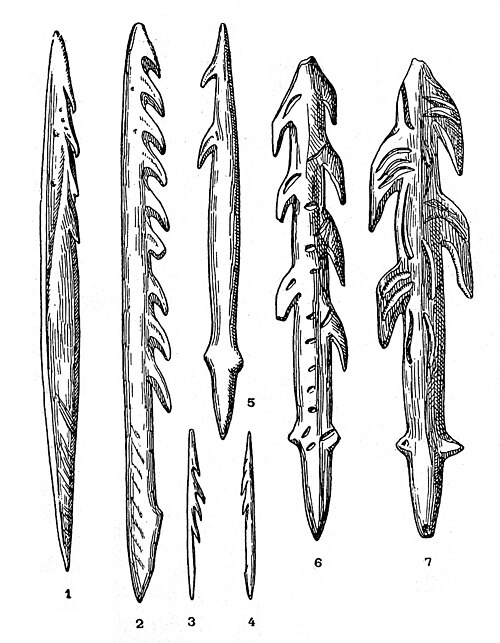
图:佚名 · Public domain · 维基共享资源
- 时间
- 公元前 16 千纪—约 1.2 万年前 (Wikidata 的日期只是大约的年代)
- 地点
- 西欧、中欧
- 属于
- 旧石器时代晚期
- 前一事件
- 梭鲁特文化
- 后一事件
- 阿伦斯堡文化、阿齐利文化
- 类型
- 文化、考古学文化、历史时期
- 简述
- archaeological culture
马格德林文化(英语:Magdalenian,也称Madelenian,法语:Magdalénien)是指约公元前15,000年至前10,000年间存在于西欧旧石器时代晚期和中石器时代的文化,以法国多尔多涅省蒂尔萨克的韦泽尔河峡谷岩棚(La Madeleine)遗址命名。
1875年,考古学家爱德华·拉尔特(Édouard Lartet)和亨利·克里斯蒂(Henry Christy)首次系统发掘该遗址,最初称其为“驯鹿时代”(L'âge du renne),因马格德林人主要猎取驯鹿。此外,遗址中还发现了马鹿和野马等大型哺乳动物的狩猎证据。该文化的遗址分布广泛,西至葡萄牙,东至波兰,北至英格兰和威尔士。
马格德林人留下了丰富的艺术遗产,包括雕像和洞穴壁画。一些证据表明,他们可能定期进行仪式性食人行为,并制作头骨杯。
马格德林人体型矮小,头长而额低,眉脊突出。基因研究表明,马格德林人是早期西欧克罗马农人的后裔,主要来自此前冰期定居于西欧的格雷夫特人(Gravettians)。后来逐渐被与埃皮格拉维特(Epigravettian)文化相关的西部猎人-采集者所取代或同化。
这一时期气候寒冷干燥,典型的野生动物包括洞狮、驯鹿、北极狐和北极兔等适应寒冷环境的物种。
马格德林文化大约从公元前17,000年持续至公元前12,000年,骨制工具种类繁多,如矛尖、鱼叉、钻孔器、钩子和针等,因此该文化也被称为“骨器时代”。其工具的显著特点是从骨状核心打制出规则的刃器。
正文摘自中文维基百科「马格德林文化」(删去了参考文献、表格和图片),按 CC BY-SA 4.0 使用
英文维基百科的更多内容
中文维基百科这一条比较短,下面是英文维基百科同一条目的节选,原文为英文,未翻译。
The Magdalenian (also Madelenian; French: Magdalénien) is a technocomplex of the Late Upper Paleolithic in parts of Western and Central Europe. It dates from around 21,000 to 13,000 years Before Present. It is named after the type site of Abri de la Madeleine, a rock shelter (abri) located in the Vézère valley of Tursac in Dordogne, France.
Édouard Lartet and Henry Christy originally termed the period L'âge du renne "the age of the reindeer". They conducted the first archaeological excavation of the type site, publishing in 1875. The Magdalenian is associated with reindeer hunters. Magdalenian sites contain extensive evidence for the hunting of red deer, wild horses, and other megafauna present in Europe toward the end of the Last Glacial Period. The culture was geographically widespread, and later Magdalenian sites stretched from Portugal in the west to Poland in the east, and as far north as France, the Channel Islands, England, and Wales. Besides la Madeleine, the chief stations of the Magdalenian are Les Eyzies, Laugerie-Basse, and Gorges d'Enfer in the Dordogne; Grotte du Placard in Charente and others in Southwest France.
Magdalenian peoples produced a wide variety of art, including figurines and cave paintings. Evidence has been found suggesting that Magdalenian peoples regularly engaged in cannibalism along with producing skull cups.
Genetic studies indicate that the Magdalenian peoples were descended mainly from earlier Western European Cro-Magnon groups like the Gravettians present in Western Europe over 30,000 years ago before the Last Glacial Maximum (LGM), who had retreated to southwestern Europe during the LGM.……
Chronology and technology
The Magdalenian complex is widely thought to have originated in the region comprising Southwestern France and Northern Spain. It is thought to have emerged from the preceding Solutrean culture in the region, differentiated from the Solutrean by its increased usage of bone points. The earliest forms of the Magdalenian are either known as the Archaic Magdalenian or the Badegoulian.……
Art
Bones, reindeer antlers and animal teeth display pictures carved or etched on them of seals, fish, reindeer, mammoths and other creatures.
In the Tuc d'Audoubert cave, an 18-inch clay statue of two bison sculpted in relief was discovered in the deepest room, now known as the Room of the Bisons.
Examples of Magdalenian portable art include batons, figurines, and intricately engraved projectile points, as well as items of personal adornment including sea shells, perforated carnivore teeth (presumably necklaces), and fossils.
Treatment of the dead
Some skulls were cleaned of soft tissues, then had the facial regions removed, with the remaining brain case retouched, possibly to make the broken edges more regular. This manipulation suggests the shaping of skulls to produce skull cups. Finds of defleshed (as evidenced by cut marks) and cracked bones with human chewing marks at Gough's Cave, England suggests that the Magdalenian peoples there engaged in cannibalism.……
Genetics
The genes of seven Magdalenians, the El Miron Cluster in Iberia, have shown close relationship to a population who had lived in Northern Europe some 20,000 years previously. The analyses suggested that 70-80% of the ancestry of these individuals was from the population represented by Goyet Q116-1, associated with the Aurignacian culture of about 35,000 BP, from the Goyet Caves in modern Belgium. It has been found that Magdalenians are closely related to Solutreans.……
正文摘自英文维基百科(原文为英文,未翻译)「Magdalenian」(节选,删去了参考文献、表格和图片),按 CC BY-SA 4.0 使用;在维基百科读全文 ›