 史鉴
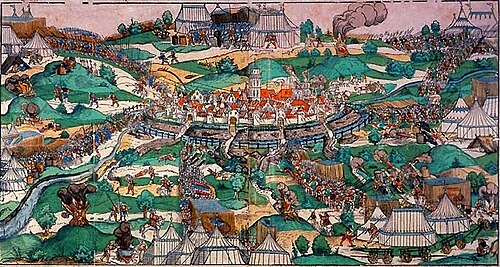
图:Erhard Schön · Public domain · 维基共享资源
- 时间
- 1534 年—1535 年
- 地点
- 明斯特
- 国家 / 地区
- 德国、神圣罗马帝国
- 类型
- 举事
- 简述
- Anabaptist rebellion
明斯特重浸派国(德语:Täuferreich von Münster),又称明斯特公社,是1534年2月重浸派在神圣罗马帝国明斯特采邑主教区明斯特建立的一个神权政府,莱顿的约翰自立为国王。1535年6月24日,明斯特被攻陷,明斯特公社倒台。
正文摘自中文维基百科「明斯特公社」(删去了参考文献、表格和图片),按 CC BY-SA 4.0 使用
英文维基百科的更多内容
中文维基百科这一条比较短,下面是英文维基百科同一条目的节选,原文为英文,未翻译。
The Münster rebellion (German: Täuferreich von Münster, lit. 'Anabaptist dominion of Münster') was an attempt by radical Anabaptists to establish a communal sectarian government in the German city of Münster – then under the large Prince-Bishopric of Münster in the Holy Roman Empire.
The city was under Anabaptist rule from February 1534, when the city hall was seized and Bernhard Knipperdolling installed as mayor, until its fall in June 1535. It was Melchior Hoffman, who initiated adult baptism in Strasbourg in 1530, and his line of eschatological Anabaptism, that helped lay the foundations for the events of 1534–35 in Münster.
Rebellion
After the German Peasants' War (1524–1525), a forceful attempt to establish theocracy was made at Münster, in Westphalia (1532–1535). Here the Anabaptists had gained considerable influence, through the adhesion of Bernhard Rothmann, the Lutheran pastor, and several prominent citizens and leaders, including Jan Matthys (also spelled Matthijs, Mathijsz, Matthyssen, Mathyszoon), a baker from Haarlem, and John of Leiden (Jan van Bockelson or Beukelszoon), a tailor from Leiden. Bernhard Rothmann was a tireless and vitriolic opponent of Catholicism and a writer of pamphlets that were published by his ally, the wealthy wool merchant Bernhard Knipperdolling.……
Siege
The city was besieged by Franz von Waldeck, its expelled bishop. In April 1534, on Easter Sunday, Matthys, who had prophesied God's judgment to come on the wicked on that day, led a procession from the city with twelve followers, as he believed himself the second Gideon. He and his followers were cut off and taken. After Matthys was killed his head was placed on a pole for all in the city to see, and his genitals later nailed to the city gate.
The 25-year-old John of Leiden was subsequently recognized as Matthys' religious and political successor, justifying his authority and actions by claiming visions from heaven. His authority grew until eventually he proclaimed himself the successor of David and adopted royal regalia, honors, and absolute power in the new "Zion".……
Aftermath
The Münster Rebellion was a turning point for the Anabaptist movement. It never again had the opportunity of assuming political importance, as both Catholic and Lutheran civil powers adopted stringent measures to counter this. It is difficult to trace the subsequent history of the group as a religious body, through changes in the names used and beliefs held.
The Batenburgers under Jan van Batenburg preserved the violent millennialist stream of Anabaptism seen at Münster. They were polygamous and believed force was justified against anyone not in their sect. Their movement went underground after the suppression of the Münster Rebellion, with members posing as Catholics or Lutherans as necessary.……
Works of fiction
The Unfortunate Traveller (1594), first English picaresque novel by Thomas Nashe, reflects the cruelty issued by the Emperor and the Duke of Saxony
A Tale of a Tub (1704) by Jonathan Swift. His first major work, brother "Jack" is based on "Jack of Leyden".
Le prophète (1849), opera by Giacomo Meyerbeer that highly fictionalizes the rebellion
The Friends of God (1963) by Peter Vansittart
The Abyss (French: L'Œuvre au noir) (1968) by Marguerite Yourcenar
Rules For a Film about Anabaptists (1976), film by Georg Brintrup
Die Wiedertäufer (The Anabaptists) (1980), play by Friedrich Dürrenmatt, translated by Lauren Friesen as The Anabaptists (unpublished manuscripts in various libraries, including the Graduate Theological Union)
正文摘自英文维基百科(原文为英文,未翻译)「Münster rebellion」(节选,删去了参考文献、表格和图片),按 CC BY-SA 4.0 使用;在维基百科读全文 ›
相关政权
同时期、同地区的大事
- 反宗教改革1545 年—1648 年 · 革命与起义 · 欧洲
- 特伦托会议1545 年 12 月 13 日—1563 年 2 月 21 日 · 其他事件 · 欧洲
- 科学革命1543 年—1687 年 · 时代与时期 · 欧洲
- 第一次摩哈赤战役1526 年 8 月 29 日 · 战役 · 欧洲
- 德国农民战争1524 年—1525 年 · 战争 · 欧洲
- 维也纳之围1529 年 9 月 27 日—1529 年 10 月 15 日 · 战役 · 欧洲
- 丹麦殖民地1536 年—1953 年 · 时代与时期 · 欧洲
- 斯德哥尔摩惨案1520 年 11 月 7 日—1520 年 11 月 9 日 · 屠杀与暗杀 · 欧洲
- 施马尔卡尔登战争1546 年 7 月 10 日—1547 年 5 月 23 日 · 战争 · 欧洲
- 萨拉戈萨条约1529 年 4 月 22 日 · 条约与会议 · 欧洲
- 帕维亚之战1525 年 2 月 24 日 · 战役 · 欧洲
- 罗马之劫1527 年 5 月 6 日 · 战役 · 欧洲
同时期的同类事件(革命与起义)
- 求恩巡礼1536 年 · 革命与起义 · 欧洲