 史鉴
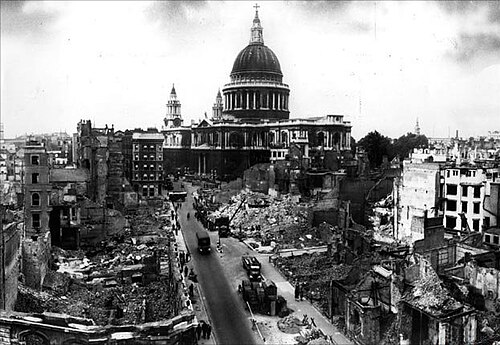
图:H.Mason · Public domain · 维基共享资源
- 时间
- 1940 年 9 月 7 日—1941 年 5 月 21 日
- 地点
- 英国
- 国家 / 地区
- 英国
- 参与方
- 英国、纳粹德国
- 属于
- 第二次世界大战战略轰炸、第二次世界大战时期的大后方
- 类型
- 轰炸城市
- 简述
- 1940 German bombing of Britain during WWII
伦敦轰炸(英语:The Blitz)是指在第二次世界大战中纳粹德国对英国首都伦敦实施的战略轰炸。德国对英国的轰炸发生在1940年9月7日至1941年5月16日间,轰炸范围遍及英国的各大城市和工业中心,但以伦敦受创最为严重。一直到不列颠战役结束,伦敦已被轰炸超过76个昼夜,超过4.3万名市民死亡,并有约10万幢房屋被摧毁。伦敦因此成为第二次世界大战期间遭受轰炸最为严重的城市之一。
由于闪电战在欧洲大陆的成功,德国同样试图用“空中闪电战”击溃英国的防御限度。由于海狮计划的无限期推迟,德国空军元帅戈林便制定了所谓鹰日计划:对伦敦和各大工业城市实行不分昼夜,不分军民的战略轰炸。德国空军的作战方针使得英国皇家空军有了充实队伍的机会,使得英国的空中实力不降反升。皇家空军逐渐恢复了制空权,并对德国本土实施了象征性的轰炸。苏德战争爆发后,轰炸终于不了了之。
到了1944年诺曼底登陆前夕,德国将最新研制的V-1导弹和V-2飞弹布署在法国北部海岸,对盟国展开了最后一次空中进攻。直到同年6月6日,8,938名伦敦市民死于导弹的袭击。加上零星轰炸时死亡的人数,死亡人数超过6万。
正文摘自中文维基百科「伦敦大轰炸」(删去了参考文献、表格和图片),按 CC BY-SA 4.0 使用
英文维基百科的更多内容
中文维基百科这一条比较短,下面是英文维基百科同一条目的节选,原文为英文,未翻译。
The Blitz (English: 'lightning') was a bombing campaign by Nazi Germany and Fascist Italy against the United Kingdom during the Second World War. It lasted for eight months, from 7 September 1940 to 16 May 1941. The name is a shortened form of Blitzkrieg (English: "lightning war"), a term used in the popular press to describe a German style of surprise attack used during the war.
Toward the end of the Battle of Britain in 1940, daylight air superiority over the United Kingdom was contested between the Luftwaffe and the Royal Air Force. Germany began conducting mass air attacks against British cities, beginning with London, in an attempt to draw the RAF Fighter Command into a battle of annihilation. Adolf Hitler and Reichsmarschall Hermann Göring, commander-in-chief of the Luftwaffe, ordered the new policy on 6 September 1940. From 7 September 1940, London was systematically bombed by the Luftwaffe for 56 of the following 57 days and nights. The attacks included a large daylight attack against London on 15 September, a large raid on 29 December 1940 against London resulting in a firestorm known as the Second Great Fire of London, and a large raid on the night of 10–11 May 1941.
The Luftwaffe gradually decreased daylight operations in favour of night attacks to evade attacks by the RAF, and the Blitz became a night bombing campaign after October 1940. The Luftwaffe attacked the main Atlantic seaport of Liverpool in the Liverpool Blitz. The North Sea port of Hull, a convenient and easily found target or secondary target for bombers unable to locate their primary targets, suffered the Hull Blitz.……
Background information
Luftwaffe and strategic bombing
In the 1920s and 1930s airpower theorists such as Giulio Douhet and Billy Mitchell claimed that air forces could win wars, obviating the need for land and sea combat. It was thought that "the bomber will always get through", and could not be resisted, particularly at night.……
Civil defence
Pre-war preparations and fears
London had nine million people—a fifth of the British population—living in an area of 750 square miles (1,940 square kilometres), which was difficult to defend because of its size.……
Pre-war RAF night defence
British air doctrine, since Hugh Trenchard had commanded the Royal Flying Corps (1915–1917), stressed offence as the best means of defence, which became known as the cult of the offensive.……
Technology
German night navigation devices
Because of the inaccuracy of celestial navigation for night navigation and target finding in a fast-moving aircraft, the Luftwaffe developed radio navigation devices and relied on three systems: Knickebein (Crooked Leg), X-Gerät (X-Device), and Y-Gerät (Y-Device).……
First phase
Loge and Seeschlange
The first deliberate air raids on London were mainly aimed at the Port of London, causing severe damage.……
Second phase
Night attacks
From November 1940 to February 1941 the Luftwaffe shifted its strategy and attacked other industrial cities. In particular, the West Midlands were targeted. On the night of 13/14 November, 77 He 111s of Kampfgeschwader 26 (26th
Final attacks
Directive 23: Göring and the Kriegsmarine
In 1941 the Luftwaffe shifted strategy again. Erich Raeder—commander-in-chief of the Kriegsmarine—had long argued the Luftwaffe should support the German submarine force (U-Bootwaffe) in the Battle of the Atlantic by attacking shipping in the Atlantic Ocean and attacking British ports.……
Aftermath
Luftwaffe losses
Between 20 June 1940, when the first German air operations began over Britain, and 31 March 1941, OKL recorded the loss of 2,265 aircraft over the British Isles, a quarter of them fighters and one-third bombers. At least 3,363 Luftwaffe aircrew were killed, 2,641 missing and 2,117 wounded.……
Effectiveness of bombing
The military effectiveness of bombing varied.……
Legacy, propaganda and memory
A popular image arose of British people in the Second World War: a collection of people locked in national solidarity. This image entered the historiography of the Second World War in the 1980s and 1990s, especially after the publication of Angus Calder's book The Myth of the Blitz (1991).……
Tables
Bombing raid statistics
Below is a table by city of the number of major raids (where at least 100 tons of bombs were dropped) and tonnage of bombs dropped during these major raids. Smaller raids are not included in the tonnages.
正文摘自英文维基百科(原文为英文,未翻译)「The Blitz」(节选,删去了参考文献、表格和图片),按 CC BY-SA 4.0 使用;在维基百科读全文 ›
相关政权

同时期、同地区的大事
- 犹太人大屠杀1933 年—1945 年 · 屠杀与暗杀 · 欧洲
- 大萧条1929 年 10 月 29 日—1941 年 · 时代与时期 · 欧洲
- 奥斯威辛集中营1940 年 5 月 20 日—1945 年 1 月 27 日 · 其他事件 · 欧洲
- 西班牙内战1936 年 7 月 18 日—1939 年 4 月 1 日 · 战争 · 欧洲
- 斯大林格勒战役1942 年 8 月 23 日—1943 年 2 月 2 日 · 战役 · 欧洲
- 苏德互不侵犯条约1939 年 8 月 23 日—1941 年 6 月 22 日 · 其他事件 · 欧洲
- 党卫队1925 年 4 月 4 日—1945 年 5 月 8 日 · 其他事件 · 欧洲
- 盖世太保1933 年 4 月 26 日—1945 年 5 月 8 日 · 其他事件 · 欧洲
- 意大利国旗1946 年 6 月 18 日 · 其他事件 · 欧洲
- 冬季战争1939 年 11 月 30 日—1940 年 3 月 13 日 · 战争 · 欧洲
- 乌克兰大饥荒1932 年—1933 年 · 屠杀与暗杀 · 欧洲
- 巴巴罗萨行动1941 年 6 月 22 日—1941 年 12 月 5 日 · 战役 · 欧洲