 史鉴
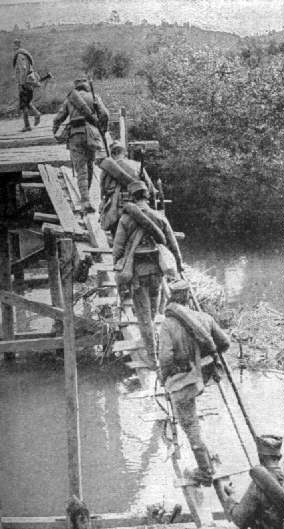
图:佚名 · Public domain · 维基共享资源
- 时间
- 1914 年 11 月 16 日—1914 年 12 月 15 日
- 地点
- 克鲁巴拉河
- 国家 / 地区
- 塞尔维亚
- 属于
- 第一次世界大战
- 类型
- 战役
- 简述
- 1914 battle during World War I
The Battle of Kolubara (Serbian Cyrillic: Колубарска битка, German: Schlacht an der Kolubara) was fought between Austria-Hungary and Serbia in November and December 1914, during the Serbian Campaign of 1914.
It commenced on 16 November, when the Austro-Hungarians under the command of Oskar Potiorek reached the Kolubara river during their third invasion of Serbia that year, having captured the strategic town of Valjevo and forced the Serbian army to undertake a series of retreats. The Serbs withdrew from Belgrade on 29–30 November, and the city soon fell under Austro-Hungarian control.
On 2 December, the Serbian army launched a surprise counterattack all along the front. Valjevo and Užice were retaken by the Serbs on 8 December. The Austro-Hungarians retreated to Belgrade, which 5th Army commander Liborius Ritter von Frank deemed untenable. The Austro-Hungarians abandoned the city between 14 and 15 December and retreated into Austria-Hungary, allowing the Serbs to retake their capital the following day.
The Austro-Hungarians and the Serbs suffered heavy casualties, with more than 20,000 dead on each side. The defeat humiliated Austria-Hungary, which had hoped to occupy Serbia by the end of 1914. On 22 December, Potiorek and von Frank were relieved of their respective commands, and the 5th and 6th Armies were merged into a single 5th Army of 95,000 men.
详细介绍
Background
On 28 June 1914, the Bosnian Serb student Gavrilo Princip assassinated Archduke Franz Ferdinand of Austria in Sarajevo. The assassination precipitated the July Crisis, which led Austria-Hungary to issue an ultimatum to Serbia on 23 July because it suspected that the assassination had been planned in Belgrade. The Austro-Hungarian ultimatum was designed to be unacceptable to Serbia and was indeed rejected. The Austro-Hungarians declared war on Serbia on 28 July. The same day, the Serbs destroyed all bridges on the Sava and Danube rivers to prevent the Austro-Hungarians from using them during any future invasion. Belgrade was shelled the following day, which marked the beginning of World War I.
Fighting in Eastern Europe began with the first Austro-Hungarian invasion of Serbia in early August 1914, under the command of Oskar Potiorek.……
Prelude
Austro-Hungarian plans
The Armeeoberkommando (AOK) acknowledged that an undefeated Serbia severed Austria-Hungary's connection to the Ottoman Empire and prevented the completion of the Berlin–Baghdad railway. The AOK also realized that the Austro-Hungarian Army's inability to defeat Serbia would discourage neutral countries such as Bulgaria, Romania and Greece, from joining the Central Powers and would tempt Italy to open up a third front against Austria-Hungary. Nevertheless, the AOK hesitated to authorize a third invasion of Serbia. That changed in September 1914, when Austro-Hungarian troops discovered a map in an abandoned Semlin bookshop titled The New Division of Europe. Originally printed in a Russian newspaper, the map was widely sold in Serbia and depicted the borders of Europe as they would appear after the war. Germany was to be divided into northern and southern confederations.……
Battle
16–26 November
The Austro-Hungarians reached the Kolubara on 16 November and launched an assault against Serbian defensive positions there the following day. The Serbs managed to force the Austro-Hungarians back, and for the next five days, both armies fought a series of battles under heavy rain and snowfall. Both sides suffered heavy casualties, with a large number of soldiers succumbing to frostbite and hypothermia.
The Austro-Hungarian assault began at Lazarevac, a strategically located town just south of Belgrade whose capture would have given them access to the Mladenovac railway line and the ability to outflank the Serbian forces holding the road to Belgrade. Further south, the Austro-Hungarians attacked the Serbian 1st army.……
Aftermath
The battle ended in a decisive Serbian victory. A directive issued by the Serbian Supreme Command on 16 December reported: "The recapture of Belgrade marks the successful end of a great and magnificent period in our operations. The enemy is beaten, dispersed, defeated and expelled from our territory once and for all." Franz Conrad von Hötzendorf, the Austro-Hungarian Chief of the General Staff, attributed the defeat to a Serbian "thunderbolt from the south." The battle achieved none of Austria-Hungary's objectives: it failed to knock Serbia out of the war, induce Bulgaria to join the Central Powers, and convince Romania to stay neutral.……
正文摘自英文维基百科(原文为英文,未翻译)「Battle of Kolubara」(节选,删去了参考文献、表格和图片),按 CC BY-SA 4.0 使用;在维基百科读全文 ›
相关人物
同时期、同地区的大事
- 大萧条1929 年 10 月 29 日—1941 年 · 时代与时期 · 欧洲
- 凡尔赛条约1920 年 1 月 10 日 · 条约与会议 · 欧洲
- 十月革命1917 年 10 月 25 日—1917 年 10 月 26 日 · 革命与起义 · 欧洲
- 国家社会主义德国工人党1920 年 2 月 24 日—1945 年 10 月 10 日 · 其他事件 · 欧洲
- 党卫队1925 年 4 月 4 日—1945 年 5 月 8 日 · 其他事件 · 欧洲
- 德国国旗1917 年 · 其他事件 · 欧洲
- 俄国二月革命1917 年 3 月 8 日—1917 年 3 月 16 日 · 革命与起义 · 欧洲
- 巴黎和会1919 年 1 月 18 日—1920 年 1 月 21 日 · 其他事件 · 欧洲
- 巴尔干战争1912 年 10 月 8 日—1913 年 7 月 18 日 · 战争 · 欧洲
- 同盟国1914 年—1918 年 11 月 11 日 · 其他事件 · 欧洲
- 第一次巴尔干战争1912 年 10 月 8 日—1913 年 5 月 30 日 · 战争 · 欧洲
- 洛桑条约1923 年 7 月 24 日 · 条约与会议 · 欧洲
同时期的同类事件(战役)
- 斯大林格勒战役1942 年 8 月 23 日—1943 年 2 月 2 日 · 战役 · 欧洲
- 巴巴罗萨行动1941 年 6 月 22 日—1941 年 12 月 5 日 · 战役 · 欧洲
- 珍珠港事件1941 年 12 月 7 日 · 战役 · 大洋洲
- 波兰战役1939 年 9 月 1 日—1939 年 10 月 6 日 · 战役 · 欧洲
- 不列颠战役1940 年 7 月 10 日—1940 年 10 月 31 日 · 战役 · 欧洲
- 加里波利之战1915 年 4 月 25 日—1916 年 1 月 9 日 · 战役 · 西亚
- 法国战役1940 年 5 月 10 日—1940 年 6 月 25 日 · 战役 · 欧洲
- 海王行动1944 年 6 月 6 日—1944 年 8 月 29 日 · 战役 · 欧洲
- 库尔斯克会战1943 年 7 月 5 日—1943 年 8 月 23 日 · 战役 · 欧洲
- 列宁格勒围城战1941 年 9 月 8 日—1944 年 1 月 27 日 · 战役 · 欧洲
- 凡尔登战役1916 年 2 月 21 日—1916 年 12 月 18 日 · 战役 · 欧洲
- 索姆河战役1916 年 7 月 1 日—1916 年 11 月 17 日 · 战役 · 欧洲