 史鉴
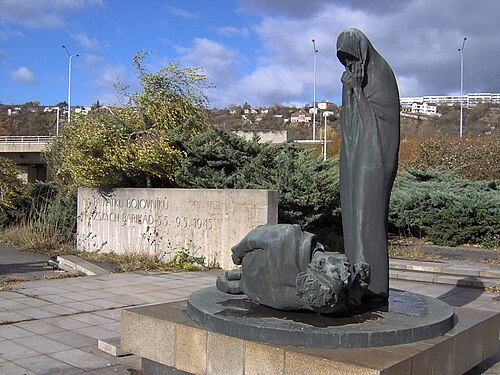
图:Joker Island · Public domain · 维基共享资源
- 时间
- 1945 年 5 月 5 日
- 地点
- 布拉格
- 国家 / 地区
- 捷克、波希米亚和摩拉维亚保护国
- 属于
- 布拉格攻势、May Uprising of the Czech people
- 类型
- 举事
- 简述
- uprising attempting to liberate the city of Prague from German occupation during World War II
布拉格起义(捷克语:Pražské povstání)是1945年5月第二次世界大战结束后布拉格当地反对纳粹德国的一次起事。纳粹德国对捷克的占领助长了捷克民众的反德情绪,同时红军和西方盟军的推进为捷克反抗军提供了机会。
1945年5月5日,在欧洲的二战结束时,占领波希米亚和摩拉维亚保护国的德军遭到了平民、捷克抵抗运动领导人和俄罗斯解放军的袭击。德军对此予以反击。5月8日,捷克和德国领导人签署了停火协议,根据该协议,所有德军撤出布拉格,但部分武装党卫军拒绝服从。战斗一直持续到5月9日,当时红军已进入布拉格。
作战双方都犯下了数项战争罪。德军使用捷克平民作为肉盾,并实施了多起屠杀。同时在捷克斯洛伐克流亡政府的支持下,针对德国平民的暴力行为有增无减。盟军最高指挥官德怀特·D·艾森豪威尔命令乔治·巴顿的美国第三军团不要前来援助捷克反德武装,这削弱了西方列强在战后捷克斯洛伐克的信誉。相反,起义被描绘成捷克反抗纳粹统治的象征。
正文摘自中文维基百科「布拉格起义」(删去了参考文献、表格和图片),按 CC BY-SA 4.0 使用
英文维基百科的更多内容
中文维基百科这一条比较短,下面是英文维基百科同一条目的节选,原文为英文,未翻译。
The Prague uprising (Czech: Pražské povstání) was a partially successful attempt by the Czech resistance movement to liberate the city of Prague from German occupation in May 1945, during the end of World War II. The preceding six years of occupation had fuelled anti-German sentiment and the rapid advance of Allied forces from the Red Army and the United States Army offered the resistance a chance of success.
On 5 May 1945, during the end of World War II in Europe, occupying German forces in Bohemia and Moravia were spontaneously attacked by civilians in an uprising, with Czech resistance leaders emerging from hiding to join them. The Russian Liberation Army (ROA), a collaborationist formation formed from former Soviet prisoners of war, defected and supported the insurgents. German forces counter-attacked, but their progress was slowed by barricades constructed by the insurgents. On 8 May, the Czech and German leaders signed a ceasefire allowing all German forces to withdraw from the city, but some Waffen-SS troops refused to obey. Fighting continued until 9 May, when the Red Army entered the nearly liberated city.
The uprising was brutal, with both sides committing several war crimes. German forces used Czech civilians as human shields and perpetrated several massacres. Violence against German civilians, sanctioned by the Czechoslovak government-in-exile, continued after the uprising, and was justified as revenge for the occupation or as a means to encourage Germans to flee. George S. Patton's Third United States Army was ordered by Supreme Allied Commander Dwight D. Eisenhower not to come to the aid of the Czech insurgents, which undermined the credibility of the Western powers in post-war Czechoslovakia.……
Background
German occupation
In 1938, the Chancellor of Germany, Adolf Hitler, announced his intention to annex the Sudetenland, a region of Czechoslovakia with a high ethnic German population. British Prime Minister Neville Chamberlain and French Prime Minister Édouard Daladier acquiesced to Hitler's demands at the Munich Agreement, in exchange for guarantees from Nazi Germany that no additional lands would be annexed. No Czechoslovak representatives were present at the negotiations.……
Military situation
During the spring of 1945, partisan forces in Bohemia and Moravia totalled about 120 groups, with a combined strength of around 7,500 people.……
Uprising
5 May
Staff of Czech Radio opposed to the occupation began the morning by broadcasting in the banned Czech language. The Bartoš Command and Communist groups met separately and both scheduled the armed uprising to begin 7 May. Czech citizens gathered in the streets, vandalised German inscriptions, and tore down German flags. Czechoslovak flags appeared openly in windows and on jacket lapels. Tram operators refused to accept Reichsmark or to give the stops in German, as was required by the occupiers. Some German soldiers were surrounded and killed.……
War crimes
German
German forces committed war crimes against Czech civilians throughout the uprising. Many people were killed in summary executions, and the SS used Czech civilians as human shields, forced them to clear barricades at gunpoint, and threatened to shoot hostages in revenge for German soldiers killed in action. When tanks were halted by barricades, they were known to fire into surrounding houses. After violently evicting or murdering the inhabitants, German soldiers looted and burned Czech houses and apartment buildings.……
Czech
The Czechoslovak government-in-exile planned to expel the German minority of Czechoslovakia in order to create an ethnically pure Czech-Slovak nation-state.……
Legacy
As "the greatest military action of the Czechs for freedom and national independence fought on their own territory," in the words of journalist Jindřich Marek, the Prague uprising became a national myth of the new Czechoslovak republic and the subject of much literature.
The Western Allies' failure to liberate Prague was seen as emblematic of their lack of concern for Czechoslovakia, first demonstrated by the Munich Agreement.……
正文摘自英文维基百科(原文为英文,未翻译)「Prague uprising」(节选,删去了参考文献、表格和图片),按 CC BY-SA 4.0 使用;在维基百科读全文 ›
下属事件
- Battle for Czech Radio1945 年 5 月 5 日—1945 年 5 月 9 日 · 战役 · 欧洲
相关政权

同时期、同地区的大事
- 犹太人大屠杀1933 年—1945 年 · 屠杀与暗杀 · 欧洲
- 奥斯威辛集中营1940 年 5 月 20 日—1945 年 1 月 27 日 · 其他事件 · 欧洲
- 西班牙内战1936 年 7 月 18 日—1939 年 4 月 1 日 · 战争 · 欧洲
- 斯大林格勒战役1942 年 8 月 23 日—1943 年 2 月 2 日 · 战役 · 欧洲
- 苏德互不侵犯条约1939 年 8 月 23 日—1941 年 6 月 22 日 · 其他事件 · 欧洲
- 盖世太保1933 年 4 月 26 日—1945 年 5 月 8 日 · 其他事件 · 欧洲
- 意大利国旗1946 年 6 月 18 日 · 其他事件 · 欧洲
- 冬季战争1939 年 11 月 30 日—1940 年 3 月 13 日 · 战争 · 欧洲
- 乌克兰大饥荒1932 年—1933 年 · 屠杀与暗杀 · 欧洲
- 巴巴罗萨行动1941 年 6 月 22 日—1941 年 12 月 5 日 · 战役 · 欧洲
- 雅尔塔会议1945 年 2 月 4 日—1945 年 2 月 11 日 · 条约与会议 · 欧洲
- 苏德战争1941 年 6 月 22 日—1945 年 5 月 7 日 · 战争 · 欧洲
同时期的同类事件(革命与起义)
- 1917年俄国革命1917 年 · 革命与起义 · 中亚与北亚
- 文化大革命1966 年 5 月 16 日—1976 年 10 月 6 日 · 革命与起义 · 东亚
- 十月革命1917 年 10 月 25 日—1917 年 10 月 26 日 · 革命与起义 · 欧洲
- 古巴革命1953 年 7 月 26 日—1959 年 1 月 1 日 · 革命与起义 · 拉丁美洲
- 俄国二月革命1917 年 3 月 8 日—1917 年 3 月 16 日 · 革命与起义 · 欧洲
- 1956年匈牙利革命1956 年 10 月 23 日—1956 年 11 月 10 日 · 革命与起义 · 欧洲
- 康乃馨革命1974 年 4 月 25 日 · 革命与起义 · 欧洲
- 复活节起义1916 年 4 月 24 日—1916 年 4 月 29 日 · 革命与起义 · 欧洲
- 德国十一月革命1918 年 10 月 24 日 · 革命与起义 · 欧洲
- 喀琅施塔得叛乱1921 年 3 月 1 日—1921 年 3 月 18 日 · 革命与起义 · 欧洲
- 阿拉伯起义1916 年 6 月—1918 年 10 月 · 革命与起义 · 西亚
- 1973年智利政变1973 年 9 月 11 日 · 革命与起义 · 拉丁美洲