 史鉴
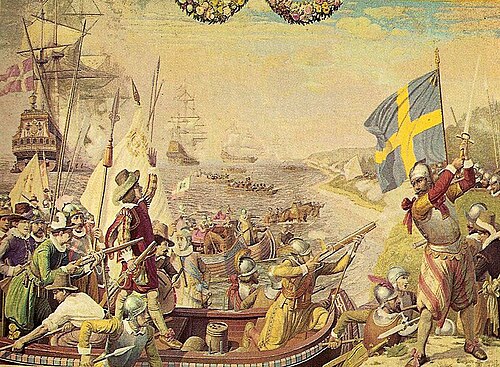
图:佚名 · Public domain · 维基共享资源
- 时间
- 1611 年—1613 年
- 属于
- 丹瑞战争
- 类型
- 战争
- 简述
- conflict
卡尔马战争(英语:Kalmar War,1611年–1613年),发生在丹麦-挪威与瑞典帝国边界之间的战争,最终由丹麦-挪威获胜。此战争促进了丹麦在波罗的海的海上强权。
详细介绍
历史
因为丹麦人控制了北海至波罗地海之间的海峡,为了避免被丹麦人征税,瑞典帝国长期在寻找替代航道。
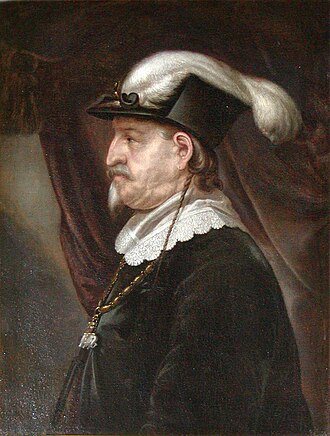
1607年,卡尔九世自称为“诺尔兰地的拉普人之王”(King of the Lapps in Nordland),开始向挪威领地征税。丹麦不希望瑞典帝国的船只改走替代航道,也不希望他们的领地被课税,克里斯蒂安四世向卡尔九世提出抗议,但没被接受。 1611年4月,回应瑞典帝国宣称拥有挪威北方领土的权利,丹麦决定宣战。
丹麦军队分成三个方向,进攻瑞典边境。有一只六千人的部队,攻下卡尔马,但是他们获得命令,不准继续进攻瑞典领地。
1611年夏天,瑞典军队攻下挪威耶姆特兰与海里耶达伦。但因当地人起来对抗,瑞典军队无法控制局面,在秋天时撤退回国。10月20日,卡尔九世过世,由古斯塔夫二世·阿道夫继位为瑞典皇帝。
1612年,丹麦军队控制了哥德堡,瑞典丧失出海口。
因为英格兰与荷兰长期使用波罗地海航路通商,不希望战争影响航路,以外交进行斡旋。1613年,英格兰国王詹姆斯一世促成和谈,两国签定Knäred和约,结束战争。
正文摘自中文维基百科「卡尔马战争」(删去了参考文献、表格和图片),按 CC BY-SA 4.0 使用
英文维基百科的更多内容
中文维基百科这一条比较短,下面是英文维基百科同一条目的节选,原文为英文,未翻译。
The Kalmar War (1611–1613) was fought between Denmark–Norway and Sweden. Though Denmark–Norway soon gained the upper hand, it was unable to defeat Sweden entirely. The Kalmar War was the last time Denmark–Norway successfully defended its dominium maris baltici against Sweden, and it also marked the increasing influence of the two countries on Baltic politics.
Background
Since Denmark–Norway controlled the strait between the Baltic Sea and the North Sea, Sweden sought an alternative trade route through sparsely populated Lapland to avoid paying Denmark's Sound Dues. In 1607, Charles IX of Sweden declared himself "King of the Lapps in Nordland" and began "collecting" taxes in Norwegian territory, even south of Tromsø.
Since the Sound Dues were Denmark's main source of income, Denmark–Norway did not want to see alternative trade routes established, particularly when established through Norwegian territory. Denmark–Norway protested.
King Charles IX of Sweden ignored the protests of King Christian IV of Denmark and Norway. Finally, in April 1611, in response to Sweden's claim of a traditionally Norwegian area in Northern Norway, Denmark–Norway declared war upon Sweden and invaded.
War
1611: Beginning of the war
The Swedes were ill-prepared for war, as their main field army was engaged in the Ingrian War, and obtaining further mercenaries was out of the question.
The Danish-Norwegian side planned to attack Sweden on three fronts; from Kristianopel towards Kalmar, from Halmstad towards Jönköping, and from the Norwegian side towards the fortress of Älvsborg and thereafter further into Västergötland.
A force of 5,200 Danish troops laid siege to the city of Kalmar, ultimately taking it. The Swedes were forced to scuttle some 20 ships in Kalmar to prevent the Danes from capturing them. Norwegian forces, although stationed on the border, were instructed not to enter Sweden. On 26 June a Swedish force carried out the Storming of Kristianopel.
In the summer of 1611, Swedish forces under Baltzar Bäck were ordered to invade Norwegian Jämtland. They did so, and armed Swedish peasants marched into Härjedalen. Both Jämtland and Härjedalen were conquered without much fight. However, Bäck's lack of ability, or will, to stop excesses against the population meant that the locals eventually rose up against the Swedish occupants. In the end, the Swedish troops could not handle the situation and were forced to leave Jämtland and Härjedalen in autumn 1612.
1612
On 20 October 1611 King Charles IX of Sweden died and was succeeded by his son, Gustavus Adolphus.……
Aftermath
One of the results coming out of the Kalmar War was the establishment of Denmark–Norway as a competent army recognized throughout Europe. Still, because the Dano–Norwegian alliance did not achieve a total overall victory, Sweden would recover under Gustavus Adolphus. Surprisingly enough, Sweden and the Danish and Norwegians would enter into a brief alliance in the coming Thirty Years' War. Eventually, however, Danish lack of gains in the war and eventual withdrawal, and Sweden's successful military campaign and rise in power led to Sweden's counterattack in the Torstenson War where Denmark–Norway would lose and cede control of the Baltic Sea to the King of Sweden.
The Kalmar War, in addition to the Northern Seven Years' War before, gave rise to centuries of rivalry between the Norwegians and the Swedes which greatly influenced the machinations of the personal union between the two countries after the Dano–Norwegian loss in 1814. Rather than ceding Norway to Sweden like what was agreed upon in the Treaty of Kiel, Norway denied being ruled under Sweden and rebelled in a short war known as the Norwegian War of Independence.……
In popular memory
Although a side-note to the war, the Battle of Kringen, in which Scottish mercenary forces were defeated by Gudbrandsdal militiamen from Lesja, Dovre, Vågå, Fron, Lom, Skjåk and Ringebu is a noted military event in Norway, celebrated to this day.
正文摘自英文维基百科(原文为英文,未翻译)「Kalmar War」(节选,删去了参考文献、表格和图片),按 CC BY-SA 4.0 使用;在维基百科读全文 ›
下属事件
- 卡尔马围城战1611 年 5 月 3 日—1611 年 8 月 3 日 · 战役 · 欧洲
- Battle of Kalmar1611 年 7 月 17 日—1611 年 7 月 19 日 · 战役 · 欧洲
- Storming of Kristianopel1611 年 6 月 26 日 · 战役 · 欧洲
- Battle of Kringen1612 年 8 月 26 日 · 战役 · 欧洲
相关人物
同时期的同类事件(战争)
- 三十年战争1618 年—1648 年 · 战争 · 欧洲
- 北美印第安战争1609 年—1924 年 · 战争 · 北美洲
- 万历朝鲜之役1592 年 5 月 23 日—1598 年 12 月 16 日 · 战争 · 东亚
- 波兰-莫斯科战争(1605年–1618年)1605 年—1618 年 · 战争 · 欧洲
- 十五年战争1593 年 7 月 29 日—1606 年 11 月 11 日 · 战争 · 欧洲
- 英西战争1585 年—1604 年 · 战争
- 葡萄牙王政复古战争1640 年 12 月 1 日—1668 年 2 月 13 日 · 战争 · 欧洲
- 三国战争1638 年—1651 年 · 战争 · 欧洲
- 法西战争 (1635-1659年)1635 年 5 月 19 日—1659 年 11 月 7 日 · 战争 · 欧洲
- 英格里亚战争1610 年—1617 年 · 战争 · 欧洲
- 荷兰-葡萄牙战争1601 年—1661 年 · 战争
- 波兰-瑞典战争1600 年—1611 年 · 战争 · 欧洲