 史鉴
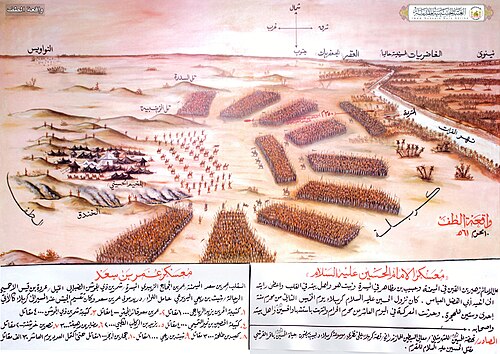
图:佚名 · Public domain · 维基共享资源
- 时间
- 680 年 10 月 10 日
- 地点
- 卡尔巴拉
- 国家 / 地区
- 伊拉克
- 属于
- 第二次内战
- 类型
- 战役
- 简述
- battle in October 680 between the army of Ubayd Allah ibn Ziyad and al-Husayn ibn Ali
卡尔巴拉战役(Battle of Karbala),公元680年10月10日发生于巴格达西南的卡尔巴拉,穆罕默德的外孙、什叶派领袖侯赛因·本·阿里·本·阿比·塔利卜率领自己的支持者对抗前来镇压的倭马亚王朝叶齐德一世的大军。最终前者全军覆没,侯赛因·本·阿里·本·阿比·塔利卜阵亡。
卡尔巴拉是伊拉克中部的一个重要城市,位于巴格达西南约100公里处1。作为卡尔巴拉省的省会,该市2024年估计人口为690,100人。
卡尔巴拉在伊斯兰教史上具有重要意义,尤其对什叶派穆斯林而言。公元680年10月10日,著名的卡尔巴拉战役在此发生,穆罕默德的外孙、什叶派领袖侯赛因·本·阿里在此殉难。自那时起,卡尔巴拉成为什叶派最重要的圣地之一,地位仅次于麦加、麦地那和纳杰夫。
城市内最著名的地标是侯赛因清真寺和阿巴斯清真寺,分别是侯赛因和其弟阿巴斯的陵墓。这两座清真寺每年吸引数百万什叶派朝圣者前来朝拜。卡尔巴拉每年举行两次大型宗教活动:
阿舒拉节:在伊斯兰历穆哈兰姆月的第十天,纪念侯赛因殉难。
阿尔巴因节:在阿舒拉节后的第40天,是更大规模的朝圣活动。
这些活动期间,来自伊拉克各地和世界各国的数百万朝圣者涌入卡尔巴拉,其中很多人选择步行朝圣。这使得卡尔巴拉成为伊拉克最富有的城市之一,其经济主要依赖朝圣旅游业和农业。
卡尔巴拉城区分为旧城和新城两部分。旧城是宗教中心,新城则是现代化的住宅区。全市拥有100多座清真寺和23所宗教学校,彰显了其作为宗教文化中心的地位。
正文摘自中文维基百科「卡尔巴拉战役」(删去了参考文献、表格和图片),按 CC BY-SA 4.0 使用
英文维基百科的更多内容
中文维基百科这一条比较短,下面是英文维基百科同一条目的节选,原文为英文,未翻译。
The Battle of Karbala (Arabic: مَعْرَكَة كَرْبَلَاء, romanized: Maʿrakat Karbalāʾ) was fought on 10 October 680 (10 Muharram in the year 61 AH of the Islamic calendar) between the forces of the second Umayyad caliph Yazid I (r. 680–683), and a small army led by Husayn ibn Ali, second son of Ali and grandson of the Islamic prophet Muhammad, at Karbala, in modern-day southern Iraq.
Prior to his death, the Umayyad caliph Mu'awiya I (r. 661–680) appointed his son Yazid as his successor, making the caliphate hereditary. Yazid's nomination was contested by Husayn and other notables, and after Mu'awiya died in 680, Yazid demanded allegiance from Husayn and the other dissidents. Husayn refused and took refuge in Mecca. While Husayn was in Mecca, the residents of Kufa, the center of Ali's caliphate, sent him numerous letters inviting him to overthrow Umayyad rule, and pledging their allegiance to him. Husayn first sent his cousin, Muslim ibn Aqil, to Kufa to assess the situation and the genuineness of their support. After receiving a favorable report from Muslim, Husayn accepted their invitation and traveled toward the city in response to their calls.
On his way to Kufa with about 72 men, Husayn's caravan was intercepted by a 1,000-strong army of the caliph at some distance from Kufa. He was forced to head north and encamp at the plains of Karbala on 2 October, where another 4,000-strong Umayyad army arrived soon afterwards. Negotiations failed after the Umayyad governor Ubayd Allah ibn Ziyad refused to grant Husayn safe passage unless he submitted to his authority, a condition Husayn rejected.……
Background
After the assassination of the third caliph Uthman ibn Affan by rebels in 656, Ali ibn Abi Talib, a cousin and son-in-law of the Islamic prophet Muhammad, was proclaimed as the fourth caliph in Medina.……
Prelude
On his succession, Yazid tasked the governor of Medina, al-Walid ibn Utba ibn Abi Sufyan, to secure allegiance from Husayn and Ibn al-Zubayr, with force if necessary.……
Journey towards Kufa
Husayn left Mecca with a group of fifty men and his family on 9 September 680 (8 Dhu al-Hijjah 60 AH), a day before the Hajj pilgrimage. He took the northerly route through the Arabian Desert.……
Battle
After the morning prayer on 10 October, both parties took up battle positions. Husayn appointed Zuhayr ibn al-Qayn to command the right flank of his army, Habib ibn Muzahir to command the left flank, and his half-brother Abbas as the standard bearer.……
Aftermath
Seventy or seventy-two people died on Husayn's side, of whom about twenty were descendants of Abu Talib, the father of Ali.……
Tawwabin uprising
In Kufa, prominent Alid partisans felt guilty for abandoning Husayn after having invited him to revolt.……
Primary and classic sources
The primary source of the Karbala narrative is the work of the Kufan historian Abu Mikhnaf titled Kitab Maqtal Al-Husayn.……
Historical analysis
Based on an official report sent to caliph Yazid, which describes the battle very briefly, stating that it lasted for no longer than a siesta, Lammens concludes that there was no battle at all but a quick massacre that was over in an hour;……
Modern historical views on Husayn's motivations
Wellhausen has described Husayn's revolt as a premature and ill-prepared campaign by an ambitious person.……
Impact in Shia Islam
The Battle of Karbala holds a central place in Shia history, tradition, and theology, and has frequently been recounted in Islamic literature.……
Shia observances
Pilgrimages to Husayn's tomb are believed by Shi'as to be a source of divine blessings and rewards.……
正文摘自英文维基百科(原文为英文,未翻译)「Battle of Karbala」(节选,删去了参考文献、表格和图片),按 CC BY-SA 4.0 使用;在维基百科读全文 ›
相关人物

同时期、同地区的大事
- 君士坦丁堡之围674 年—678 年 · 战役 · 西亚
- 第二次内战680 年—692 年 · 战争 · 西亚
- 二十年动乱期695 年—717 年 · 时代与时期 · 西亚
- 在奇里乞亚的一场战役692 年 · 战役 · 西亚