 史鉴
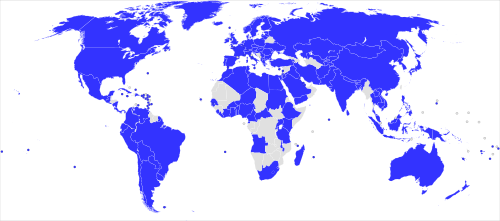
图:User:Ketiltrout · Public domain · 维基共享资源
- 时间
- 1925 年 6 月 17 日
- 地点
- 日内瓦
- 国家 / 地区
- 瑞士
- 类型
- 条约
- 简述
- 禁止在国际冲突中使用生化武器的公约
《禁止在战争中使用窒息性、毒性或其他气体和细菌作战方法的议定书》(法语:Protocole concernant la prohibition d'emploi à la guerre de gaz asphyxiants, toxiques ou similaires et de moyens bactériologiques; 英语:Protocol for the Prohibition of the Use in War of Asphyxiating, Poisonous or other Gases, and of Bacteriological Methods of Warfare),简称《日内瓦议定书》(法语:Protocole de Genève; 英语:Geneva Protocol),各缔约国同意在战争中不使用窒息性、毒性或其他气体,以及使用一切类似的液体、物体或器件,即化学武器与生物武器。缔约国于1925年6月17日在瑞士日内瓦签署了该协议,于1928年2月8日开始生效。
日内瓦议定书的缔约国有140个。
正文摘自中文维基百科「日内瓦议定书」(删去了参考文献、表格和图片),按 CC BY-SA 4.0 使用
英文维基百科的更多内容
中文维基百科这一条比较短,下面是英文维基百科同一条目的节选,原文为英文,未翻译。
The Protocol for the Prohibition of the Use in War of Asphyxiating, Poisonous or other Gases, and of Bacteriological Methods of Warfare, usually called the Geneva Protocol, is a treaty prohibiting the use of chemical and biological weapons in international armed conflicts. It was signed at Geneva on 17 June 1925 and entered into force on 8 February 1928. It was registered in League of Nations Treaty Series on 7 September 1929. The Geneva Protocol is a protocol to the Convention for the Supervision of the International Trade in Arms and Ammunition and in Implements of War signed on the same date, and followed the Hague Conventions of 1899 and 1907.
It prohibits the use of "asphyxiating, poisonous or other gases, and of all analogous liquids, materials or devices" and "bacteriological methods of warfare". This is now understood to be a general prohibition on chemical weapons and biological weapons between state parties, but has nothing to say about production, storage or transfer. Later treaties did cover these aspects – the 1972 Biological Weapons Convention (BWC) and the 1993 Chemical Weapons Convention (CWC).
A number of countries submitted reservations when becoming parties to the Geneva Protocol, declaring that they only regarded the non-use obligations as applying to other parties and that these obligations would cease to apply if the prohibited weapons were used against them.
Negotiation history
In the Hague Conventions of 1899 and 1907, the use of dangerous chemical agents was outlawed. In spite of this, the First World War saw large-scale chemical warfare. France used tear gas in 1914, but the first large-scale successful deployment of chemical weapons was by the German Empire in Ypres, Belgium, in 1915, when chlorine gas was released as part of a German attack at the Battle of Gravenstafel.……
Historical assessment
Eric Croddy, assessing the Protocol in 2005, took the view that the historic record showed it had been largely ineffectual. Specifically it does not prohibit:
use against not-ratifying parties
retaliation using such weapons, so effectively making it a no-first-use agreement
use within a state's own borders in a civil conflict
research and development of such weapons, or stockpiling them
Violations
Several state parties have deployed chemical weapons for combat in spite of the treaty. For example, chemical weapons were used by Spain during the Rif War, by Italy in the Second Italo-Ethiopian War, and by France during the Algerian War. In World War II, Germany employed chemical weapons in combat on several occasions along the Black Sea, notably in Sevastopol, where they used toxic smoke to force Soviet resistance fighters out of caverns below the city.……
Subsequent interpretation of the protocol
In 1966, United Nations General Assembly resolution 2162B called for, without any dissent, all states to strictly observe the protocol. In 1969, United Nations General Assembly resolution 2603 (XXIV) declared that the prohibition on use of chemical and biological weapons in international armed conflicts, as embodied in the protocol (though restated in a more general form), were generally recognized rules of international law.……
State parties
To become party to the Protocol, states must deposit an instrument with the government of France (the depositary power). Thirty-eight states originally signed the Protocol. France was the first signatory to ratify the Protocol on 10 May 1926. El Salvador, the final signatory to ratify the Protocol, did so on 26 February 2008. As of April 2021, 146 states have ratified, acceded to, or succeeded to the Protocol, most recently Colombia on 24 November 2015.
Reservations
A number of countries submitted reservations when becoming parties to the Geneva Protocol, declaring that they only regarded the non-use obligations as applying with respect to other parties to the Protocol and/or that these obligations would cease to apply with respect to any state, or its allies, which used the prohibited weapons.……
Non-signatory states
The remaining UN member states and UN observers that have not acceded or succeeded to the Protocol are:
正文摘自英文维基百科(原文为英文,未翻译)「Geneva Protocol」(节选,删去了参考文献、表格和图片),按 CC BY-SA 4.0 使用;在维基百科读全文 ›
同时期、同地区的大事
- 犹太人大屠杀1933 年—1945 年 · 屠杀与暗杀 · 欧洲
- 大萧条1929 年 10 月 29 日—1941 年 · 时代与时期 · 欧洲
- 奥斯威辛集中营1940 年 5 月 20 日—1945 年 1 月 27 日 · 其他事件 · 欧洲
- 西班牙内战1936 年 7 月 18 日—1939 年 4 月 1 日 · 战争 · 欧洲
- 凡尔赛条约1920 年 1 月 10 日 · 条约与会议 · 欧洲
- 十月革命1917 年 10 月 25 日—1917 年 10 月 26 日 · 革命与起义 · 欧洲
- 国家社会主义德国工人党1920 年 2 月 24 日—1945 年 10 月 10 日 · 其他事件 · 欧洲
- 苏德互不侵犯条约1939 年 8 月 23 日—1941 年 6 月 22 日 · 其他事件 · 欧洲
- 党卫队1925 年 4 月 4 日—1945 年 5 月 8 日 · 其他事件 · 欧洲
- 盖世太保1933 年 4 月 26 日—1945 年 5 月 8 日 · 其他事件 · 欧洲
- 德国国旗1917 年 · 其他事件 · 欧洲
- 冬季战争1939 年 11 月 30 日—1940 年 3 月 13 日 · 战争 · 欧洲
同时期的同类事件(条约与会议)
- 雅尔塔会议1945 年 2 月 4 日—1945 年 2 月 11 日 · 条约与会议 · 欧洲
- 慕尼黑协定1938 年 9 月 30 日 · 条约与会议 · 欧洲
- 波茨坦会议1945 年 7 月 17 日—1945 年 8 月 2 日 · 条约与会议 · 欧洲
- 洛桑条约1923 年 7 月 24 日 · 条约与会议 · 欧洲
- 布列斯特-立托夫斯克和约1918 年 3 月 3 日 · 条约与会议 · 欧洲
- 特里亚农条约1920 年 6 月 4 日 · 条约与会议 · 欧洲
- 色佛尔条约1920 年 8 月 10 日 · 条约与会议 · 欧洲
- 赛克斯-皮科协定1916 年 5 月 16 日 · 条约与会议
- 反共产国际协定1936 年 11 月 25 日 · 条约与会议 · 欧洲
- 非战公约1929 年 7 月 24 日 · 条约与会议 · 欧洲
- 布雷顿森林协定1944 年 7 月 22 日 · 条约与会议 · 北美洲
- 马关条约1895 年 4 月 17 日 · 条约与会议 · 东亚