 史鉴
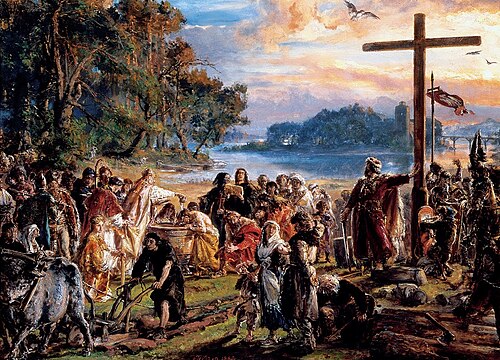
图:Jan Matejko · Public domain · 维基共享资源
- 时间
- 966 年 4 月 14 日 (日期为儒略历)
- 国家 / 地区
- 西维塔斯人
- 属于
- 斯拉夫人的基督教化
- 类型
- 基督教化
- 简述
- 波兰历史事件
波兰的基督教化(波兰语:chrystianizacja Polski)指基督宗教传入波兰,并在波兰境内盛行的过程;这最终使基督宗教、尤其是天主教会,成为波兰人的主要信仰。此过程始于波兰受洗(chrzest Polski),也就是梅什科一世个人的受洗,而梅什科一世在后来成了波兰的首位统治者。受洗典礼的举行日期为公元966年4月14日的圣周六,确切地点至今历史学者仍有争议,但最有可能位在波兹南或格涅兹诺这两座城市之一。一般认为,梅什科之所以会接受基督信仰,主要是受其妻子波希米亚的杜布拉娃所影响。
基督信仰在波兰境内的传布虽耗时几个世纪,最终还是开花结果,而波兰也在几十年内,晋升教宗与神圣罗马帝国所承认的欧洲国家行列。部分历史学者将波兰受洗一事视为波兰建国的开端 。由于原先波兰绝大多数人口皆非基督徒,故其基督教化的过程非常漫长而艰巨,直至公元1030年代异教徒势力起义,波兰的基督教化才算告终。
正文摘自中文维基百科「波兰的基督教化」(删去了参考文献、表格和图片),按 CC BY-SA 4.0 使用
英文维基百科的更多内容
中文维基百科这一条比较短,下面是英文维基百科同一条目的节选,原文为英文,未翻译。
The Christianization of Poland (Polish: chrystianizacja Polski [xrɘs.tja.ɲiˈza.t͡sja ˈpɔl.ski]) refers to the introduction and subsequent spread of Christianity in Poland. The impetus to the process was the Baptism of Poland (Polish: chrzest Polski [ˈxʂɛst ˈpɔl.ski]), the personal baptism of Mieszko I, the first ruler of the future Polish state, and much of his court. The ceremony took place on Holy Saturday, 14 April 966 (under the Julian pre-Gregorian calendar, equivalent to 19 April 966 Gregorian), although the exact location is disputed by historians, with the cities of Poznań and Gniezno being the most likely sites. Mieszko's wife, Dobrawa of Bohemia, is often seen as a major influence on Mieszko's decision to accept Christianity.
While the spread of Christianity in Poland took centuries to finish, the process was ultimately successful, as within several decades Poland joined the rank of established Christian polities recognised by the papacy and the Holy Roman Empire. According to much historiography, the baptism of Poland marks the beginning of Polish statehood. Nevertheless, the Christianization was a long and arduous process, as most of the Polish population remained pagan until the pagan reaction during the 1030s.
Background
Before the adoption of Christianity in modern-day Poland, there were a number of different pagan tribes. Svetovid was among the most widespread pagan gods worshiped in Poland. Christianity arrived around the late 9th century, most likely around the time when the Vistulan tribe encountered the Christian rite in dealings with their neighbors, the Great Moravia (Bohemian) state.
The Moravian cultural influence played a significant role in the spread of Christianity onto the Polish lands and the subsequent adoption of that religion. In the opinion of Davies, the Christianization of Poland through the Czech–Polish alliance represented a conscious choice on the part of Polish rulers to ally themselves with the Czech state rather than the German one. In a similar fashion, some of the later political struggles involved the Polish Church refusing to subordinate itself to the German hierarchy and instead being directly subordinate to the Vatican.
Baptism
"The Baptism of Poland" refers to the ceremony when the first ruler of the Polish state, Mieszko I, and much of his court converted to Christianity. Mieszko's wife Dobrawa of Bohemia, a zealous Christian, played a significant role in promoting Christianity in Poland, and might have had a significant influence on converting Mieszko himself.
The exact place of Mieszko's baptism is disputed;……
Christianization of Poland
The baptismal mission which began in the two major cities of Gniezno and Poznań with the baptism of Mieszko and his court spread throughout the country.……
Millennial celebrations of 1966
The preparations for the millennial celebrations begun with the Great Novena of 1957, which marked a nine years period of fast and prayer. In 1966, the People's Republic of Poland witnessed large festivities on the 1,000th anniversary of those events, with the Church celebrating the 1,000 years of Christianity in Poland, while the Communist government celebrated the secular 1,000 years of the Polish State, culminated in twice denying Pope Paul VI permission to visit Poland that year. The desire of the Communist party to separate religion from the state made the festivities a culture clash between the state and the Church. While the Church was focusing on the religious, ecclesiastical aspects of the baptism, with slogans (in Latin) like Sacrum Poloniae Millenium (Poland's Sacred Millennium), the Communist Party was framing the celebrations as a secular, political anniversary of the creation of the Polish state, with slogans (in Polish) like Tysiąclecie Państwa Polskiego (A Thousand Years of the Polish State). As Norman Davies noted, both the Church and the Party had "rival, and mutually exclusive, interpretations of [Poland's baptism] significance".
On 30 July 1966, the U.S. Bureau of Engraving and Printing issued 128,475,000 commemorative stamps honoring the millennium anniversary of the adoption of Christianity in Poland.
正文摘自英文维基百科(原文为英文,未翻译)「Christianization of Poland」(节选,删去了参考文献、表格和图片),按 CC BY-SA 4.0 使用;在维基百科读全文 ›