 史鉴
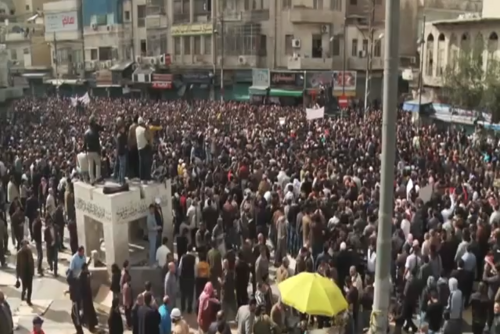
图:Elizabeth Arrott · Public domain · 维基共享资源
- 时间
- 2011 年 1 月 14 日
- 属于
- 阿拉伯之春
- 死亡人数
- 2 人
- 类型
- 抗议
- 简述
- protest
2011-2012年,约旦发生一系列的示威抗议活动,起因为失业问题、通货膨胀、政治腐败等。示威群众要求实行真正的君主立宪,并进行选制改革。长期的示威抗议导致约旦国王阿卜杜拉二世在18个月内三度撤换内阁首相,并于2012年解散国会,提前于隔年举行选举。
2011年埃及革命和发生于突尼斯的茉莉花革命也带来了此区域政治改革的呼声。这次示威和发生在中东、北非等地的其他示威同为阿拉伯之春的一部分。
正文摘自中文维基百科「2011年-2012年约旦反政府示威」(删去了参考文献、表格和图片),按 CC BY-SA 4.0 使用
英文维基百科的更多内容
中文维基百科这一条比较短,下面是英文维基百科同一条目的节选,原文为英文,未翻译。
The Jordanian protests were a series of protests in Jordan that began in January 2011, and resulted in the firing of the cabinet ministers of the government. In its early phase, protests in Jordan were initially against unemployment, inflation, corruption. along with demanding for real constitutional monarchy and electoral reforms.
Food inflation and salaries were a cause for resentment in the country.
The 2010-2011 Tunisian Revolution and the 2011 Egyptian Revolution also raised hopes for political change in the region. Together with unrest elsewhere in the Middle East and North Africa, including the disturbances in Syria and Yemen, they were part of the Arab Spring.
King Abdullah II responded to the protests by reforming around a third of the constitution, establishing the Independent Election Commission, and vowing to embark on a democratic trajectory. He sacked three prime ministers in 18 months, settling on Abdullah Ensour as prime minister in 2012 and called for early elections in 2013. Later, introducing complete proportional representation to the House of Representatives in the 2016 parliamentary election, introducing decentralization in the 2017 local elections, and reforming the judiciary.
Background
Jordan's economy continues to struggle, weighed down by a record deficit of $2 billion in between 2010 and 2011 due to the Arab Spring. Inflation in Jordan has risen by 1.5% to 6.1% in December 2010, and unemployment and poverty have become rampant, estimated at 12% and 25% respectively. The government is also accused of impoverishing the working class with regressive tax codes which forced the poor to pay a higher proportion of their income as tax. The parliament is accused of serving as a "rubber stamp" to the executive branch.
Jordan has a history of persecuting activists and journalists. The country amended its penal code in August 2010 and passed a Law of Information System Crimes, to regulate the Internet. Revised laws continue to criminalize peaceful expression and extend those provisions to Internet expression.……
Protests
Early stage
Protests began on 14 January 2011, as protesters demanded Samir Rifai's resignation as well as economic conditions. On 26 January, the Muslim Brotherhood, one of the largest opposition groups in Jordan, urged Jordanians to pour into streets on 28 January to continue the protests against prime minister Samir Rifai's economic policies and the political situation in the country.
Demonstrators protested rising prices and demanded the dismissal of the Prime Minister and his government, but they have not directly challenged the king, criticism of whom is banned in Jordan. The demonstrators have been peaceful and have not been confronted by the police. So far no deaths, injuries or riots have been reported;……
Concerns
As the original protests were based to a degree on rising food prices, the expectation of food riots in summer 2012 grew due to the rise of global food prices and a drought in the country. This caused concern amongst the political class.
Response
Domestic response
On 1 February, the Royal Palace announced that King Abdullah II had sacked the government as a consequence of the street protests and had asked Marouf al-Bakhit, an ex-army general, to form a new cabinet. Abdullah told al-Bakhit his authority will be to "take quick, concrete and practical steps to launch a genuine political reform process,". The reforms should put Jordan on the path "to strengthen democracy," and provide Jordanians with the "dignified life they deserve," the monarch said. He also asked al-Bakhit for a "comprehensive assessment ... to correct the mistakes of the past." and also the statement said Abdullah demanded an "immediate revision" of laws governing politics and public freedoms.
正文摘自英文维基百科(原文为英文,未翻译)「2011–2012 Jordanian protests」(节选,删去了参考文献、表格和图片),按 CC BY-SA 4.0 使用;在维基百科读全文 ›
同时期的同类事件(革命与起义)
- Black Lives Matter2013 年 7 月 13 日 · 革命与起义 · 北美洲
- 乌克兰亲欧盟示威运动2013 年 11 月 21 日—2014 年 2 月 23 日 · 革命与起义 · 欧洲
- 2021年美国国会大厦遭冲击事件2021 年 1 月 6 日 · 革命与起义 · 北美洲
- 2011年埃及革命2011 年 1 月 25 日—2011 年 2 月 11 日 · 革命与起义 · 非洲
- Me Too2017 年 10 月 · 革命与起义
- 橙色革命2004 年 11 月 22 日—2005 年 1 月 23 日 · 革命与起义 · 欧洲
- 黄背心运动2018 年 11 月 17 日 · 革命与起义 · 欧洲
- 2025年—2026年伊朗抗议活动2025 年 12 月 28 日—2026 年 2 月 28 日 · 革命与起义 · 西亚
- 天鹅绒革命1989 年 11 月 17 日—1989 年 12 月 29 日 · 革命与起义 · 欧洲
- 2021年缅甸政变2021 年 2 月 1 日 · 革命与起义 · 东南亚
- 波罗的海之路1989 年 8 月 23 日 · 革命与起义 · 欧洲
- 气候大罢课2018 年 8 月 20 日 · 革命与起义