 史鉴
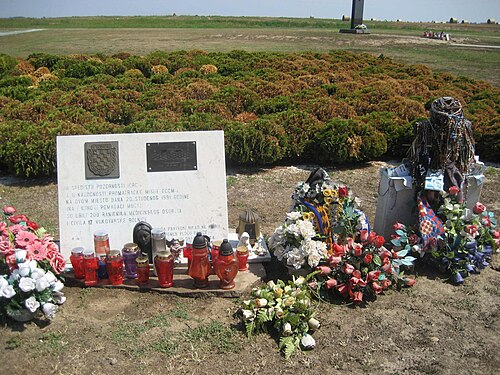
图:Modzzak · Public domain · 维基共享资源
- 时间
- 1991 年 11 月 18 日—1991 年 11 月 21 日
- 地点
- Grabovo, Tompojevci
- 国家 / 地区
- 克罗地亚
- 类型
- 屠杀
- 简述
- massacre
The Vukovar massacre, also known as the Vukovar hospital massacre or the Ovčara massacre, was the killing of at least 200 Croatian prisoners of war and civilians by Serb paramilitaries, to whom they had been turned over by the Yugoslav People's Army (JNA), at the Ovčara farm southeast of Vukovar on 20 November 1991, during the Croatian War of Independence. The massacre occurred shortly after Vukovar's capture by the JNA, Territorial Defence (TO), and paramilitaries from neighbouring Serbia. It was the largest massacre of the Croatian War of Independence.
In the final days of the battle, the evacuation of the Vukovar hospital was negotiated between Croatian authorities, the JNA and the European Community Monitor Mission in cooperation with the International Committee of the Red Cross (ICRC). The JNA subsequently refused the ICRC access to the hospital despite the agreement and removed approximately 300 people from its premises. The group, largely consisting of Croats but also including Serbs, Hungarians, Bosniaks and two foreign nationals who fought on the side of the Croatian National Guard, was initially transported to the JNA barracks in Vukovar. Several prisoners were identified as hospital staff and removed from the group to be returned to the hospital while the rest of them were transported to the Ovčara farm south of Vukovar. Once at the farm, the prisoners were beaten for several hours before the JNA pulled its troops from the site, leaving the prisoners in the custody of the Croatian Serb TO and Serbian paramilitaries. The prisoners were then taken to a prepared site, shot in groups of ten to twenty and buried in a mass grave.
详细介绍
Background
In 1990, ethnic tensions between Serbs and Croats worsened after the electoral defeat of the government of the Socialist Republic of Croatia by the Croatian Democratic Union (Croatian: Hrvatska demokratska zajednica – HDZ). The Yugoslav People's Army (Serbo-Croatian: Jugoslovenska narodna armija – JNA) confiscated Croatia's Territorial Defence (Croatian: Teritorijalna obrana – TO) weapons to minimize resistance. On 17 August, the tensions escalated into an open revolt of the Croatian Serbs. The rebellion was centred on the predominantly Serb-populated areas of the Dalmatian hinterland around Knin, approximately 60 kilometres (37 miles) north-east of Split, as well as parts of Lika, Kordun, Banovina and eastern Slavonia.……
Prelude
After Croatia launched the Battle of the Barracks on 14–15 September to capture the JNA's facilities in Croatia, the JNA launched a small-scale operation against Vukovar to relieve the city garrison. At the same time, it began large-scale mobilisation of men in preparation for its campaign in Croatia. It was met with widespread refusal of mobilised personnel to report to their designated units, desertions and an overall lack of enthusiasm for the campaign. The response rate was particularly poor in Central Serbia, where only 26 percent of those called up reported for service. This resulted in low troop availability, forcing the JNA to deploy fewer infantry units.
The JNA's offensive operations, directly associated with the campaign in the east Croatian region of Slavonia, were launched on 20 September.……
Timeline
Evacuation arrangements
On 17 November, Major General Andrija Rašeta, the commander of the JNA 5th (Zagreb) Military District, notified the European Community Monitor Mission (ECMM) that the JNA accepted in principle the quick evacuation of vulnerable persons from Vukovar. At the time, it was estimated that there were about 400 people trapped in the city's hospital, but the actual number was later discovered to be about 450. This included about 40 patients receiving treatment for severe injuries sustained over the preceding few days and about 360 patients recovering from wounds suffered earlier on. In addition to these individuals, some civilians had taken shelter in the hospital in the final days of the battle. They moved there expecting to be evacuated from the city, even though the hospital itself was subjected to daily artillery attack.……
Takeover of the hospital
On the morning of 19 November, the ECMM became aware that organised resistance had ceased in Vukovar, but it did not receive any information on the fate of the hospital patients.……
Aftermath
Croatian Serb forces turned Ovčara into a prison camp in early October 1991. Aside from the massacre, 3,000–4,000 male prisoners were temporarily held in the Ovčara camp at some point during autumn of 1991 before being transported to the prison in Sremska Mitrovica or to the local JNA barracks, which was the transit point for Serbian detention camps such as Stajićevo and Begejci. Following a series of political agreements concluded in 1991 and a ceasefire between the JNA and Croatia in early 1992, the United Nations Protection Force (UNPROFOR) was deployed for peacekeeping in certain parts of Croatia, including Vukovar and its surroundings. It began its deployment in March 1992.
Discovery of the mass grave
Forensic anthropologist Clyde Snow learned of the massacre during his visit to Zagreb in October 1992.……
正文摘自英文维基百科(原文为英文,未翻译)「Vukovar massacre」(节选,删去了参考文献、表格和图片),按 CC BY-SA 4.0 使用;在维基百科读全文 ›
同时期、同地区的大事
- 切尔诺贝利核事故1986 年 4 月 26 日 · 其他事件 · 欧洲
- 两德统一1989 年 11 月 9 日—1990 年 10 月 3 日 · 其他事件 · 欧洲
- 申根公约1985 年 6 月 14 日 · 条约与会议 · 欧洲
- 波斯尼亚战争1992 年 4 月 6 日—1995 年 12 月 14 日 · 战争 · 欧洲
- 斯雷布雷尼察种族灭绝1995 年 7 月 11 日—1995 年 7 月 22 日 · 屠杀与暗杀 · 欧洲
- 科索沃战争1998 年 2 月 27 日—1999 年 6 月 11 日 · 战争 · 欧洲
- 橙色革命2004 年 11 月 22 日—2005 年 1 月 23 日 · 革命与起义 · 欧洲
- 伦敦七七爆炸案2005 年 7 月 7 日 · 其他事件 · 欧洲
- 东欧剧变1989 年 3 月 9 日—1992 年 4 月 27 日 · 其他事件 · 欧洲
- 南斯拉夫内战1991 年 3 月 31 日—2001 年 8 月 13 日 · 战争 · 欧洲
- 克罗地亚战争1991 年 3 月 31 日—1995 年 8 月 7 日 · 战争 · 欧洲
- 天鹅绒革命1989 年 11 月 17 日—1989 年 12 月 29 日 · 革命与起义 · 欧洲
同时期的同类事件(屠杀与暗杀)
- 六四事件1989 年 4 月 15 日—1989 年 6 月 4 日 · 屠杀与暗杀 · 东亚
- 2011年挪威爆炸和枪击事件2011 年 7 月 22 日 · 屠杀与暗杀 · 欧洲
- 2019年新西兰基督城清真寺枪击案2019 年 3 月 15 日 · 屠杀与暗杀 · 大洋洲
- 查理周刊总部枪击案2015 年 1 月 7 日 · 屠杀与暗杀 · 欧洲
- 2016年法国尼斯袭击2016 年 7 月 14 日 · 屠杀与暗杀 · 欧洲
- 2016年3月布鲁塞尔袭击事件2016 年 3 月 22 日 · 屠杀与暗杀 · 欧洲
- 美莱村屠杀1968 年 3 月 16 日 · 屠杀与暗杀 · 东南亚
- 肯尼迪遇刺案1963 年 11 月 22 日 · 屠杀与暗杀 · 北美洲
- 2013年波士顿马拉松爆炸案2013 年 4 月 15 日 · 屠杀与暗杀 · 北美洲
- 慕尼黑惨案1972 年 9 月 5 日—1972 年 9 月 6 日 · 屠杀与暗杀 · 欧洲
- 2016年奥兰多夜店枪击案2016 年 6 月 12 日 · 屠杀与暗杀 · 北美洲
- 科加雷姆航空9268号班机空难2015 年 10 月 31 日 · 屠杀与暗杀 · 非洲