 史鉴
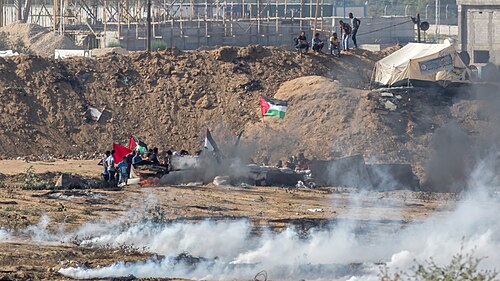
图:מינוזיג - MinoZig · CC BY-SA 4.0 · 维基共享资源
- 时间
- 2018 年 3 月 30 日
- 地点
- Israel–Gaza Strip border
- 国家 / 地区
- 巴勒斯坦
- 参与方
- 以色列、哈马斯、巴勒斯坦伊斯兰圣战组织
- 属于
- 加沙-以色列冲突
- 起因
- 土地日
- 死亡人数
- 183 人
- 类型
- 武装冲突、骚乱、游行示威
- 简述
- 抗议事件
2018年加沙边境抗议事件于2018年3月30日开始,在加沙地带靠近以色列边境处进行。进行示威的巴勒斯坦人要求原居于以色列的巴勒斯坦人及其后代可以享有返回故乡定居的权利。他们也抗议以色列对加沙的长期封锁以及美国把驻以色列大使馆搬迁到耶路撒冷。示威由独立的活跃分子发起,并得到哈马斯的认可和支持。造成自2014年加沙战争以来最严重的以巴冲突伤亡。 此事亦被称为 Great March of Return (2018年巴勒斯坦回归大游行)。
在2018年3月30日至5月15日期间,以色列士兵发射催泪弹和实弹,至少110名巴勒斯坦人丧生。其中一些人是不同的巴勒斯坦武装组织的成员。截至2018年5月15日,以军有一名士兵受轻伤。
在美国驻以色列大使馆迁往耶路撒冷之日,即2018年5月14日星期一,巴人示威进一步升温。以军估计在加沙的12个地点共有35,000人参与示威,另有数千人朝着边境围栏前进。在加沙边境,以色列人的开火造成448名巴人受伤,41名示威者被杀,其中3人正带着爆炸物前往围栏。
2018年6月13日联合国大会第十届紧急特别会议以120票赞成、8票反对、45票弃权作出联合国大会第ES-10/20号决议批评以色列对本事件的镇压。
正文摘自中文维基百科「2018—2019年加沙边境抗议事件」(删去了参考文献、表格和图片),按 CC BY-SA 4.0 使用
英文维基百科的更多内容
中文维基百科这一条比较短,下面是英文维基百科同一条目的节选,原文为英文,未翻译。
The 2018–2019 Gaza border protests, also known as the Great March of Return (Arabic: مسیرة العودة الكبرى, romanized: Masīra al-ʿawda al-kubrā), were a series of demonstrations held each Friday in the Gaza Strip near the Gaza–Israel barrier from 30 March 2018 until 27 December 2019, in which Israel killed a total of 223 Palestinians. The demonstrators demanded that the Palestinian refugees must be allowed to return to lands they were displaced from in territory that was Mandatory Palestine and is now Israel. They protested against Israel's land, air and sea blockade of Gaza and the United States recognition of Jerusalem as capital of Israel.
The first demonstrations were organized by independent activists, but the initiative was soon endorsed by Hamas, the governing party of Gaza, as well as other major factions in Gaza. The activists who planned the Great March of Return intended it to last only from 30 March 2018 (Land Day) to 15 May (Nakba Day) but the demonstrations continued for almost 18 months until the organizing committee for the Great March of Return announced on 27 December 2019 that they would be postponed. Thirty thousand Palestinians participated in the first demonstration on 30 March. Larger protests took place on the following Fridays, 6 April, 13 April, 20 April, 27 April, 4 May, and 11 May — each of which involved at least 10,000 demonstrators — while smaller numbers attended activities during the week.
Most of the demonstrators demonstrated peacefully far from the border fence. Peter Cammack, a fellow with the Middle East Program at the Carnegie Endowment for International Peace, argued that the march indicated a new trend in Palestinian society and Hamas, with a shift away from violence towards non-violent forms of protest.……
Background
In 2005, Israel withdrew its forces from Gaza and allowed the Palestinian authority to take control.……
Gaza's "no-go zone" and border barrier
In late 2005, after the Israeli disengagement from Gaza, the Israeli military imposed a "no-go zone" on the interior side of the Gaza–Israel border in response to rocket fire from Gaza falling on Israeli towns.……
Idea, organization, and strategy
The idea for a peaceful protest by Gazans demanding their right of return to Israel dates to the early 2010s. Ahmed Abu Ratima (pref. Artema), a Palestinian journalist, proposed a protest of this sort in a Facebook post.……
Timeline
Prior incidents
There was some violence between Israel and Gaza militants in the months leading up to the protests. In February 2018, four IDF soldiers were injured by an explosive device concealed in a Palestinian flag placed on the Gazan border fence during a Palestinian protest.……
30 March 2018
The first protest took place on 30 March 2018, around 500 to 700 metres (1,600 to 2,300 ft) from the Israel–Gaza border fence.……
Casualties
One Israeli soldier was injured due to shrapnel from a grenade thrown by a Palestinian from inside Gaza and one Israeli soldier was killed by Palestinian sniper fire near the fence but outside of the context of the protests.
Characterization of the injuries caused by Israeli fire
The Commissioner General of the United Nations Relief and Works Agency for Palestine Refugees in the Near East (UNRWA) stated that the ammunition used by Israel caused severe internal damage to internal organs, muscle tissue and bones.……
Legal cases
Two Palestinians, Yousef Karnaz and Mohammad Al-Ajouri, each had to have one of their legs amputated after Israeli authorities denied their requests to receive medical treatment at a better-equipped hospital in the West Bank.……
Investigations
On 5 April 2018, the IDF announced that its Southern Command would conduct an internal investigation into the deaths of civilians during the prior week. Brigadier General Moti Baruch was appointed to lead a second government investigation.……
Tactics
Palestinian tactics
Observers from the International Crisis Group and the UN Office for the Coordination of Humanitarian Affairs reported that the majority of protesters acted nonviolently on 30 March and 6 April.
Tent encampment
Organizers set up five tents 500 to 700 metres (1,600 to 2,300 ft) from the border and during the campaign their number grew to several dozen.……
Worldwide protests
Demonstrations expressing solidarity with the protesters and condemning the use of lethal force by Israeli forces, were held in Israel, the US, the UK, and Australia. Thousands of protesters gathered in Tel Aviv, Washington D.C., Boston, London, Manchester, Sheffield, Bristol, and Melbourne.
Reactions
States
The escalation of violence in Gaza drew concern from the Arab world. Jordan and Egypt condemned Israel's use of force, considering recent developments as harmful to brokering peace.……
Supranational organisations
Arab League: The Arab League condemned the continuous discrimination and violence against peaceful Palestinian protesters.……
Criticism of media coverage
The area of the conflict was subject to intense monitoring. On the Israeli side of the border, observers watched and filmed events using telescopes, long lenses, and feeds from the cameras, drones, quadcopters and tethered surveillance balloons hovering over the sites.……
Gaza war
Ahmed Abu Ratima (pref. Artema), one of the organizers of the original Gaza border protests, was seriously injured in an Israeli airstrike during the Gaza war;……
正文摘自英文维基百科(原文为英文,未翻译)「2018–2019 Gaza border protests」(节选,删去了参考文献、表格和图片),按 CC BY-SA 4.0 使用;在维基百科读全文 ›
同时期、同地区的大事
- 加沙战争2023 年 10 月 7 日 · 战争 · 西亚
- 叙利亚内战2011 年 3 月 15 日—2024 年 12 月 8 日 · 战争 · 西亚
- 伊拉克战争2003 年 3 月 20 日—2011 年 12 月 15 日 · 战争 · 西亚
- 2026年伊朗战争2026 年 2 月 28 日 · 战役 · 西亚
- 加沙地带种族灭绝2023 年 10 月 7 日 · 屠杀与暗杀 · 西亚
- 2023年土耳其-叙利亚地震2023 年 2 月 6 日 · 其他事件 · 西亚
- 2008年南奥塞梯战争2008 年 8 月 7 日—2008 年 8 月 12 日 · 战争 · 西亚
- 2020年贝鲁特爆炸事故2020 年 8 月 4 日 · 其他事件 · 西亚
- 十二日战争2025 年 6 月 13 日—2025 年 6 月 24 日 · 战争 · 西亚
- 2016年土耳其政变2016 年 7 月 15 日 · 其他事件 · 西亚
- 2006年以黎冲突2006 年 7 月 12 日—2006 年 8 月 14 日 · 战争 · 西亚
- 2020年9月纳戈尔诺-卡拉巴赫冲突2020 年 9 月 27 日—2020 年 11 月 10 日 · 战争 · 西亚
同时期的同类事件(战争)
- 俄罗斯入侵乌克兰2022 年 2 月 24 日 · 战争 · 欧洲
- 俄乌战争2014 年 2 月 20 日 · 战争 · 欧洲
- 波斯湾战争1990 年 8 月 2 日—1991 年 2 月 28 日 · 战争 · 西亚
- 阿拉伯之春2010 年 12 月 18 日—2012 年 12 月 · 战争 · 非洲
- 利比亚内战2011 年 2 月 15 日—2011 年 10 月 23 日 · 战争 · 非洲
- 卢旺达大屠杀1994 年 4 月 7 日—1994 年 7 月 4 日 · 战争 · 非洲
- 阿富汗战争2001 年 10 月 7 日—2021 年 8 月 30 日 · 战争 · 南亚
- 第一次车臣战争1994 年 12 月 11 日—1996 年 8 月 31 日 · 战争 · 西亚
- 波斯尼亚战争1992 年 4 月 6 日—1995 年 12 月 14 日 · 战争 · 欧洲
- 反恐战争2001 年 9 月 11 日 · 战争
- 科索沃战争1998 年 2 月 27 日—1999 年 6 月 11 日 · 战争 · 欧洲
- 顿巴斯战争2014 年 4 月 12 日—2022 年 2 月 24 日 · 战争 · 欧洲