 史鉴
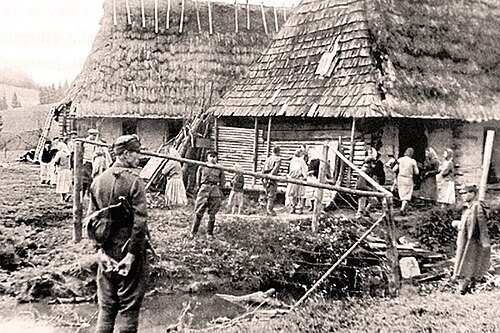
图:佚名 · Public domain · 维基共享资源
- 时间
- 1947 年 4 月 28 日—1947 年 7 月 31 日
- 地点
- 别什查第、Low Beskids
- 国家 / 地区
- 波兰人民共和国
- 参与方
- 波兰工人党、波兰人民军、内部安全部队
- 属于
- Polish–Ukrainian conflict
- 起因
- 瓦莱尼亚与东加利西亚波兰人大屠杀
- 类型
- 军事作战、强迫迁移
- 简述
- 1947 population resettlement in Poland
维斯瓦河行动(波兰语:Akcja „Wisła”)是1947年波兰把境内东南部乌克兰人、博伊科人、兰科人强制迁徙至“收复的领土”行动的代号。该行动由受苏联支持的波兰共产党政权执行,其目的为消除当地人对乌克兰反抗军的物质支持。1947年前,乌克兰反抗军一直在喀尔巴阡山省和卢布林省进行游击战活动,期间波兰裔苏联红军将领卡罗尔·希维尔切夫斯基被反抗军击毙。希维尔切夫斯基之死成为接下来波兰展开维斯瓦河行动的借口。而维斯瓦河行动实际上消除了当地的敌对行为。从1947年4月28日起的3个月内,在苏联的许可和帮助下,当地141000人被强制迁移到了德国前东部领土。一些波兰和乌克兰政治家将此次行动视作“种族清洗”和种族灭绝。
正文摘自中文维基百科「维斯瓦河行动」(删去了参考文献、表格和图片),按 CC BY-SA 4.0 使用
英文维基百科的更多内容
中文维基百科这一条比较短,下面是英文维基百科同一条目的节选,原文为英文,未翻译。
Operation Vistula (Polish: Akcja Wisła; Ukrainian: Опера́ція «Ві́сла», romanized: Operatsiya "Visla") was the codename for the 1947 ethnic cleansing, deportation and forced resettlement of close to 150,000 Ukrainians, Rusyns, Boykos, and Lemkos from the southeastern provinces of postwar Poland to the Recovered Territories in the north and west of the country.
The action was carried out by the Soviet-installed Polish communist authorities to remove material support to the Ukrainian Insurgent Army. The Ukrainian Insurgent Army continued its guerrilla activities until 1947 in Subcarpathian and Lublin Voivodeships with no hope for any peaceful resolution; Operation Vistula brought an end to the hostilities.
In a period of three months beginning on 28 April 1947 and with Soviet approval and aid about 141,000 civilians residing around Bieszczady, Low Beskids and most of Zakerzonia were deported to former German territories, ceded to Poland at the Yalta Conference at the end of World War II.
The operation was named after the Vistula River, Wisła in Polish; Polish and Ukrainian politicians as well as historians condemned the operation following the 1989 fall of communism in Eastern Europe and described it as ethnic cleansing Others argued that no other means of stopping the violence existed since partisans used to regroup outside Polish borders.
At the same time the Soviet Union carried out a parallel action, Operation West (Operatsiia Zakhid, or Operatsiya Zapad), in the Ukrainian SSR. Although both operations were coordinated from Moscow, there was a difference in their results. Operation West was conducted in West Ukraine by the Soviet NKVD and targeted the families of suspected UPA members.……
Background
The goal of the operation was to suppress the Ukrainian Insurgent Army (UPA), which had been fighting the Polish People's Army (LWP) in the southeast of Poland.……
Action participants
The operation was carried out by the Operational Group Vistula consisting of about 20,000 personnel commanded by General Stefan Mossor.……
Process of deportation
A principle of 'collective responsibility' was applied–all Ukrainians within the indicted area of Poland were deported regardless of political leanings, alliances and historical affiliations. Polish authorities decided to resettle "every person of Ukrainian nationality".……
Events
The deportations occurred in stages. Poland and the Soviet Ukraine conducted population exchanges resulting from bilateral agreements signed on 9 September 1944 and 16 August 1945. The first transfers occurred at the end of World War II.……
Conditions upon resettlement
Living standards were harsh for the deported Ukrainians, as deportees were refused compensation for the property and land they were forced to leave behind and because communities and families were separated across the four provinces of Olsztyn, Szczecin, Wrocław and Gdańsk, carefully dispersed so that the Ukrainian deportees did not constitute more than 10% of the local population.……
Situation of Lemkos in Poland
Some five thousand Lemko families returned to their home regions in south-eastern Poland in 1957 and 1958.……
Legacy
On 3 August 1990, the Polish Senate adopted a resolution condemning the postwar Polish government's Operation Vistula.……
正文摘自英文维基百科(原文为英文,未翻译)「Operation Vistula」(节选,删去了参考文献、表格和图片),按 CC BY-SA 4.0 使用;在维基百科读全文 ›
相关政权
同时期、同地区的大事
- 犹太人大屠杀1933 年—1945 年 · 屠杀与暗杀 · 欧洲
- 柏林墙1961 年 8 月 13 日—1989 年 11 月 9 日 · 其他事件 · 欧洲
- 奥斯威辛集中营1940 年 5 月 20 日—1945 年 1 月 27 日 · 其他事件 · 欧洲
- 西班牙内战1936 年 7 月 18 日—1939 年 4 月 1 日 · 战争 · 欧洲
- 斯大林格勒战役1942 年 8 月 23 日—1943 年 2 月 2 日 · 战役 · 欧洲
- 苏德互不侵犯条约1939 年 8 月 23 日—1941 年 6 月 22 日 · 其他事件 · 欧洲
- 盖世太保1933 年 4 月 26 日—1945 年 5 月 8 日 · 其他事件 · 欧洲
- 意大利国旗1946 年 6 月 18 日 · 其他事件 · 欧洲
- 冬季战争1939 年 11 月 30 日—1940 年 3 月 13 日 · 战争 · 欧洲
- 乌克兰大饥荒1932 年—1933 年 · 屠杀与暗杀 · 欧洲
- 巴巴罗萨行动1941 年 6 月 22 日—1941 年 12 月 5 日 · 战役 · 欧洲
- 雅尔塔会议1945 年 2 月 4 日—1945 年 2 月 11 日 · 条约与会议 · 欧洲
同时期的同类事件(战役)
- 珍珠港事件1941 年 12 月 7 日 · 战役 · 大洋洲
- 第二次中东战争1956 年 10 月 29 日—1956 年 11 月 7 日 · 战役 · 非洲
- 波兰战役1939 年 9 月 1 日—1939 年 10 月 6 日 · 战役 · 欧洲
- 不列颠战役1940 年 7 月 10 日—1940 年 10 月 31 日 · 战役 · 欧洲
- 法国战役1940 年 5 月 10 日—1940 年 6 月 25 日 · 战役 · 欧洲
- 海王行动1944 年 6 月 6 日—1944 年 8 月 29 日 · 战役 · 欧洲
- 柏林战役1945 年 4 月 16 日—1945 年 5 月 2 日 · 战役 · 欧洲
- 库尔斯克会战1943 年 7 月 5 日—1943 年 8 月 23 日 · 战役 · 欧洲
- 列宁格勒围城战1941 年 9 月 8 日—1944 年 1 月 27 日 · 战役 · 欧洲
- 中途岛海战1942 年 6 月 4 日—1942 年 6 月 7 日 · 战役 · 北美洲
- 莫斯科战役1941 年 9 月 30 日—1942 年 4 月 20 日 · 战役 · 欧洲
- 硫磺岛战役1945 年 2 月 8 日—1945 年 3 月 26 日 · 战役 · 东亚