 史鉴
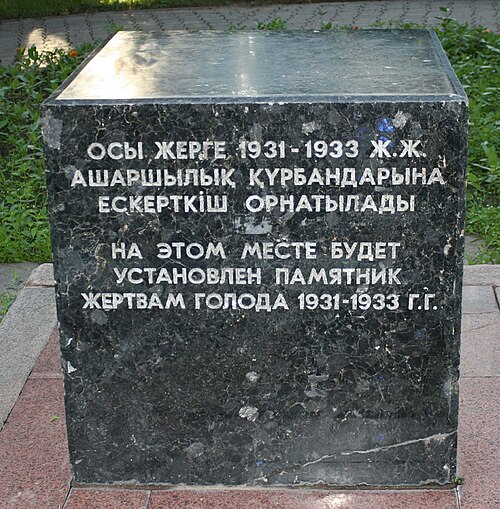
图:Ds02006 · Public domain · 维基共享资源
- 时间
- 1930 年—1933 年
- 国家 / 地区
- 哈萨克自治社会主义共和国
- 属于
- 1932年苏联大饥荒
- 类型
- 饥荒
- 简述
- 1930–1933 man-made famine that affected Soviet Kazakhstan
哈萨克大饥荒是1932年苏联大饥荒的一部分,发生于当时苏联苏俄哈萨克自治社会主义苏维埃共和国。哈萨克人按死亡人数比例在苏联大饥荒中受影响最为严重(约38%)。
详细介绍
重大意义
哈萨克大约150万死亡人口中有130万人是哈萨克族。其余20万人当中,大部分乌克兰人也受到影响。根据其他估计,可能最终有多达200–230万哈萨克族死于这场饥荒。此外,饥荒期间约有25万哈萨克人突破封锁,越境逃往中国,苏联为防消息走漏与动荡,开始调来兵力控制骚乱,并在边境部署狙击手射杀那些逃难的匪徒。而这场饥荒除了政策错误,有部分的天气因素导致农牧欠收,以及游牧、耕作习惯的强制改变,并使得哈萨克族在他们的共和国变成少数民族,直到1990年代哈萨克族才在哈萨克再次成为最大族群。这场饥荒之前,这个共和国60%的人口是哈萨克族,但饥荒过后,只有大约38%的人口是哈萨克族。德国与法国等决议将大饥荒视其为对前苏联国家的种族灭绝,这受到俄罗斯的抗议。
正文摘自中文维基百科「1932年哈萨克斯坦大饥荒」(删去了参考文献、表格和图片),按 CC BY-SA 4.0 使用
英文维基百科的更多内容
中文维基百科这一条比较短,下面是英文维基百科同一条目的节选,原文为英文,未翻译。
The Kazakh famine of 1930–1933, also known as the Asharshylyq, was a man-made famine in the Kazakh Autonomous Socialist Soviet Republic, then part of the Soviet Union, during which an estimated 1.3 to 2.3 million people died, the majority of them ethnic Kazakhs. Between 38 and 42 percent of all Kazakhs perished, the highest proportion of any ethnic group killed in the Soviet famines of the early 1930s. Other estimates put the number of deaths at about 1.75 million, while some research suggests the toll may have exceeded 2 million.
The famine was a direct result of Soviet collectivization policies, implemented in Kazakhstan under the authority of First Secretary Filipp Goloshchyokin. Traditionally a nomadic people, Kazakhs relied heavily on livestock herding. Collectivization destroyed this system: herds were seized by the state, traditional migrations were disrupted, and communities were forced into collective farms ill-suited for the steppe environment. Hunger was intensified by harsh state requisitioning, the imposition of excessive grain and livestock quotas, and repressive measures such as the blacklisting of entire districts from trade. Thousands of Kazakhs who attempted to escape to neighboring China were shot by border guards, while others died during mass migrations across Central Asia.
The famine began in late 1930, a year before the worst phase of the Ukrainian famine, or Holodomor, and lasted through 1933. Its effects were catastrophic: Kazakhstan's population fell by more than a third, and Kazakhs were reduced from about 60 percent of the republic's inhabitants to 38 percent, making them a minority in their own homeland for decades. Large numbers of survivors fled permanently to China, Afghanistan, and other regions.……
Etymology
The famine is commonly known as the Asharshylyq or Asharshylyk. It comes from Kazakh: Ашаршылық, [ɑʃɑrʃɯˈɫɯq], meaning 'famine' or 'hunger'.
Background
In the years leading up to the famine, several interconnected factors played a crucial role in exacerbating the dire situation. The historical context was shaped by a complex interplay of demographic changes and traditional nomadic pastoralism practices in Central Asia, particularly centered around a meat and dairy based diet.……
Overview
Signs of the Kazakh famine began emerging in the late 1920s, with the factor being the jut from 1927 to 1928, which was a period of extreme cold in which cattle were starved and were unable to graze.
Casualties
Kazakhstan included some of the regions affected severely by famine, percentage-wise, although more people died in famine in Soviet Ukraine, which began a year later. In addition to the Kazakh famine of 1919–1922, Kazakhstan lost more than half of its population in 10–15 years due to the actions of the Soviet state.……
Refugees
Due to starvation, between 665,000 and 1.1 million Kazakhs fled the famine with their cattle outside Kazakhstan to China, Mongolia, Afghanistan, Iran, Turkey, and the Soviet republics of Uzbekistan, Kyrgyzstan, Turkmenistan, Tajikistan, and Russia in search of food and employment in the new industrialization sites of Western Siberia.……
Aftermath and legacy
Two thirds of the Kazakh survivors of the famine were successfully sedentarized due to the 80% reduction of their herds, the impossibility of resuming pastoral activity in the immediate post-famine environment, and the repatriation and resettlement program undertaken by Soviet authorities.……
Assessment, legality, and censorship
Like the Holodomor, there is heated debate as to whether or not the famine fits in with the legal definition of genocide, as defined by the UN. In November 1991, the Kazakhstan parliament created a committee, chaired by Historian Manash Kozybayev, to investigate the famine and its causes.……
Portrayals in media
The Crying Steppe (2020), director Marina Kunarova, and selected as the Kazakhstani entry for the Best International Feature Film at the 93rd Academy Awards. The movie follows an eagle hunter trying to save his family.
Qash (2023), director Aisultan Seitov. The movie follows a gravedigger facing a difficult choice during the famine.
正文摘自英文维基百科(原文为英文,未翻译)「Kazakh famine of 1930–1933」(节选,删去了参考文献、表格和图片),按 CC BY-SA 4.0 使用;在维基百科读全文 ›
同时期的同类事件(灾难与瘟疫)
- 艾滋病1959 年 · 灾难与瘟疫
- 1960年智利大地震1960 年 5 月 21 日 · 灾难与瘟疫 · 拉丁美洲
- 1906年旧金山大地震1906 年 4 月 18 日 · 灾难与瘟疫 · 北美洲
- 三年大饥荒1959 年—1961 年 · 灾难与瘟疫 · 东亚
- 1943年孟加拉饥荒1943 年—1944 年 · 灾难与瘟疫 · 南亚
- 1952年伦敦烟雾事件1952 年 12 月 5 日—1952 年 12 月 9 日 · 灾难与瘟疫 · 欧洲
- 哈利法克斯爆炸1917 年 12 月 6 日 · 灾难与瘟疫 · 北美洲
- 1908年墨西拿地震1908 年 12 月 28 日 · 灾难与瘟疫 · 欧洲
- 亚洲流感1957 年—1958 年 · 灾难与瘟疫
- 1921年俄国大饥荒1921 年—1922 年 · 灾难与瘟疫 · 欧洲
- 1932年苏联大饥荒1932 年—1933 年 · 灾难与瘟疫 · 中亚与北亚
- 波士顿糖蜜灾难1919 年 1 月 15 日 · 灾难与瘟疫 · 北美洲