 史鉴
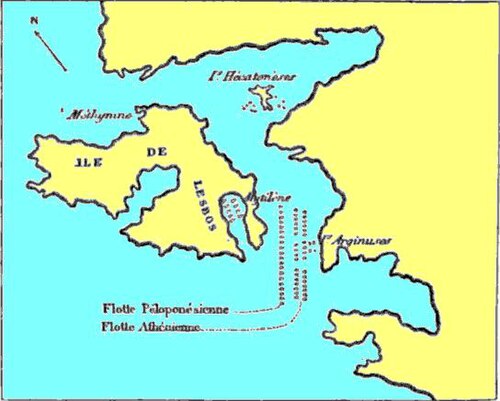
图:A. du Sein (colors added) · Public domain · 维基共享资源
- 时间
- 公元前 406 年 9 月
- 地点
- Garip Island
- 国家 / 地区
- 土耳其
- 属于
- Decelean War
- 类型
- 海军作战
- 简述
- battle of the Peloponnesian war
The Battle of Arginusae took place in 406 BC during the Peloponnesian War near the city of Canae in the Arginusae Islands, east of the island of Lesbos. In the battle, an Athenian fleet commanded by eight strategoi defeated a Spartan fleet under Callicratidas. The battle was precipitated by a Spartan victory, which led to the Athenian fleet under Conon being blockaded at Mytilene. To relieve Conon, the Athenians assembled a scratch force composed largely of newly-constructed ships manned by inexperienced crews. The inexperienced fleet was thus tactically inferior to the Spartans, but its commanders circumvented the problem by employing new and unorthodox tactics, which allowed the Athenians to secure a dramatic and unexpected victory. Slaves and metics who participated in the battle may have been granted Athenian citizenship.
The news of the victory itself was met with jubilation at Athens. Their joy was tempered, however, by the aftermath of the battle, in which a storm prevented the ships assigned to rescue the survivors of the 25 disabled or sunken Athenian triremes from performing their duties, and a great number of sailors drowned. A fury erupted at Athens when the public learned of that, and a bitter struggle occurred after which the assembly tried and executed as a group six of the eight commanding generals.
At Sparta, meanwhile, traditionalists who had supported Callicratidas pressed for peace with Athens since they knew that a continuation of the war would lead to the reascendence of their opponent Lysander. The party initially prevailed, and a delegation was dispatched to Athens to make an offer of peace.……
详细介绍
Background
Callicratidas and Conon
In 406 BC, Callicratidas was appointed as the navarch of the Spartan fleet, replacing Lysander. Callicratidas was a traditionalist Spartan, distrustful of Persian influence and reluctant to ask for support from the Persian prince Cyrus, who had been a strong supporter of Lysander. Thus, Callicratidas was forced to assemble his fleet and funding by seeking contributions from Sparta's allies among the Greek cities of the region. In this fashion, he assembled a fleet of some 140 triremes. Conon, meanwhile, in command of the Athenian fleet at Samos, was compelled by problems with the morale of his sailors to man only 70 of the more than 100 triremes he had in his possession.
Callicratidas, once he had assembled his fleet, sailed against Methymna, on Lesbos, which he laid siege to and stormed. From Methymna, Callicratidas could potentially move to capture the rest of Lesbos, which would clear the way for him to move his fleet to the Hellespont, where he would be athwart the all-important Athenian grain supply line.……
Relief force
When the messenger ship reached Athens with news of Conon's situation, the assembly wasted no time in approving extreme measures to build and man a relief force.……
Battle
At dawn the next day, Callicratidas led his fleet out to meet the Athenians. He had 140 ships to match the Athenians' 150 and had left 50 to watch Conon at Mytilene. For the first time in the war, the Spartan crews and commanders were more experienced than their Athenian opposites, as the Athenians' best crews had been at sea with Conon. To counter the Spartans' superior skill and maneuverability, the Athenian commanders implemented several new and innovative tactics. Firstly, the Athenian fleet was divided into eight autonomous divisions, each commanded by one of the generals. Secondly, they arranged their fleet in a double line, instead of the traditional single line, to prevent the Spartans from using the maneuver known as the diekplous in which a trireme raced into a gap between two enemy ships and then wheeled to strike one of them in the side. If the Spartans attempted that against a double line, a ship from the second line could move up to attack the Spartan ship.
Aftermath
In the immediate aftermath of the battle, the Athenian commanders had to decide on which of several pressing tasks to focus their attention. Conon was still blockaded at Mytilene by 50 Spartan ships, and decisive action against those ships could lead to their destruction before they had a chance to join the remainder of Callicratidas' fleet. At the same time, however, the survivors from the 25 Athenian ships that had been sunk or disabled in the battle remained afloat off the Arginusae islands. To address both of these concerns, the generals decided that all eight of them would sail with the majority of the fleet to Mytilene, where they would attempt to relieve Conon, and the trierarchs Thrasybulus and Theramenes would remain behind with a smaller detachment to rescue the survivors. Both missions, however, were thwarted by the sudden arrival of a storm, which drove the ships back into port. The Spartan fleet at Mytilene escaped, and rescuing the drowning sailors proved impossible.
Trial of generals
At Athens, the public relief at this unexpected victory was quickly subsumed in a bitter rhetorical battle over who was responsible for the failure to rescue the sailors.……
The battle in fiction
An account of the battle appears in The Last of the Wine by Mary Renault. The narrator is an Athenian who takes part in the battle, but is shipwrecked and manages to swim to safety.
正文摘自英文维基百科(原文为英文,未翻译)「Battle of Arginusae」(节选,删去了参考文献、表格和图片),按 CC BY-SA 4.0 使用;在维基百科读全文 ›