 史鉴
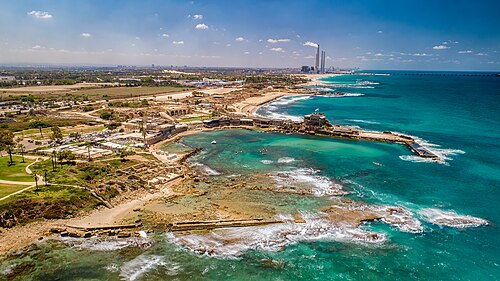
图:Idomeir · CC BY-SA 4.0 · 维基共享资源
- 时间
- 公元前 13 年—1265 年
- 国家 / 地区
- 以色列
- 类型
- 村、人类聚居地、殖民地、depopulated Palestinian village 等 6 项
- 包括
- 自行拆毁、Siege of Caesarea Maritima
- 简述
- ancient Levantine city
滨海凯撒里亚,又译滨海该撒利亚,天主教译海边的凯撒勒雅(拉丁语:Caesarea Maritima,古希腊语:Παράλιος Καισάρεια)是以色列的一处国家公园,包括海滨城市凯撒里亚的古代遗迹。这一城市和港口修建于大希律王时期,是重要的早期基督教中心。古代城市的遗迹位于现代城市凯撒里亚以南约2公里处,在1950年代和1960年代进行了挖掘,并在2011年设为国家公园。
正文摘自中文维基百科「滨海凯撒里亚」(删去了参考文献、表格和图片),按 CC BY-SA 4.0 使用
英文维基百科的更多内容
中文维基百科这一条比较短,下面是英文维基百科同一条目的节选,原文为英文,未翻译。
Caesarea, also Caesarea Maritima, Caesarea Palaestinae or Caesarea Stratonis, was an ancient and medieval port city on the coast of the eastern Mediterranean, and later a small fishing village. It was the capital of Roman Judaea, Syria Palaestina and Palaestina Prima, successively, for a period of c. 650 years and a major intellectual hub of the Mediterranean. Today, the site is part of the Caesarea National Park, on the western edge of the Sharon plain in Israel.
The site was first settled in the 4th century BCE as a Phoenician colony and trading village known as Straton's Tower after the ruler of Sidon. It was enlarged in the 1st century BCE under Hasmonean rule, becoming a Jewish village; and in 63 BCE, when the Roman Republic annexed the region, it was declared an autonomous city. It was then significantly enlarged in the Roman period by the Judaean client King Herod the Great, who established a harbour and dedicated the town and its port to Caesar Augustus as Caesarea.
During the early Roman period, Caesarea became the seat of the Roman procurators in the region. The city was populated throughout the 1st to 6th centuries CE and became an important early centre of Christianity during the Byzantine period. Its importance may have waned following the Muslim conquest of 640 when the city, then known in Arabic as Qisarya (قيسارية), lost its status as provincial capital. After being re-fortified by Muslim rulers in the 11th century, it was conquered by the Crusaders, who strengthened and made it into an important port, which was finally slighted by the Mamluks in 1265.
Qisarya was a small fishing village in the early modern period.……
Name
Whilst the name Caesarea was frequently used alone for the subject of this article, various markers were used to differentiate the location from these other locations; these include "Palaestina" ("of Palestine"), "Maritima" ("by the sea"; Greek: Παράλιος Parálios), "Sebaste" and "Stratonis". "Palaestina" is the most common term used in ancient sources, but, since the creation of Israel in 1948, historians in the West have tended to use the term less frequently.
The Latin name Caesarea also referred to several other cities in the region, notably Caesarea near Mount Hermon and Caesarea the capital of Cappadocia.
History
Straton's Tower
Stratonos pyrgos (Straton's Tower) was founded in the 4th century BCE by Abdashtart I, or Straton I king of Sidon. It was first established as a Phoenician colony and trading village. In 90 BCE, Jewish ruler Alexander Jannaeus captured Straton's Tower as part of his policy of developing the shipbuilding industry and enlarging the Hasmonean kingdom. Straton's Tower remained a Jewish settlement for two more generations, until the area became dominated by the Romans in 63 BCE, when they declared it an autonomous city.
Herod the Great builds Caesarea
Caesarea was built in Roman Judea under the Jewish client King Herod the Great during c. 22-10/9 BCE near the ruins of the small naval station of Straton's Tower. The site, along with all of Judea, was awarded by Rome to Herod in 30 BCE.……
Sebastos harbor
Herod built the two jetties of the harbour between 22 and 15 BCE, and in 10/9 BCE he dedicated the city and harbour to Emperor Augustus (sebastos is Greek for augustus).……
Archaeology and reconstruction
Large-scale archaeological excavations began in the 1950s and 1960s and continue to this day, conducted by volunteers working under the supervision of archaeologists. The majority of the archaeological excavations are done by the United States and Israel. Remains from many periods have been uncovered, in particular from the large city of the Roman and Byzantine periods and from the fortified town of the Crusaders. Major Classical-era findings are the Roman theatre; a temple dedicated to the goddess Roma and Emperor Augustus; a hippodrome rebuilt in the 2nd century as a more conventional theatre; the Tiberieum, where archaeologists found a reused limestone block with a dedicatory inscription mentioning Pilate the only archaeological find bearing his name and title; a double aqueduct that brought water from springs at the foot of Mount Carmel;……
正文摘自英文维基百科(原文为英文,未翻译)「Caesarea Maritima」(节选,删去了参考文献、表格和图片),按 CC BY-SA 4.0 使用;在维基百科读全文 ›