 史鉴
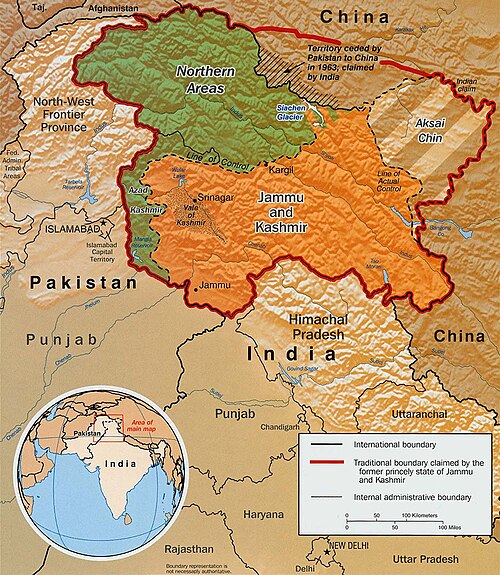
图:Central Intelligence Agency · Public domain · 维基共享资源
- 时间
- 2026 年 10 月 10 日
- 地点
- 克什米尔
- 参与方
- 印度、巴基斯坦
- 类型
- 武装冲突
- 简述
- 消歧义页
Since the partition of British India in 1947 and subsequent creation of the dominions of India and Pakistan, the two countries have been involved in a number of wars, conflicts, and military standoffs. A long-running dispute over Kashmir and cross-border terrorism have been the predominant cause of conflict between the two states, with the exception of the Indo-Pakistani War of 1971, which occurred as a direct result of hostilities stemming from the Bangladesh Liberation War in erstwhile East Pakistan (now Bangladesh).
详细介绍
Background
The Partition of India came in 1947 with the sudden grant of independence. It was the intention of those who wished for a Muslim state to have a clean partition between independent and equal "Pakistan" and "Hindustan" once independence came.
Nearly one third of the Muslim population of India remained in the new India.
Inter-communal violence between Hindus, Sikhs and Muslims resulted in between 200,000 and 2 million casualties leaving 14 million people displaced.
Wars
Indo-Pakistani war of 1947–1948
The war, also called the first Indo-Pakistani war, started in October 1947 when Pakistan feared that the Maharaja of the princely state of Kashmir and Jammu would accede to India. Following partition, princely states were left to choose whether to join India or Pakistan or to remain independent. Jammu and Kashmir, the largest of the princely states, had a majority Muslim population and significant fraction of Hindu population, all ruled by the Hindu Maharaja Hari Singh.……
Indo-Pakistani war of 1965
This war started following Pakistan's Operation Gibraltar, which was designed to infiltrate forces into Jammu and Kashmir to precipitate an insurgency against rule by India.……
Other conflicts
Apart from the aforementioned wars, there have been other regional conflicts between the two nations from time to time, which have not bordered on all-out war.
Siachen conflict (1984–2003)
The Siachen conflict, sometimes referred to as the Siachen Glacier conflict or the Siachen War, was a military conflict between India and Pakistan over the disputed 1,000-square-mile (2,600 km2) Siachen Glacier region in Kashmir. The conflict was started in 1984 by India's successful capture of the Siachen Glacier as part of Operation Meghdoot, and continued with Operation Rajiv in 1987.……
India-Pakistan conflict (2025)
The 2025 India–Pakistan conflict was a brief armed conflict between India and Pakistan that began on 7 May 2025, after India launched missile strikes on Pakistan, codenamed Operation Sindoor.……
Skirmishes, incidents and standoffs
Alongside full-scale wars and conflicts, several notable military skirmishes, border incidents, and standoffs have occurred between India and Pakistan, further straining bilateral relations and drawing international attention.
1959 Canberra shootdown: Pakistan intercepts an Indian aircraft during an aerial reconnaissance mission.
Operation Desert Hawk : Operation Desert Hawk was the codename for the military operation launched by the Pakistan Army in this area.……
Proxy wars
Insurgency in Jammu and Kashmir (1989–present): An insurgency in Kashmir has been a cause for heightened tensions. India has also accused Pakistan-backed militant groups of executing several terrorist attacks across India.
Insurgency in Balochistan (1948–present): An insurgency in Balochistan province of Pakistan has also caused tensions recently. Pakistan has accused India of causing the insurgency with the help of ousted Baloch leaders, militant groups and terrorist organizations like the Balochistan Liberation Army.……
Risk of nuclear conflict
The nuclear conflict between both countries is of passive strategic nature with nuclear doctrine of Pakistan stating a first strike policy, although the strike would only be initiated if and only if, the Pakistan Armed Forces are unable to halt an invasion (as for example in 1971 war) or a nuclear strike is launched against Pakistan, whereas India has a declared policy of no first use.……
Annual celebrations
The nations of South Asia observe national and armed forces-specific days which originate from conflicts between India and Pakistan as follows:
28 May (since 1998) as Youm-e-Takbir (The day of Greatness) in Pakistan.
26 July (since 1999) as Kargil Vijay Diwas (Kargil Victory Day) in India.
6 September (since 1965) as Defence Day (Youm-e-Difa) in Pakistan.
7 September (since 1965) as Air Force Day (Youm-e-Fizaya) in Pakistan.
8 September (since 1965) as Victory Day/Navy Day (Youm-e-Bahr'ya) in Pakistan.
4 December (since 1971) as Navy Day in India.
Involvement of other nations
Soviet Union:
The USSR remained neutral during the 1965 war and played a pivotal role in negotiating the peace agreement between India and Pakistan.
The Soviet Union provided diplomatic and military assistance to India during the 1971 war. In response to the US and UK's deployment of the aircraft carriers USS Enterprise and HMS Eagle, Moscow sent nuclear submarines and warships with anti-ship missiles in the Arabian Sea and Indian Ocean, respectively.
United States:
The US had not given any military aid to Pakistan in the Indo-Pakistani War of 1965.
正文摘自英文维基百科(原文为英文,未翻译)「India–Pakistan wars and conflicts」(节选,删去了参考文献、表格和图片),按 CC BY-SA 4.0 使用;在维基百科读全文 ›
下属事件
同时期、同地区的大事
- 2015年尼泊尔地震2015 年 4 月 25 日 · 灾难与瘟疫 · 南亚
- 马来西亚航空370号班机空难2014 年 3 月 8 日 · 其他事件 · 南亚
- 攻占喀布尔2021 年 8 月 15 日 · 战役 · 南亚
- 2021年塔利班攻势2021 年 5 月 1 日 · 战争 · 南亚
- 2025年尼泊尔Z世代抗议运动2025 年 9 月 8 日—2025 年 9 月 13 日 · 革命与起义 · 南亚
- 2019冠状病毒病印度疫情2020 年 1 月 30 日 · 灾难与瘟疫 · 南亚
- 2025年帕哈尔加姆袭击2025 年 4 月 22 日 · 屠杀与暗杀 · 南亚
- 2026年阿富汗-巴基斯坦战争2026 年 2 月 21 日 · 战争 · 南亚
- 2014年白沙瓦学校袭击事件2014 年 12 月 16 日 · 屠杀与暗杀 · 南亚
- 2024年孟加拉国公职配额改革运动2024 年 6 月 6 日—2024 年 8 月 3 日 · 革命与起义 · 南亚
- 2025年阿富汗地震2025 年 8 月 31 日 · 灾难与瘟疫 · 南亚
- 2022年斯里兰卡示威2022 年 3 月 15 日—2022 年 11 月 14 日 · 革命与起义 · 南亚
同时期的同类事件(战争)
- 俄罗斯入侵乌克兰2022 年 2 月 24 日 · 战争 · 欧洲
- 俄乌战争2014 年 2 月 20 日 · 战争 · 欧洲
- 加沙战争2023 年 10 月 7 日 · 战争 · 西亚
- 叙利亚内战2011 年 3 月 15 日—2024 年 12 月 8 日 · 战争 · 西亚
- 阿拉伯之春2010 年 12 月 18 日—2012 年 12 月 · 战争 · 非洲
- 伊拉克战争2003 年 3 月 20 日—2011 年 12 月 15 日 · 战争 · 西亚
- 利比亚内战2011 年 2 月 15 日—2011 年 10 月 23 日 · 战争 · 非洲
- 2008年南奥塞梯战争2008 年 8 月 7 日—2008 年 8 月 12 日 · 战争 · 西亚
- 阿富汗战争2001 年 10 月 7 日—2021 年 8 月 30 日 · 战争 · 南亚
- 十二日战争2025 年 6 月 13 日—2025 年 6 月 24 日 · 战争 · 西亚
- 反恐战争2001 年 9 月 11 日 · 战争
- 2006年以黎冲突2006 年 7 月 12 日—2006 年 8 月 14 日 · 战争 · 西亚