 史鉴
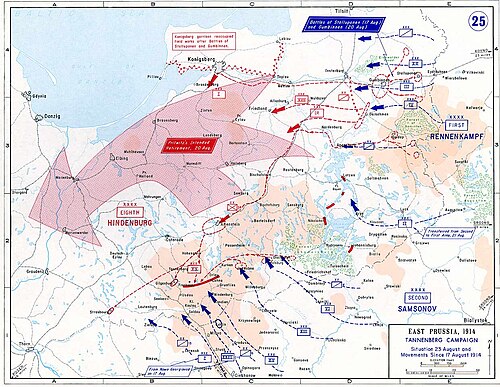
图:Department of Military Art and Engineering, at the U.S. Military Academy (West P · Public domain · 维基共享资源
东普鲁士战役是第一次世界大战期间在德意志帝国和俄罗斯帝国之间发生的一系列战役,持续时间从1914年8月至9月。为将更多德军吸引到东线以缓解西线法国的压力,自1914年7月30日俄国开始总动员后,俄国就准备入侵东普鲁士(今波兰瓦尔米亚-马祖里省、俄罗斯加里宁格勒州)。尽管俄军在数量上有着极大的优势(85万俄军对25万德军),但由于俄军间的配合不利,入侵行动最终还是以俄军的惨败而告终。
正文摘自中文维基百科「东普鲁士战役 (1914年)」(删去了参考文献、表格和图片),按 CC BY-SA 4.0 使用
英文维基百科的更多内容
中文维基百科这一条比较短,下面是英文维基百科同一条目的节选,原文为英文,未翻译。
The Russian invasion of East Prussia occurred during World War I, lasting from August to September 1914. As well as being the natural course for the Russian Empire to take upon the declaration of war on the German Empire, it was also an attempt to focus the Imperial German Army on the Eastern Front, as opposed to the Western Front as part of the alliance and to force Germany to fight a two front war. Despite superiority over the Germans in numbers, the invading Imperial Russian Army spread its forces thin and was defeated in the battles of Tannenberg and the Masurian Lakes, resulting in a complete strategic collapse of the Russian plan of war. The Germans also seemed to have weak cooperation among the troops and disagreements in the generals. The victory in East Prussia inspired too much self-confidence, which led to defeats at Warsaw and Lodz.
The shock of the invasion served to assist the German war effort. According to Alexander Watson "Outrage at the violation of national territory and Tsarist atrocities strengthened German solidarity, cemented conviction in the righteousness of the national cause, and acted as a terrible and lasting warning of the penalties of defeat".
German planning
German strategy regarding Russia was defensive from 1888 onward, when the Chief of the German General Staff, Helmuth von Moltke, abandoned the concept of a decisive offensive into Russian territory and began to consider defensive options. According to German intelligence estimates, the railway network in Poland limited the Russians to three options: a purely defensive posture against Germany, an offensive down the Vistula straight towards Berlin or an invasion of East Prussia with two armies, one from the Narew and one from the Neman.……
Russian planning
Grand Duke Nicholas, who had been appointed by Emperor Nicholas II as supreme commander of the Russian Army, fully supported going to war with Germany, especially after German troops occupied the town of Kalisz in Russian territory and committed atrocities there. He was an admirer of France and also understood the need for Russia to assist France's efforts on the Western Front. He told the French ambassador that Russia would invade East Prussia quickly to draw Germany's attention away from France.……
Comparison of strength
The invasion was led by two Russian armies: the 1st Army, which was commanded by General Paul von Rennenkampf and consisted of 6.5 infantry divisions, 5.5 cavalry divisions, 472 guns, 254 machine guns (later 7 new reserve divisions arrived) and the 2nd Army under the command of General Alexander Samsonov, composed of 11 infantry divisions, 3 cavalry divisions, 724 guns, 434 machine guns.……
Battle
However, quite quickly, Russia was able to mobilize an invasion into East Prussia. Any invasion of Prussia was an important blow to German morale as well as its general strategic situation. The German deployment on the outbreak of the war left only the 10 divisions of the German Eighth Army under General Maximilian von Prittwitz in East Prussia whereas the Russians had been able to mobilize the 1st Army, under General Paul von Rennenkampf and the 2nd Army, under General Alexander Samsonov. They entered East Prussia on 7–9 August.
Casualties and losses
According to the regimental lists of casualties and information from reports and logs of military operations, as well as information submitted later from the remnants of the formations that were surrounded, the units that were part of the Russian 2nd Army lost 220 officers and 5,302 soldiers killed before September 1914 (these are those who was taken out of the battlefield and buried by the Russian side), 542 officers and 11,784 soldiers were wounded (evacuated to Russia or admitted to field hospitals), missing (excluding two encircled corps)—391 officers and 29,491 soldiers.……
正文摘自英文维基百科(原文为英文,未翻译)「Russian invasion of East Prussia (1914)」(节选,删去了参考文献、表格和图片),按 CC BY-SA 4.0 使用;在维基百科读全文 ›
相关政权
同时期、同地区的大事
- 大萧条1929 年 10 月 29 日—1941 年 · 时代与时期 · 欧洲
- 凡尔赛条约1920 年 1 月 10 日 · 条约与会议 · 欧洲
- 十月革命1917 年 10 月 25 日—1917 年 10 月 26 日 · 革命与起义 · 欧洲
- 国家社会主义德国工人党1920 年 2 月 24 日—1945 年 10 月 10 日 · 其他事件 · 欧洲
- 党卫队1925 年 4 月 4 日—1945 年 5 月 8 日 · 其他事件 · 欧洲
- 德国国旗1917 年 · 其他事件 · 欧洲
- 俄国二月革命1917 年 3 月 8 日—1917 年 3 月 16 日 · 革命与起义 · 欧洲
- 巴黎和会1919 年 1 月 18 日—1920 年 1 月 21 日 · 其他事件 · 欧洲
- 巴尔干战争1912 年 10 月 8 日—1913 年 7 月 18 日 · 战争 · 欧洲
- 同盟国1914 年—1918 年 11 月 11 日 · 其他事件 · 欧洲
- 第一次巴尔干战争1912 年 10 月 8 日—1913 年 5 月 30 日 · 战争 · 欧洲
- 洛桑条约1923 年 7 月 24 日 · 条约与会议 · 欧洲
同时期的同类事件(战役)
- 斯大林格勒战役1942 年 8 月 23 日—1943 年 2 月 2 日 · 战役 · 欧洲
- 巴巴罗萨行动1941 年 6 月 22 日—1941 年 12 月 5 日 · 战役 · 欧洲
- 珍珠港事件1941 年 12 月 7 日 · 战役 · 大洋洲
- 波兰战役1939 年 9 月 1 日—1939 年 10 月 6 日 · 战役 · 欧洲
- 不列颠战役1940 年 7 月 10 日—1940 年 10 月 31 日 · 战役 · 欧洲
- 加里波利之战1915 年 4 月 25 日—1916 年 1 月 9 日 · 战役 · 西亚
- 法国战役1940 年 5 月 10 日—1940 年 6 月 25 日 · 战役 · 欧洲
- 海王行动1944 年 6 月 6 日—1944 年 8 月 29 日 · 战役 · 欧洲
- 库尔斯克会战1943 年 7 月 5 日—1943 年 8 月 23 日 · 战役 · 欧洲
- 列宁格勒围城战1941 年 9 月 8 日—1944 年 1 月 27 日 · 战役 · 欧洲
- 凡尔登战役1916 年 2 月 21 日—1916 年 12 月 18 日 · 战役 · 欧洲
- 索姆河战役1916 年 7 月 1 日—1916 年 11 月 17 日 · 战役 · 欧洲