 史鉴
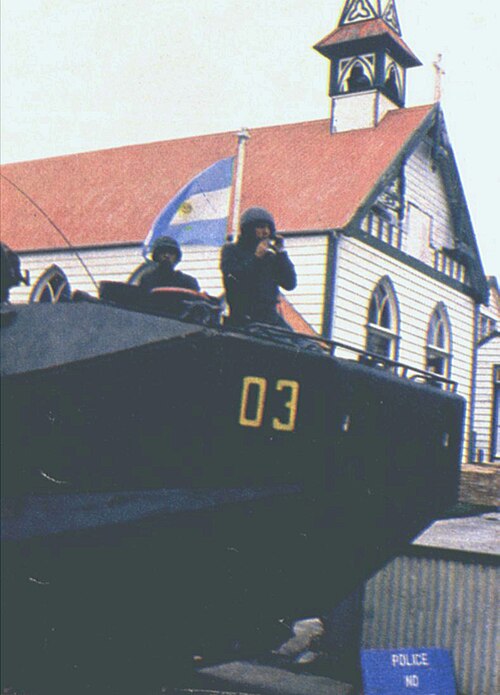
图:Official Argentine Navy photographer · Public domain · 维基共享资源
- 时间
- 1982 年 4 月 2 日—1982 年 4 月 3 日
- 地点
- 斯坦利
- 国家 / 地区
- 阿根廷
- 参与方
- 阿根廷军队
- 属于
- 马岛战争
- 结果 / 影响
- 马岛战争
- 类型
- 军事作战
- 简述
- invasion marking the beginning of the Falklands War in 1982
1982年4月2日,阿根廷武装部队入侵福克兰群岛(英语:Invasion of the Falkland Islands,西班牙语:Invasión de las Islas Malvinas),即“罗萨里奥行动”(Operación Rosario)。福克兰群岛是英国海外领土之一,不过阿根廷声称拥有福克兰群岛、南乔治亚和南三明治群岛的主权。1982年,阿根廷由东向西展开维护其主权各式行动,试图加强对于其领土的全面控制。
1982年4月2日,阿根廷海军突击队展开两栖登陆作战,入侵福克兰群岛。在行动开始前48小时,阿根廷政府设法秘密准备这次军事行动。最终阿根廷军队成功占领福克兰群岛首府史坦利,福克兰群岛政府大楼投降。整个占领福克兰群岛的行动仅花费11小时,并只造成1人死亡、5人受伤。不过这次入侵并占领福克兰群岛的军事行动导致福克兰战争爆发。作为这次事件的回应,英国派遣两支英国皇家海军特遣队前往南大西洋,试图夺回对福克兰群岛的控制权。
详细介绍
行动时间线
此次行动的时间线如下:
正文摘自中文维基百科「阿根廷入侵福克兰群岛」(删去了参考文献、表格和图片),按 CC BY-SA 4.0 使用
英文维基百科的更多内容
中文维基百科这一条比较短,下面是英文维基百科同一条目的节选,原文为英文,未翻译。
Argentine forces invaded the Falkland Islands on 2 April 1982 in a military operation code-named Operation Rosario (Operación Rosario). The invasion served as a catalyst for the subsequent Falklands War. The Argentines mounted amphibious landings and the invasion ended with the surrender of Falkland Government House, due to the location of the fighting the invasion is occasionally known as the Battle of Government House.
Defence
Governor Rex Hunt was informed on 1 April 1982, by the British Government of a possible Argentine invasion. At 3:30 pm that day he received a telegram from the Foreign and Commonwealth Office stating:
We have apparently reliable evidence that an Argentine task force could be assembling off Stanley at dawn tomorrow. You will wish to make your dispositions accordingly.
Forces involved
The Governor summoned the two senior Royal Marines of Naval Party 8901 to Government House in Stanley to discuss the options for defending the Falklands. He said during the meeting, "Sounds like the buggers mean it."
Major Mike Norman was given overall command of the Marines due to his seniority, while Major Gary Noott became the military advisor to Governor Hunt. The total strength was 68 Marines and 11 sailors from the Antarctic patrol ship Endurance's survey team, commanded by RN Lieutenant Chris Todhunter. That number was greater than would normally have been available because the garrison was in the process of changing over—both the replacements and the troops preparing to leave were in the Falklands at the time of the invasion.
This was decreased to 57 when 22 Royal Marines embarked aboard HMS Endurance to join the 13-man British Antarctic Survey (BAS) team under base commander Steve Martin to observe Argentine soldiers on South Georgia. The Royal Navy and author Russell Phillips state that a total of 85 marines were present at Stanley.
Their numbers were reinforced by at least 25 Falkland Islands Defence Force (FIDF) members.……
Operation Rosario
The Argentine amphibious operation began in the late evening of Thursday 1 April, when the destroyer ARA Santísima Trinidad disembarked special naval forces south of Stanley. The bulk of the Argentine force was to land some hours later from the amphibious warfare ship ARA Cabo San Antonio near the airport on a beach previously marked by frogmen from the submarine ARA Santa Fe. The operation had been called Azul (Blue) during the planning stage, but it was finally renamed Rosario.
ARA Santa Fe
Rosario began with the reconnaissance of Port William by the submarine ARA Santa Fe and the landing of 14 members of the Buzos Tácticos near Cape Pembroke, including the commander of this elite unit, Lieutenant-Commander Alfredo Raúl Cufré. The reconnaissance mission began as early as 31 March, when the trawler Forrest was spotted through the periscope at 10:00 p.m. off Port Stanley. The next day, Santa Fe learned that the authorities in Stanley were aware of the Argentine plans, so a change was necessary. Instead of landing right on Pembroke, the commandos would initially take a beach nearby.
The commandos left Santa Fe at 1:40 p.m. and from the beach headed towards Pembroke peninsula in Zodiac boats. They reached Yorke Bay at 4:30 a.m. on 2 April. After planting beacons for the main landing, they took over the airfield and the lighthouse without encountering significant resistance. After the British surrender at Port Stanley, this team was given the task of gathering the Royal Marines and taking them into custody.
Attack on Moody Brook barracks
On the night of 1–2 April 1982, Santísima Trinidad halted 500 metres (1,600 ft) off the mouth of Mullet Creek, on the northern bank of Port Harriet, and lowered 21 Gemini assault craft into the water.……
Reaction in the United Nations
On 3 April 1982, the United Nations Security Council passed Resolution 502 demanding an immediate withdrawal of all Argentine forces from the islands and calling on the governments of Argentina and the United Kingdom to seek a diplomatic solution to the situation and to refrain from further military action.
Informing London
At 16:30 local time on 2 April 1982, the last telex conversation between the operator in the Falklands and an operative in London announced that the islands were under Argentine control.
Operation timeline
The timeline of the operation was as follows:
正文摘自英文维基百科(原文为英文,未翻译)「1982 invasion of the Falkland Islands」(节选,删去了参考文献、表格和图片),按 CC BY-SA 4.0 使用;在维基百科读全文 ›
由此引发
- 马岛战争1982 年 4 月 2 日—1982 年 6 月 14 日 · 战争 · 拉丁美洲
同时期、同地区的大事
- 马岛战争1982 年 4 月 2 日—1982 年 6 月 14 日 · 战争 · 拉丁美洲
- 足球战争1969 年 7 月 14 日—1969 年 7 月 18 日 · 战争 · 拉丁美洲
- 1973年智利政变1973 年 9 月 11 日 · 革命与起义 · 拉丁美洲
- 秃鹰行动1975 年 11 月 25 日—1989 年 · 其他事件 · 拉丁美洲
- 入侵格林纳达1983 年 10 月 25 日—1983 年 12 月 15 日 · 战役 · 拉丁美洲
- 琼斯镇1974 年 · 其他事件 · 拉丁美洲
- 美国入侵巴拿马1989 年 12 月 20 日—1990 年 1 月 31 日 · 战役 · 拉丁美洲
- 国家重组过程委员会1976 年 3 月 24 日—1983 年 12 月 10 日 · 其他事件 · 拉丁美洲
- 尼加拉瓜革命1978 年—1990 年 · 革命与起义 · 拉丁美洲
- 1985年墨西哥城大地震1985 年 9 月 19 日 · 灾难与瘟疫 · 拉丁美洲
- 萨尔瓦多内战1979 年 10 月 15 日—1992 年 1 月 16 日 · 战争 · 拉丁美洲
- 特拉特洛尔科事件1968 年 10 月 2 日 · 屠杀与暗杀 · 拉丁美洲
同时期的同类事件(战役)
- 第二次中东战争1956 年 10 月 29 日—1956 年 11 月 7 日 · 战役 · 非洲
- 北约轰炸南斯拉夫1999 年 3 月 24 日—1999 年 6 月 10 日 · 战役 · 欧洲
- 奠边府战役1954 年 3 月 13 日—1954 年 5 月 7 日 · 战役 · 东南亚
- 阿拉摩之战2001 年 9 月 11 日 · 战役 · 北美洲
- baku19901990 年 1 月 20 日 · 战役 · 西亚
- 土耳其入侵塞浦路斯1974 年 7 月 20 日—1974 年 8 月 18 日 · 战役 · 非洲
- 2003年入侵伊拉克2003 年 3 月 20 日—2003 年 5 月 1 日 · 战役 · 西亚
- 萨拉热窝围城战役1992 年 4 月 5 日—1996 年 2 月 29 日 · 战役 · 欧洲
- 春节攻势1968 年 1 月 30 日—1968 年 9 月 23 日 · 战役 · 东南亚
- 武科瓦尔战役1991 年 8 月 25 日—1991 年 11 月 18 日 · 战役 · 欧洲
- 安法尔行动1986 年—1989 年 · 战役 · 西亚
- 430事件1975 年 4 月 30 日 · 战役 · 东南亚