 史鉴
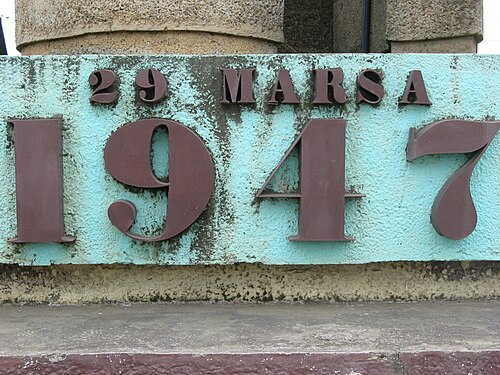
图:Robin Taylor from Bamako, Mali · CC BY 2.0 · 维基共享资源
- 时间
- 1947 年 3 月 29 日—1949 年 2 月
- 地点
- 马达加斯加
- 国家 / 地区
- 马达加斯加
- 属于
- 民族解放战争
- 类型
- 举事
- 简述
- 1940s rebellion in Madagascar
马达加斯加起义(法语:Insurrection malgache;马达加斯加语:Tolom-bahoaka tamin' ny 1947)是法属马达加斯加的马尔加什人试图推翻法国的统治而发动的举事。马达加斯加起义于1947年3月29日爆发,当时马尔加什人进攻位于穆拉曼加和马纳卡拉附近的法国军事基地和种植园。次月马尔加什人的攻势蔓延至马达加斯加中部高地和塔那那利佛。马达加斯加起义一直持续到1949年2月,最终马尔加什人的的举事被镇压。
正文摘自中文维基百科「马达加斯加起义」(删去了参考文献、表格和图片),按 CC BY-SA 4.0 使用
英文维基百科的更多内容
中文维基百科这一条比较短,下面是英文维基百科同一条目的节选,原文为英文,未翻译。
The Malagasy Uprising (French: Insurrection malgache; Malagasy: Tolom-bahoaka tamin' ny 1947) was a Malagasy nationalist rebellion against French colonial rule in Madagascar, lasting from March 1947 to February 1949. Starting in late 1945, Madagascar's first French National Assembly deputies, Joseph Raseta, Joseph Ravoahangy, and Jacques Rabemananjara of the Mouvement démocratique de la rénovation malgache (MDRM) political party, led an effort to achieve independence for Madagascar through legal channels. The failure of this initiative and the harsh response it drew from the Socialist Ramadier administration radicalized elements of the Malagasy population, including leaders of several militant nationalist secret societies.
On the evening of 29 March 1947, coordinated surprise attacks were launched by Malagasy nationalists, armed mainly with spears, against military bases and French-owned plantations in the eastern part of the island concentrated around Moramanga and Manakara. The nationalist cause was rapidly adopted in the south and spread to the central highlands and the capital of Antananarivo by the following month, with the number of Malagasy nationalist fighters estimated at over one million.
By May 1947, the French began to counter the nationalists. The French tripled the number of troops on the island to 18,000, primarily by transferring soldiers from French colonies elsewhere in Africa. The colonial authorities sought to fight on the physical and psychological fronts and engaged in a variety of terror tactics designed to demoralize the population.……
Background
By the close of the 19th century, Madagascar was largely under the control of the Kingdom of Imerina, with its royal palaces at its capital in Antananarivo. Although the kingdom had existed since the early 16th century, it expanded its control beyond its traditional borders in the 1820s under King Radama I, who the British government officially recognized as the sovereign over the entire island of Madagascar.……
Independence movement
Nationalist insurgency
The Malagasy Uprising began on the evening of 29 March 1947, the evening before Palm Sunday. The timing had additional significance as the historic date of the traditional Merina Kingdom fandroana new year's festival, historically celebrated by a ritual period of anarchy followed by the Merina sovereign's reestablishment of order.……
Aftermath
Although the MDRM leadership consistently maintained its innocence, the party was outlawed by the French colonial rulers. The French government classified the Malagasy Uprising documentation of the military, the Ministry of Foreign Affairs and the Ministry of the Colonies.
The French media reported little on the event as it happened, and relatively little mention of the nationalist struggle was mentioned in Les Temps Modernes, the leftist publication that would become considered the leading anti-colonial advocate after the launch of the French offensive in Indochina.……
Trials and executions
From July to October 1948 in Antananarivo, the French organized a large public trial of the uprising, charging 77 officials of the MDRM.……
Commemoration
The Malagasy government has organized official annual commemorations of the Uprising since 1967, when 29 March was first declared a day of mourning by President Tsiranana. It is now observed as Martyrs' Day. The annual commemorations under his administration brought together perpetrators of war crimes, their surviving victims, former nationalist guerrillas and leaders, and family members of those killed, and characterized the Uprising as a tragic mistake.……
正文摘自英文维基百科(原文为英文,未翻译)「Malagasy Uprising」(节选,删去了参考文献、表格和图片),按 CC BY-SA 4.0 使用;在维基百科读全文 ›
同时期、同地区的大事
- 第二次中东战争1956 年 10 月 29 日—1956 年 11 月 7 日 · 战役 · 非洲
- 火炬行动1942 年 11 月 8 日—1942 年 11 月 16 日 · 战役 · 非洲
- 埃及七月革命1952 年 7 月 23 日 · 革命与起义 · 非洲
- 刚果危机1960 年 6 月—1966 年 11 月 · 战争 · 非洲
- 第二次阿拉曼战役1942 年 10 月 23 日—1942 年 11 月 11 日 · 战役 · 非洲
- 克里特岛战役1941 年 5 月 20 日—1941 年 6 月 1 日 · 战役 · 非洲
- 第一次阿拉曼战役1942 年 7 月 1 日—1942 年 7 月 27 日 · 战役 · 非洲
- 罗盘行动1940 年 12 月 9 日—1941 年 2 月 9 日 · 战役 · 非洲
- 沙佩维尔事件1960 年 3 月 21 日 · 屠杀与暗杀 · 非洲
- 茅茅起义1952 年—1960 年 · 其他事件 · 非洲
- 葡萄牙殖民地战争1961 年 2 月 4 日—1974 年 4 月 25 日 · 战争 · 非洲
- 安哥拉独立战争1961 年 2 月 4 日—1974 年 4 月 25 日 · 战争 · 非洲
同时期的同类事件(革命与起义)
- 1917年俄国革命1917 年 · 革命与起义 · 中亚与北亚
- 文化大革命1966 年 5 月 16 日—1976 年 10 月 6 日 · 革命与起义 · 东亚
- 十月革命1917 年 10 月 25 日—1917 年 10 月 26 日 · 革命与起义 · 欧洲
- 古巴革命1953 年 7 月 26 日—1959 年 1 月 1 日 · 革命与起义 · 拉丁美洲
- 俄国二月革命1917 年 3 月 8 日—1917 年 3 月 16 日 · 革命与起义 · 欧洲
- 1956年匈牙利革命1956 年 10 月 23 日—1956 年 11 月 10 日 · 革命与起义 · 欧洲
- 康乃馨革命1974 年 4 月 25 日 · 革命与起义 · 欧洲
- 德国十一月革命1918 年 10 月 24 日 · 革命与起义 · 欧洲
- 喀琅施塔得叛乱1921 年 3 月 1 日—1921 年 3 月 18 日 · 革命与起义 · 欧洲
- 1973年智利政变1973 年 9 月 11 日 · 革命与起义 · 拉丁美洲
- 1953年伊朗政变1953 年 8 月 18 日—1953 年 8 月 19 日 · 革命与起义 · 西亚
- 向罗马进军1922 年 10 月 27 日—1922 年 10 月 30 日 · 革命与起义 · 欧洲