 史鉴
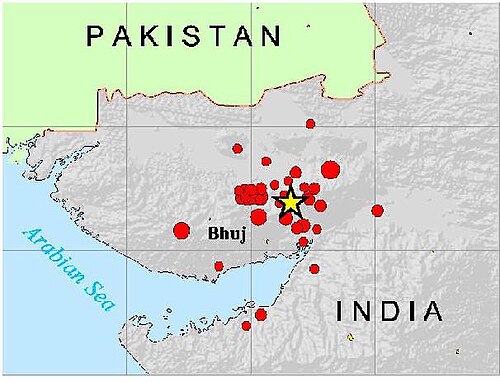
图:USGS · Public domain · 维基共享资源
- 时间
- 2001 年 1 月 26 日
- 国家 / 地区
- 印度
- 死亡人数
- 20,023 人
- 类型
- 地震、自然灾害、灾害
- 简述
- earthquake in India
古吉拉特邦地震是指中华人民共和国地震台网测定的北京时间2001年1月26日11时16分36.4秒,印度北纬23.2°,东经70°地区发生的Ms8级地震。地震的震中在印度西北部古吉拉特邦。印度新德里和巴基斯坦境内都有感。截止当地时间2001年1月31日下午,共发生3级以上余震110多次,3级以下余震300多次。
马来西亚首相马哈蒂尔·穆罕默德向印度总理阿塔尔·比哈里·瓦杰帕伊表示慰问。外交部长赛哈密称马来西亚将为地震受害者提供约10万美金的即时援助。马来西亚特别天灾援助和拯救队被派往印度协助救灾。由于地震,印度总理取消原定于2月7日至2月10日访问马来西亚的计划。
正文摘自中文维基百科「2001年印度古吉拉特邦大地震」(删去了参考文献、表格和图片),按 CC BY-SA 4.0 使用
英文维基百科的更多内容
中文维基百科这一条比较短,下面是英文维基百科同一条目的节选,原文为英文,未翻译。
An earthquake struck India and Pakistan on 26 January 2001 at 08:46 am IST. The epicentre was about 9 km south-southwest of the village of Chobari in Bhachau Taluka of Kutch district in Gujarat, India. The earthquake had a maximum Mercalli intensity of XII (Extreme).
The intraplate earthquake measured 7.6 on the moment magnitude scale and occurred at a depth of 17.4 km (10.8 mi). The earthquake killed at least 20,023 people, injured another 166,000 and destroyed about 400,000 buildings in Gujarat and the Pakistani province of Sindh. The vast majority of deaths and damage were observed in Kutch district, while nearly 1,600 additional deaths occurred in the cities of Ahmedabad, Rajkot, Jamnagar, Surendranagar, Surat, Gandhinagar and Vadodara.
Tectonic setting
Gujarat lies 300–400 km from the plate boundary between the Indian plate and the Eurasian plate, but the current tectonics are still governed by the effects of the continuing continental collision along this boundary. During the break-up of Gondwana in the Jurassic, this area was affected by rifting with a roughly west–east trend. During the collision with Eurasia the area has undergone shortening, involving both reactivation of the original rift faults and development of new low-angle thrust faults. The related folding has formed a series of ranges, particularly in central Kutch.
Earthquake
The earthquake was caused by movement on a previously unknown south-dipping fault, trending parallel to the inferred rift structures. No major surface ruptures were associated with the shock, classifying it as a blind thrust earthquake. Lateral spreading was widely reported and strike-slip faulting was observed at Bharodia and Manfara. On the moment magnitude scale, the International Seismological Centre said it measured a magnitude of 7.6, while the United States Geological Survey put it at 7.7.
Rupture propagation
A finite fault model from the USGS estimated that the earthquake rupture had an area of 141 km (88 mi) x 18 km (11 mi), lasting approximately 25 seconds.……
Damage and casualties
The United States Geological Survey's PAGER-CAT catalog reported 20,023 fatalities. Additionally, 166,836 injuries were recorded, a total of 28 million people across Gujarat were affected, and 442 villages lost at least 70% of houses. In Kutch District, 90% of homes were damaged or destroyed, with 24% of the housing stock affected overall in Gujarat; most affected buildings were non-engineered, unreinforced stonemasonry, although many reinforced concrete buildings also collapsed.……
Reconstruction
Four months after the earthquake the Gujarat government announced the Gujarat Earthquake Reconstruction and Rehabilitation Policy. The policy proposed a different approach to urban and rural construction with the estimated cost of rebuilding to be US$1.77 billion.
The main objectives of the policy included repairing, building, and strengthening houses and public buildings. Other objectives included the revival of the economy, health support, and reconstruction of the community and social infrastructure.
Housing
The housing policies focused on the removal of rubble, setting up temporary shelters, full reconstruction of damaged houses, and the retrofitting of undamaged units.……
Relief
The Government of Gujarat created four assistance packages worth up to US$1 billion to support the reconstruction and rehabilitation of the city. These packages assisted about 300,000 families. The government also announced a US$2.5 million package to revive small, medium, and cottage industries. The World Bank and Asian Development Bank also provided loans worth $300 million and $500 million, respectively.
Assistance was offered from many countries and organisations.
Memorials
Smritivan, a memorial park and museum dedicated to victims of the earthquake was built on top of Bhujia Hill in Bhuj, Kutch and opened in 2022. Spread over an area of 470 acres, it has more than 13,805 trees, each dedicated to a victim, planted in the garden and 108 small water reservoirs created on the hill.
Veer Balak Smarak in Anjar is a memorial dedicated to 185 school children and 20 teachers who died during the earthquake.
正文摘自英文维基百科(原文为英文,未翻译)「2001 Gujarat earthquake」(节选,删去了参考文献、表格和图片),按 CC BY-SA 4.0 使用;在维基百科读全文 ›
同时期、同地区的大事
- 阿富汗战争2001 年 10 月 7 日—2021 年 8 月 30 日 · 战争 · 南亚
- 2015年尼泊尔地震2015 年 4 月 25 日 · 灾难与瘟疫 · 南亚
- 马来西亚航空370号班机空难2014 年 3 月 8 日 · 其他事件 · 南亚
- 2008年孟买连环恐怖袭击2008 年 11 月 26 日—2008 年 11 月 29 日 · 其他事件 · 南亚
- 卡吉尔战争1999 年 5 月 3 日—1999 年 7 月 26 日 · 战争 · 南亚
- 北方联盟1996 年 9 月—2001 年 12 月 · 其他事件 · 南亚
- 尼泊尔内战1996 年 2 月 13 日—2006 年 11 月 21 日 · 战争 · 南亚
- 2014年白沙瓦学校袭击事件2014 年 12 月 16 日 · 屠杀与暗杀 · 南亚
- 尼泊尔王室枪击事件2001 年 6 月 1 日 · 屠杀与暗杀 · 南亚
- 巴基斯坦西北部战争2004 年 3 月 16 日 · 战争 · 南亚
- 阿富汗内战 (1989-1992)1989 年 2 月 15 日—1992 年 4 月 27 日 · 战争 · 南亚
- 阿富汗内战 (1996-2001)1996 年 9 月 27 日—2001 年 10 月 7 日 · 战争 · 南亚
同时期的同类事件(灾难与瘟疫)
- 2019冠状病毒病疫情2019 年 12 月 1 日 · 灾难与瘟疫 · 东亚
- 2004年印度洋大地震2004 年 12 月 26 日 · 灾难与瘟疫 · 东南亚
- 2010年海地地震2010 年 1 月 12 日 · 灾难与瘟疫 · 拉丁美洲
- 2025年缅甸地震2025 年 3 月 28 日 · 灾难与瘟疫 · 东南亚
- 2009年H1N1流感大流行2009 年 3 月—2010 年 8 月 10 日 · 灾难与瘟疫
- 2014年西非埃博拉病毒疫情2013 年 12 月—2016 年 6 月 · 灾难与瘟疫 · 非洲
- 2023年摩洛哥地震2023 年 9 月 8 日 · 灾难与瘟疫 · 非洲
- 2010年智利大地震2010 年 2 月 27 日 · 灾难与瘟疫 · 拉丁美洲
- 2019冠状病毒病意大利疫情2020 年 1 月 30 日 · 灾难与瘟疫 · 欧洲
- 汶川大地震2008 年 5 月 12 日 · 灾难与瘟疫 · 东亚
- 2005年克什米尔大地震2005 年 10 月 8 日 · 灾难与瘟疫 · 东亚
- 唐山大地震1976 年 7 月 28 日 · 灾难与瘟疫 · 东亚