 史鉴
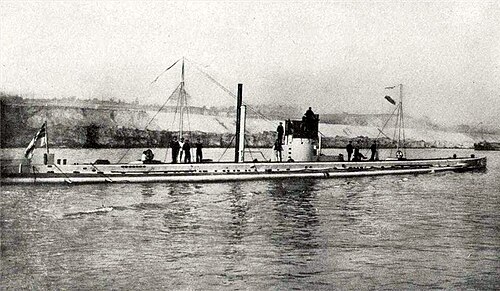
图:佚名 · Public domain · 维基共享资源
- 时间
- 1914 年 7 月 28 日—1918 年 11 月 11 日
- 地点
- 大西洋、黑海、北海、地中海、不列颠群岛
- 属于
- 北海作战行动
- 类型
- 战役
- 简述
- 1914 World War I naval campaign fought by German U-boats against the trade routes of the Allies
The U-boat campaign from 1914 to 1918 was the World War I naval campaign fought by German U-boats against the trade routes of the Allies, largely in the seas around the British Isles and in the Mediterranean, as part of a mutual blockade between the German Empire and the United Kingdom.
Both Germany and Britain relied on food and fertilizer imports to feed their populations, and raw materials to supply their war industry. The British Royal Navy was superior in numbers and could operate on most of the world's oceans because of the British Empire, whereas the Imperial German Navy surface fleet was mainly restricted to the German Bight, and used commerce raiders and submarine warfare to operate elsewhere.
German U-boats sank almost 5,000 ships with over 12 million gross register tonnage, losing 178 boats and about 5,000 men in combat. The Allies were able to keep a fairly constant tonnage of shipping available, due to a combination of ship construction and countermeasures, particularly the introduction of convoys.
详细介绍
1914: Initial campaign
North Sea: Initial stage
In August 1914, a flotilla of ten U-boats sailed from their base in Heligoland to attack Royal Navy warships in the North Sea in the first submarine war patrol in history. Their aim was to sink capital ships of the British Grand Fleet, and so to reduce the Grand Fleet's numerical superiority over the German High Seas Fleet. The first sortie was not a success. One of SM U-9's engines broke down and she had to return to Heligoland.……
Mediterranean: Initial stage
The initial phase of the U-boat campaign in the Mediterranean comprised the actions by the Austro-Hungarian Navy's U-boat force against the French, who were blockading the Straits of Otranto.……
1915: War on commerce
Unrestricted submarine warfare
Because Germany could not possibly deal with British naval strength on an even basis, the German navy was relatively inactive at the start of the war, yet eager to demonstrate a role for itself. Throughout 1914, figures like Hermann Bauer, Alfred von Tirpitz and Hugo von Pohl argued that submarine commerce raiding provided a means of quickly defeating Britain.……
1916: The High Seas Fleet; Mediterranean, American, Arctic and Black Sea waters
In support of the High Seas Fleet
In 1916 the German Navy again tried to use the U-boats to erode the Grand Fleet's numerical superiority; they staged operations to lure the Grand Fleet into a U-boat trap. Because the U-boats were much slower than the battle fleet, these operations required U-boat patrol lines to be set up in advance; then the battle fleet manoeuvred to draw the Grand Fleet onto them.
Mediterranean waters
During 1916 the commerce war continued in the Mediterranean, albeit under cruiser rules after April 24 due to the Sussex incident.……
1917: Resumption of unrestricted submarine warfare
On 22 December 1916, Admiral von Holtzendorff composed a memorandum which became the pivotal document for Germany's resumption of unrestricted U-boat warfare in 1917.……
1918: The last year
At the end of 1917 Allied shipping losses stood at over 6 million GRT for the year overall.
However monthly shipping losses had dropped to around 300,000 GRT, and never rose to the levels suffered in spring 1917.
With the establishment of a comprehensive convoy system, Allied shipping losses fell to non-critical levels, while U-boat losses increased alarmingly.……
U-cruisers
Late in the war, the German high command decided to take the submarine war to the coast of the US, using the large Type U-151 and Type U-139 U-boats.……
Japanese participation
Beginning in April 1917, Japan, an ally of the United Kingdom, sent a total of 14 destroyers to the Mediterranean with cruiser flagships which were based at Malta and played an important part in escorting convoys to guard them against enemy submarines. The Japanese ships were very effective in patrol and anti-submarine activity.……
Brazilian participation
On 21 December 1917 the British government requested that a Brazilian naval force of light cruisers be placed under Royal Navy control and a squadron comprising the cruisers Rio Grande do Sul and Bahia, the destroyers Paraíba, Rio Grande do Norte, Piauí, and Santa Catarina, and the support ship Belmonte and the ocean-going tug Laurindo Pitta was formed, designated the Divisão Naval em Operações de Guerra ("Naval Division in War Operations").……
Aftermath
By mid-1918, U-boat losses had reached unacceptable levels, and the morale of their crews had drastically deteriorated; by the autumn it became clear that the Central Powers could not win the war.
The Allies insisted that an essential precondition of any armistice was that Germany surrender all her submarines, and on 24 October 1918 all German U-boats were ordered to cease offensive operations and return to their home ports.……
Summary
Allied losses
Grand Total 12,850,815 gross tons. More than 3000 British civilian ships were sunk with almost 15,000 British merchant sailors killed.
The heaviest losses were suffered after unrestricted submarine warfare was resumed in February 1917, before the British began full-scale convoying in September 1917. 150,000 tons of purely British shipping were lost in January 1917, and 300,000 tons in February;……
U-boat losses
According to Clodfelter's encyclopedia of military casualties:
正文摘自英文维基百科(原文为英文,未翻译)「U-boat campaign」(节选,删去了参考文献、表格和图片),按 CC BY-SA 4.0 使用;在维基百科读全文 ›
下属事件
- 第一次世界大战大西洋U型潜艇海战1914 年 8 月 8 日—1918 年 10 月 20 日 · 战役
相关人物
同时期、同地区的大事
- 大萧条1929 年 10 月 29 日—1941 年 · 时代与时期 · 欧洲
- 凡尔赛条约1920 年 1 月 10 日 · 条约与会议 · 欧洲
- 十月革命1917 年 10 月 25 日—1917 年 10 月 26 日 · 革命与起义 · 欧洲
- 国家社会主义德国工人党1920 年 2 月 24 日—1945 年 10 月 10 日 · 其他事件 · 欧洲
- 党卫队1925 年 4 月 4 日—1945 年 5 月 8 日 · 其他事件 · 欧洲
- 德国国旗1917 年 · 其他事件 · 欧洲
- 俄国二月革命1917 年 3 月 8 日—1917 年 3 月 16 日 · 革命与起义 · 欧洲
- 巴黎和会1919 年 1 月 18 日—1920 年 1 月 21 日 · 其他事件 · 欧洲
- 巴尔干战争1912 年 10 月 8 日—1913 年 7 月 18 日 · 战争 · 欧洲
- 同盟国1914 年—1918 年 11 月 11 日 · 其他事件 · 欧洲
- 第一次巴尔干战争1912 年 10 月 8 日—1913 年 5 月 30 日 · 战争 · 欧洲
- 洛桑条约1923 年 7 月 24 日 · 条约与会议 · 欧洲
同时期的同类事件(战役)
- 斯大林格勒战役1942 年 8 月 23 日—1943 年 2 月 2 日 · 战役 · 欧洲
- 巴巴罗萨行动1941 年 6 月 22 日—1941 年 12 月 5 日 · 战役 · 欧洲
- 珍珠港事件1941 年 12 月 7 日 · 战役 · 大洋洲
- 波兰战役1939 年 9 月 1 日—1939 年 10 月 6 日 · 战役 · 欧洲
- 不列颠战役1940 年 7 月 10 日—1940 年 10 月 31 日 · 战役 · 欧洲
- 加里波利之战1915 年 4 月 25 日—1916 年 1 月 9 日 · 战役 · 西亚
- 法国战役1940 年 5 月 10 日—1940 年 6 月 25 日 · 战役 · 欧洲
- 海王行动1944 年 6 月 6 日—1944 年 8 月 29 日 · 战役 · 欧洲
- 库尔斯克会战1943 年 7 月 5 日—1943 年 8 月 23 日 · 战役 · 欧洲
- 列宁格勒围城战1941 年 9 月 8 日—1944 年 1 月 27 日 · 战役 · 欧洲
- 凡尔登战役1916 年 2 月 21 日—1916 年 12 月 18 日 · 战役 · 欧洲
- 索姆河战役1916 年 7 月 1 日—1916 年 11 月 17 日 · 战役 · 欧洲